Tuesday, October 25, 2016

COMMANDER ERNEST EDWIN EVANS - AMERICAN HERO

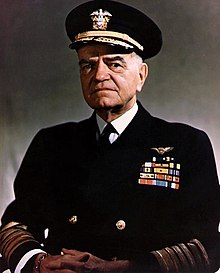
10/25/1944 - Ninety years to the day that the British Light Brigade so bravely charges the Russian guns at Balaclava (the 600 gentlemen that ride into the "valley of death"), America is blessed to have its own example heroism in the face of truly overwhelming odds ... Commander Ernest Edwin Evans of the Fletcher-class destroyer, USS Johnston.
Image result for charge of the light brigade
The Charge Of The Light Brigade

Far from the seas he will one day roam, half Cherokee and one quarter Creek Indian (his white paternal grandfather marries a Creek woman to gain access to her land, mission accomplished, he then divorces the woman and disowns his son), Evans is born on 8/13/1908 in Pawnee, Oklahoma, with warrior blood running through his veins.  Battling prejudice in a time not far removed from Indians being the nation's number one boogie-man, Evans graduates from the all-white Muskogee Central High School, joins the Oklahoma National Guard, and then transfers from there into the United States Navy.  Quickly recognized for his intelligence, determination, and leadership capabilities, without the normal political pull, he wins an appointment to the United States Naval Academy at Annapolis, Maryland, and graduates with the class of 1931 (a class that will produce three Congressional Medal-of-Honor winners) ... and while there of course, he gets the nickname that will be his until his death, "Chief."
Ernest E. Evans, 1931 -- Medal of Honor Recipient
Evans At Annapolis

Graduated, Ensign Evans is first assigned to the battleship USS Colorado as part of the Pacific fleet stationed at San Diego, California.  In the years before WWII, in various capacities, Evans will serve on the destroyers USS Roper and USS Rathburne, the light cruiser USS Pensacola, the transport USS Chaumont, and on the destroyer tender, USS Black Hawk (he also finds time to get married and have two sons).  When the Japanese attack Pearl Harbor, he is the executive officer aboard the WWI destroyer, USS Alden, stationed in the Far East (in 1942 he will be made the ship's skipper).  Luck shown early, by the time the USS Alden arrives in Singapore to support the British battleship HMS Prince of Wales and the battlecruiser HMS Repulse in their attempt to stop the Japanese invasion of Malaya, Force Z has already left port ... the USS Alden is only in time to pick up survivors of the double sinking that takes place on 12/10/1941.
Prince of Wales and Repulse.jpg
Prince of Wales (Front) & Repulse Under Attack

On 2/27/1942, the USS Alden is present at another naval debacle, the Battle of the Java Sea in which a Japanese fleet sinks two heavy cruisers, 3 destroyers, and damages a heavy cruiser at the cost of one destroyer being damaged and thirty-six Japanese sailors losing their lives.  Ordered to break off from the one-sided clash, the USS Alden insures there are survivors by covering the retreat by laying down walls of smoke from his destroyer's ancient stacks.  Alive, but not happy (he will win a Bronze star during this period for the depth charge attack he orchestrates against a mine laying Japanese submarine), Evans vows never to run from the Japanese again ... a pledge he tells all who will listen ... including the Seattle, Washington crowd that is on hand in 1943 to celebrate the launching of Evans' new command, the Fletcher-class destroyer, USS Johnston (using John Paul Jones's words, he tells all that he intends to take the USS Johnston "... in harm's way).
Exeter sinking.jpg
HMS Exeter Sinking - The Battle Of The Java Sea
Image result for uss johnston
Commissioning Ceremony - 1943

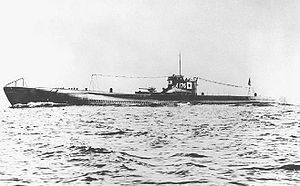
The destroyer Evans receives from the Seattle-Tacoma Shipbuilding Corporation is 376 feet and 6 inches long, has a beam of 39 feet and 8 inches, a draft 17 feet and 9 inches, is propelled by two steam turbines that can produce 35 knots of speed, and is armed with five 5-inch guns, ten 40mm AA guns, seven 20mm guns, depth charges, and torpedoes.  Placed into immediate service in the war raging over the waters of the Pacific, the USS Johnston fires on the beaches of Kwajalein on 2/1/1944 before the Marines storm ashore, bombards the island of Eniwetok for five days prior to its invasion, sinks the Japanese submarine I-176 on 5/15/1944, sends more than 4,000 shells into Guam before its invasion, provides escort carrier protection during the invasion of Peleliu, and on 10/25/1945, the USS Johnston is protecting the escort carriers of Taffy-3 (a support group under the command of Rear Admiral Clifton A. F. "Ziggy" Sprague consisting of six slow, and lightly armored escort carriers, three destroyers, and four destroyer-escorts) during the invasion of Leyte island in the Philippines.
USS Johnston
The USS Johnston
I-176 submarine.jpg
I-176
Clifton Sprague.jpg
Sprague

Expecting a normal day, the USS Johnston is the northern-most ship circling the escort carriers when the unexpected call goes up, "Enemy ships approaching!"  Enemy ships indeed, coming over the northern horizons are the pagoda masts of a Japanese battle fleet under the command of Admiral Takeo Kurita that consists of four battleships, six heavy cruisers, two light cruisers, and eleven destroyers ... ships that are faster, more heavily armored and armed, and that in the case of the battleship Yamato (by contrast to the USS Johnston, the Japanese battleship is 862 feet and 11 inches long), can send high-explosive or armor piercing shells to targets up to twenty-six miles away.  Disaster looming (because Admiral "Bull" Halsey has mistaken left San Bernadino Strait open while he pursues four Japanese carriers to the north), before any orders can be given, Evans reacts by ordering his ship hard to port, tells the engine room to begin laying down a smoke screen, and charges the twenty-three ships of Kurita ... knowing the USS Johnston is alone and must cover miles of open ocean to get close enough to use his 5-inch guns or torpedoes.
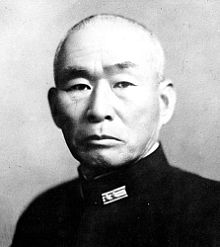
Kurita.jpg
Kurita
The Yamato during sea trials off Japan near Bungo Strait, 20 October 1941.
Yamato - 1941
   
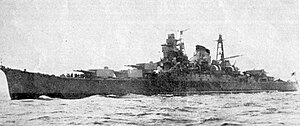
Zig-zagging forward by chasing the colorful splashes of Japanese rounds (the rounds of each Japanese ship include a variety of pastel colored dyes in the shells for improved adjusted aiming) that miss the USS Johnston (passing overhead, some of the sixteen inch shells that miss the destroyer are described as sounding like a freight train going by a full speed), without being hit, the USS Johnston gets close enough to Kurita's fleet to score 5-inch hits on the leading heavy cruisers (during this part of the fight the USS Johnston will more than 200 rounds at the Japanese) and to launch her full compliment of ten torpedoes from their maximum range of 9,000 yards ... two blow off the bow of the heavy cruiser Kumano, several miss the battleship Kongo, but force her to change course and turn away from her attack, and the heavy cruiser Suzuya turns away to assist the Kumano.  Confused by air attacks, smoke, the sea covered in shell splashes, and the weariness of being under almost constant attack the day before, Kurita believes he is in a duel with several heavy cruisers, not a single destroyer.
IJN Kumano
Kumano
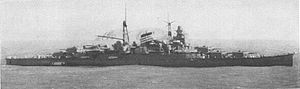
Suzuya-1.jpg
Suzuya
Image result for charge of the uss johnston
The USS Johnston Attacks

Under cover of his smoke screen, Evans reverses course and tries to put distance between himself and the still advancing Japanese ... but ship's luck comes to an end at around 7:30 in the morning, when from a distance of over eight miles, Evans' ship is first hit by shells from the Kongo that cause the destroyer to only be able to operate at half speed, and a deadly salvo from the Yamato that hits the ships bridge area, mangling the men and equipment operating there, including Evans who has his body peppered by shrapnel, loses two fingers off his left hand, and his helmet and shirt portion of his uniform is blown off.  And once more, the warrior soul of the man is exposed ... wrapping a handkerchief around his bleeding hand, Evans tells the ship's doctor, "Don't bother me now.  Help some of those guys who are hurt," then he finds a position among his mangled ship with an open hatch where he can yell down course changes to the men now maneuvering the ship from its fantail.  Incredible, and Evans isn't done!
Image result for ernest e evans
Evans

The other destroyers and escort destroyers of Taffy 3 by now ordered to launch their own torpedo attacks on Kurita, bare chested and covered in blood, Evans salutes the Samuel B. Roberts as that ship goes by on its torpedo run ... then he orders the USS Johnston into a rain squall where they are protected long enough to do some quick emergency repairs, once more calls for a reverse of course and moves towards the Japanese in support of the torpedo runs of the other Taffy 3 escorts, firing all her still operational guns (surprised suddenly by the presence of the USS Johnston, the destroyer USS Heerman mixes colliding with her sister ship by only ten feet) ... and for her next opponent, she chooses the Kongo, getting so close to the huge battleship that the Japanese guns can't suppress enough to target the pesky destroyer ... a temporary advantage that the USS Johnston uses to shoot up the bridge area of Kongo (of the 40 rounds sent Kongo's way, at least 15 hit the vulnerable bridge area) before disappearing into the smoke.
USS Heermann (DD-532); undated wartime photo.
USS Heermann

Kongo

Informed that cruisers are about to attack the escort carrier Gambier Bay, Evans closes on the heavy cruiser Haguro, and duels with the vessel for over ten minutes, giving and receiving hits.  That crisis taken care of for the moment, Evans then reverses course once more and goes after a column of Japanese destroyers closing on the escort carriers, crossing the "T," one ship against seven Japanese destroyers ... and the incredible day of the USS Johnston and her commander continues.  The first ship in the Japanese line is hit a dozen times and veers away, the next ship up is hit five times, and it veers away ... and to avoid more fire from the USS Johnston, the whole column turns west, away from the escort carriers ... so far away that when they do launch their torpedoes at Taffy 3, each one is a miss.
USS Gambier Bay
USS Gambier Bay
Japanese cruiser Haguro
Haguro

Fighting for over two hours, continuing to fire on its opponents, the USS Johnston is eventually by four cruisers and a number of destroyers which finally cause the ship to go dead in the water until finally, at around 9:40 in the morning, Evans gives the order to abandon his sinking ship.  Twenty-five minutes later, the valiant USS Johnston goes under the waves of the Philippine off Samar Island ... a death not in vain for the 186 of her sailors that never get back to their homes in America because Admiral Kurita, confused and tired of the beating his ships have been taking, at the moment when he can sink the rest of Taffy 3 and shoot up the American landing beaches, orders his fleet to reverse course and retreat back to its base at Brunei.  Evans and the USS Johnston, along with the other destroyers and destroyer escorts have turned absolute and certain defeat into one of the greatest moments in United States naval history.

USS Samuel B. Roberts
USS Hoel
USS Hoel

And the honors for the commander and ship that gave its all begin immediately ... expecting to be machine-gunned in the water, the survivors of the USS Johnston are instead acknowledged as respected warriors by a host of Japanese sailors passing by chanting "SAMURAI" to the men below, and a destroyer captain raises a salute as to the men in the water as he heads north.  Sadly, though Evans is seen lowering himself into the Pacific, he is not found when two days later, the surviving members of his crew are plucked out of the shark infested waters.  For their deeds, the crew of the USS Johnston will be awarded a Presidential Unit Citation, and Evans will be posthumously given the Congressional Medal-of-Honor.   
Image result for ernest e evans medal of honor
Evans' Wife And Two Sons Reading His Medal of Honor
Citation, She While Wearing His Medal

One very, very special man ... on the anniversary of his death, I'll close with the author of the Battle of Leyte Gulf, Thomas J. Cutler last words in his book describing the battle.  "The causes for which these men fought and sacrificed have faded with time; the machines that were used to carry out their deadly business are now rusted relics of another era; the sands have swallowed their footprints and the waters show no trace of their wakes.  But the glory of their deeds will never be tarnished by time."  Amen to that ... rest in peace Commander Evans ... and thank you!
Image result for ernest e evans
Commander Ernest Edwin Evans


Monday, October 24, 2016

RESURRECTION ... AND REVENGE!

10/24/1944 & 10/25/1944 - Sadly, throughout history, the beginnings of wars seemingly are fought with the outmoded tactics and technologies from the conflict just before.  For America, WWII is no different and on the first day of battle, the Unites States is sent a violently emphatic message from Japan that the day of the battleship has passed and naval airpower will prevail in the coming Pacific War.
Image result for pearl harbor
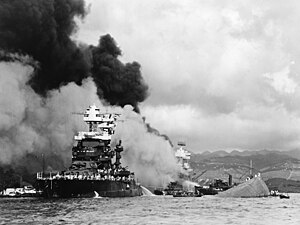
The Battleship USS Arizona - 12/7/1941

Passed, but not quite over.  In the sneak attack on the American fleet based at Pearl Harbor, anchored off Ford Island on what is known as Battleship Row, the USS West Virginia is sunk by two bombs and seven torpedoes, the USS California goes under from two bomb and two torpedo hits, the USS Tennessee is gravely wounded by two bombs, the USS Maryland is seriously damaged by two bombs, and the USS Pennsylvania is hit by one bomb, but unlike the others, remains in service.  American ingenuity and spirit on display, all are back in service, with ship-wide upgrades and state-of-the-art weaponry by 1944, and serve in Admiral Chester Nimitz's island hopping campaign across the Pacific, mostly trying to soften up Japanese shore defenses prior to Marine or Army landings.  October, 1944, finds the five battleships, plus the dreadnought, USS Mississippi, part of the support elements of General Douglas MacArthur's return to the Philippines by way of an American invasion of the island of Leyte.
Image result for uss west virginia pearl harbor
USS West Virginia - 12/7/1941
Image result for uss california pearl harbor
USS California - 1942 Refloat
Image result for uss tennessee under attack
USS Tennessee Between Sunken USS West Virginia And
The Smoking USS Arizona
Image result for uss maryland under attack
USS Maryland Next To Capsized USS Oklahoma.
USS West Virginia Smoking In Background
Image result for uss pennsylvania under attack
USS Pennsylvania In Dry Dock Behind Ruins Of The
Destroyers, USS Cassin And USS Downes

A location the Japanese can not afford to lose or their supplies from Southeast Asia, the reason they went to war, will be cut-off, they respond with Fleet Admiral Soemu Toyoda's Sho-Go 1 "victory" plan in which a northern fleet of four aircraft carriers missing almost all of their planes and pilots, will be the juicy target to lure Admiral "Bull" Halsey's 3rd Fleet away from Leyte, opening the way for a pincer movement that will allow two different Japanese fleets to shoot up the American transports and invasion beaches at roughly the same time ... a desperate roll of the dice, the go ahead from Toyoda will result in the biggest naval battle in world history, a clash of over 200,000 men, 282 American, Japanese, and Australian ships that takes place for over four days and nights on more than a hundred thousand square miles of Pacific Ocean known as the Battle of Leyte Gulf.  Part of the force that will guard the southern approaches to Luzon, the six battleships become part of Rear Admiral Jesse Oldendorf 7th Fleet Support Force watching the northern outlet of the narrow Surigao Strait leading to Leyte (additionally, the admiral has four heavy cruisers, four light cruisers, and a number of destroyers and PT boats he can call upon).
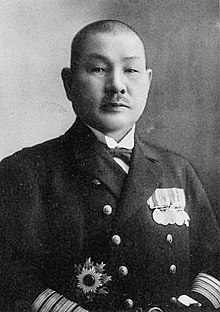
Toyoda Soemu.JPG
Toyoda
Image result for bull halsey
Halsey
Jesse Oldendorf.jpg
Oldendorf

Advancing from the south are two Japanese attack forces, the lead element is under the command of Vice Admiral Shoji Nishimura and consists of two battleships, a heavy cruiser, and four destroyers, while the second force, roughly 30 miles behind, is under the direction of Vice Admiral Kiyohide Shima and composed of two heavy cruisers, a light cruiser, and four destroyers.  By the time the Japanese reach the area of the Suriago Strait, the quarter moon has vanished into the sea and the stars are blotted out by clouds and overcast ... it is a pitch black evening, with blood hungry Americans waiting in the darkness (the Japanese had been spotted from the sky on their approach earlier in the day).
ShojiNishimura.jpg Shima Kiyohide.jpg
Nishimura & Shima

The Battle of Surigao Strait begins at 22:36 with the first PT boat (they are 77 feet long, weigh 45 tons, and are built out of wood, by contrast, Admiral Nishimura's flagship, the battleship Yamashiro, is 665 feet long, made of fortified steel, and weighs 29,797 tons) attacks on Nishimura's force ... an effort that will go on for over three hours as squads of three boats launch torpedoes, but are either chased away by Japanese guns before they can attain firing positions, or shoot misses (only one boat is lost, but many take hits and casualties) ... on north, the Japanese come.
Image result for battle of surigao strait
The Battle Of Surigao Strait

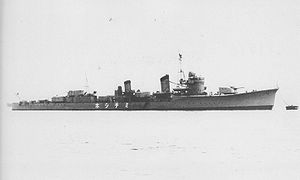
Then it is the turn of the American destroyers.  Not part of Oldendorf's original plan to protect the strait, he is convinced by the pleadings and plan of Captain J. G. Coward to let the tin cans of Destroyer Squadron 54 participate in the clash.  Finding the Japanese force approaching in a column due to the narrowness of the strait, Coward and his five destroyers launch torpedo attacks from both the eastern (three vessels) and western (two vessels) sides of the strait (knowing the 5-inch guns of his destroyers are useless on the heavy armor of the approaching Japanese ships, and their gun flashes will give away their positions along the flanks of the column) just as a Japanese star shell ignites, lighting up the area in grey-white light, and Nisimura's force begins looking for opponents with green search lights.  Torpedoes away (47 in all) and then the destroyers run as Japanese shells chase them, the night is suddenly brightened by a huge fireball, followed by several other detonations on the water.  Then it is the turn of Oldendorf's Destroyer Squadron 24 and Destroyer Squadron 56, but not for long ... despite scoring several more hits, the admiral does not want his destroyers among the Japanese force when his cruisers and battleships are about to open fire and calls off any further assaults by his tin cans.  In the strait, the battleship Yamashiro is on fire, as are several other Japanese ships, and the destroyer Michishio has been sunk ... and worse is coming as the Japanese column begins falling apart as it approaches the American line of cruisers and battleships.
Michishio.jpg
Michishio - 1937

Crossing the "T" the most basic of naval battle maneuvers, either for single ships fighting each other or whole fleets, it is the favorite attack opportunity of all surface sailors because vessels that "cap" or "cross" the "T" can bring all their guns to bear on an enemy, while that enemy can only shoot his forward weaponry ... due to the configuration of the strait, Nishimura is the long column, and two rows of American cruisers and battleships are the top of the "T" as the destroyers clear the area.  At a range of 26,000 yards, Oldendorf gives the order to "Commence Firing," and as commanded, the six-, eight-, fourteen-, and sixteen-inch guns of the American force open fire with devastating results ... including the Pearl Harbor survivors. It is battleship against battleship for the last time in history.
Image result for the battle of surigao strait
The USS West Virginia Firing On The Japanese
Fleet
Image result for the battle of surigao strait
Night Battle In The Surigao Strait
Image result for the battle of surigao strait
Caught In A Searchlight

Payback a bitch, in the resulting pounding by Oldendorf's ships (the USS West Virginia will get off 93 rounds of 16-inch shells, the USS Tennessee will fire 69 rounds, the USS California will fire 63 times, the USS Maryland will send 48 rounds Nishimura's way, and the USS Mississippi will fire a single round ... unable to locate a target, the USS Pennsylvania does not fire during the engagement) Nishimura's force is virtually destroyed (as is he, going down with the Yamashiro in the same seas that took his son Teiji earlier in the war), with only the cruiser Mogami and the destroyer Shigure able to flee the area despite their wounds ... just as the force of Shima arrives.  Realizing he has entered a watery abattoir, Shima orders a launch of torpedoes at Oldendorf (none of which score a hit, two are found intact the next day, beached on a nearby island) and then wisely turns tail, but not before contributing to the chaos himself ... wildly maneuvering to avoid further torpedo and shell strikes, the Mogami collides with Shima's flagship, the cruiser Nachi, and slowed by its many injuries, the Mogami will be sunk by naval flyers the next day (in only a matter of weeks, the balance of Shima's command will be sunk in other engagements).  Revenge sweet for the Americans, at the slight cost of one PT boat sunk, several damaged, and one destroyer severely hurt, for trying to break through the strait, the Japanese have lost two battleships, three cruisers, and four destroyers.
Image result for battle of surigao strait
Plucking A Japanese Survivor From The
Sea - 10/25/1944

The Battle of Surigao Strait over, but not yet the Battle of Leyte Gulf ... Halsey has indeed gone after the carriers of Vice Admiral Jisaburo Ozawa leaving the San Bernadino Strait above Leyte open for a Japanese excursion which is coming in the form of four battleships (with group leader Kurita aboard the biggest battleship ever made, the Yamato), six heavy cruisers, two light cruisers, and eleven destroyers.  A wolf among sheep about to feast on lightly armored escort carriers, destroyers, escort destroyers and invasion transports, instead of slaughter, compliments of the destroyer USS Johnston, the smaller destroyer escort USS Samuel B. Roberts, the destroyer USS Hoel, the destroyer USS Heermann, and countless sorties by naval fliers in the region, the sure defeat coming will instead be transformed into perhaps the most glorious day in United States Navy history!
Image result for uss johnston
The USS Johnston Attacks      


Thursday, October 20, 2016

MURDER IN MENOMONIE

10/20/1931 - Following the sheltering policy of the St. Paul police that the outlaws they are protecting must not practice their craft within the city limits, the Holden-Keating gang visits the Kraft State Bank in Menomonie, Wisconsin ... with disastrous results.
Image result for holden-keating gang
Holden & Keating

Keating, the son of Irish parents, is a former Chicago cabdriver, streetcar conductor, and U.S. Navy veteran, while Holden once was a Stutz car salesman and steam fitter ... both men are married and have children before they turn away from normalcy and become career criminals.  Their first major known crime is the robbery of a Port Huron and Chicago train in the town of Evergreen Park, Illinois in 1928 ... a crime that gets them $130,000 in loot ... and 25-year sentences each in the Federal penitentiary at Leavenworth, Kansas.  With the help of bandits and fellow cons, Frank "Jelly" Nash, Charlie Harmon, and George "Machine Gun" Kelly, in 1930 the pair escapes Leavenworth using forged trustee passes, and sets up shop in St. Paul ... putting together jobs of their own, and hiring out their services to folks like Harvey Bailey and the Barker-Karpis gang.  For their Menomonie job, the crook partners are joined by their con buddy, Charlie Harmon (released from Leavenworth in January of 1931 after taking a convict curve ball in the left ear that required stitches and hospitalization), and convicted Utah felon Frank Webber. 
Image result for leavenworth prison 1930s
Leavenworth Prison
Image result for jelly nash
Nash
Image result for machine gun kelly
Kelly

A lovely fall day in which the talk of the town is the human fly from Chicago, Babe White, that scaled the Marion Hotel the night before, at a little after 9:00 in the morning, a black, 1928 Lincoln Sport Phaeton pulls up to the curb in front of the Frank Hintzman Funeral Parlor, only a few doors down from the two-story red brick building that houses the town's bank.  Exiting the vehicle, Holden, Keating, and Harmon walk down to the bank and enter, while Webber remains with the car, its engine left running.  The bank robbery will be the state's 34th of 1931.
Image result for black 1928 lincoln sport phaeton
1928 Lincoln
Image result for kraft state bank wisconsin
Inside The Bank

Inside the bank are ten customers and five employees when the outlaws enter ... including bank guard Vernon Townsend, who because he is not allowed to fire on intruders from a bullet-proof cage when he sees the trio expose their weapons, trips the bank's alarm (it rings in a number of nearby stores, including the Farmer's Store and the Lakeside Cafe), then runs upstairs to a spot on the roof where he can snipe on the robbers once they are outside the bank.  In moments, the whole town is seemingly aware of the robbery and prepared to take action.
Image result for menomonie wisconsin downtown
Downtown Menonomie

While the citizens are arming themselves, the robbers go into action, Keating and Holden have their hostages lie on the floor, while Harmon grabs stacks of bonds and cash from the establishment's open vault ... around $90,000.  Stepping out of the vault and over where 24-year-old bank employee William Kraft is laying (the son of the bank's owner, Sam Kraft), Harmon yells at the young man, "There's more money here, I want it!"  Looking up, Kraft responds that the bandit has it all ... an answer Harmon responds to by shooting the man in the chest (barely missing his heart, Kraft will survive).  Robbery over, the three men grab two hostages (clerk James Kraft, another son of the owner, and cashier, Mrs. A. W. Schafer) and exit the front door ... where they walk into a raging gun battle.
Image result for kraft state bank robbery
Harmon

Up and down the street, irate citizens fire out the outlaws from roofs, doors, and windows (careful not to hit Kraft ... in the confusion outside the bank, Mrs. Schaefer stumbles and falls, then creeps away from the chaos) while the intruders return fire with Thompson machine guns and pistols.  In the exchange of gunfire, someone mortally wounds Webber in the right eye, and Harmon is shot in the knee, but the outlaws and Kraft are able to exit the town. Following their escape plan, the outlaws outdistance pursuit using hidden five gallon gas cans, the power of their Lincoln, and tacks on the road, but somewhere along the way, the evil of the outfit goes fully on display.  Minutes into their flight, Webber passes away, and already upset by the events in town, Harmon retaliates by shooting Kraft in the head.  Two bodies dumped (Webber will by found sporting two pistols and a steel vest), the road gets a third corpse when either Holden or Keating, believing Harmon's shot in the bank alerted the town, or upset at the needless killing of young Kraft, shoot the bandit in the neck.
Image result for kraft state bank wisconsin
Newspaper Coverage
Image result for kraft state bank wisconsin
More Coverage

Away, with loot now only being needed to be split two ways instead of four, Holden and Keating will continue their robbing ways until they are arrested on a Kansas City, Missouri golf course with master bank robber, Harvey Bailey in July of 1932.  Sent to the new federal prison on Alcatraz Island, the Rock cures Keating of further criminal activities and he dies of heart failure, a free man in St. Paul, in 1978, at the age of 79.  Holden, however, has one more big splurge atop the country's most wanted lists.  Paroled in 1947, Holden will mind his own business until a drunken argument with his wife has the outlaw take up his gun again to kill his wife and two of her brothers.  The first fugitive to be atop the FBI's Ten Most Wanted List, two years later, he is captured working as a plasterer in Oregon using the name John McCullough.  Found guilty of the three murders and sentenced to life behind bars, he dies in prison at the age of 57 in 1953.
Image result for thomas holden outlaw
Keating
Image result for thomas holden outlaw
Holden - From FBI Wanted Poster

And finally of interest from the robbery is the fate of Charlie Harmon's widow, Paula.  Having developed a taste for bad boys, the widow's grief doesn't last long, and she soon becomes the moll of murderous young man named Frederick George Barker, Ma Barker's youngest son, Freddy ... as such, she is there for most of the Barker-Karpis gang's midwest crime spree and she becomes the only outlaw girlfriend that Ma doesn't dislike ... until her arrest in Cleveland in 1934.
Image result for fred barker
Fred And Ma - January, 1935