Tuesday, March 12, 2013

ARNOLD SCHUSTER IS REWARDED POORLY

3/8/1952 - A tragedy takes place in Brooklyn when twenty-four-year-old Coast Guard veteran and amateur detective Arnold Schuster is gunned down for his roll in the February capture of notorious bank robber, Willie "The Actor" Sutton.

                                                 
                                                              Schuster

Looking for any angle that might put Sutton back in custody (he is a 1947 escapee from the Philadelphia County Prison), authorities have sent out wanted posters of the dapper dressing outlaw to clothing shops and tailor stores across the country hoping a sighting might be reported.  Schuster, employed in his father's tailoring business as a pants-presser, sees Sutton's picture every day for two years at work.  On February 18th though, the picture becomes real when the tailor instantly recognizes the robber on a Brooklyn subway.  Following the thief to a garage where he is having his car's battery replaced, Schuster notifies police and Sutton is quickly arrested. 

                 
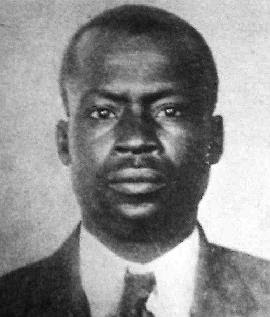
                                               Willie "The Actor" Sutton

Instant celebrity follows for Schuster as his role in Sutton's capture is covered in newspaper, radio, and television reports, he receives a citizenship award from a watch company, and even makes an appearance on the game show, "I've Got A Secret."  Unfortunately his act of identifying Sutton to authorities does not sit well at all with one member of the New York underworld, a murderer who's nicknames of "Lord High Executioner" and "The Mad Hatter" fit his personality and criminal tactics perfectly ... the former head of the mob's killing arm, Murder, Inc., gangster Umberto "Albert" Anastasia.

                          
                                                           The Mad Hatter

Watching television, Anastasia goes berserk when he sees an interview with Schuster.  "I can't stand squealers   Hit that guy!" the mob boss proclaims.  Order given, order carried out.  Intending to go to a neighborhood party, Schuster walks home from the tailor shop to change his clothes before attending ... a short distance of only about a mile he will never complete.  On the way home he chats with friends he meets on the street who are also on their way to the party.  It is roughly 9:00 in the evening.  About ten doors from his home, a solitary gunman jumps out of the darkness he has been hiding in and fires at Schuster with a dump weapon ... a .38 revolver stolen from a U.S. Army shipment consigned to go to Japan that will be found in an empty lot five blocks from the crime scene.  A message murder, the young man is shot twice in the groin and once in each of his eyes.  Watching television down the block, his father, mother, and sixteen-year-old brother find out about the crime when a news bulletin about the killing interrupts the program the family is in the middle of watching.

                   
                                                    Schuster Crime Scene

No one will ever be held responsible for the crime, but years later the murder is "solved" when Mafia member, Joseph "Joe Cargo" Valachi, breaking the underworld's code of Omerta, testifies before a U.S. Senate Committee as to how the hit came about.  The information is too late to prosecute Anastasia though since the mob boss had already reaped what he had spent his entire adult life sowing ... in the way of a reorganization of Lucky Luciano's former crime family due to his support of Frank Costello, on orders from Vito Genovese, "The Lord High Executioner" is himself executed at the Park Sheraton as he sits in a barber's chair at the hotel with a hot towel about his face while awaiting a shave.

     
                                                Albert is retired

A horrible tragedy, some good however does eventually come from Schuster's death.  Sued by the tailor's family for New York City's failure to protect Schuster, establishing a precedent, the state's highest court finds that there is a protection obligation when police ask the public to come forward with help on cases.  Not enough to ever replace the son and brother that has been lost, in 1958, the Schuster Family is awarded a settlement of $41,000 from the city.


Monday, March 11, 2013

THE LINDBERGH BABY KIDNAPPING

3/1/1932 - Tragedy comes to New Jersey in the form of a kidnapping and murder that will be called "The Crime of the Century," when Charles Augustus Lindbergh, Jr., the 20-month-old son of Charles Lindbergh, the first person to fly non-stop over the Atlantic Ocean, and his wife, Anne Spencer Morrow Lindbergh, discover their baby boy has been stolen from his crib.

                              
                                                      Little Lindy

Put to bed at roughly 8:00 in the evening by Betty Gow, two hours later, when the nurse maid goes to check on the tyke, she discovers the baby is missing.  Parents alerted (reading in the library which is directly under the nursery, Lindbergh believes he hears a thumping noise at around 9:30), the home is searched from top to bottom but Jr. is nowhere to be found ... what is discovered however is a ransom note in a white envelope on a radiator in the baby's room, and outside, some muddy footprints, and in some bushes on the grounds, three sections of a crude home-made ladder.  Trouble brewing, the ransom note left behind reads: 

Dear Sir! Have 50.000$ redy 25.000$ in 20$ bills 15.000$ in 10$ bills and 10.000$ in 5$ bills After 2-4 days we will inform you were to deliver the mony. We warn you for making anyding public or for notify the Police The child is in gut care. Indication for all letters are Signature and three hohls. 

             
                                                       The Demands

Below the message, there are two interconnected circles in blue around a red circle, with the red circle pierced by a hole and two more holes outside each of the blue circles.

                                 
                                                  American Hero

Police Chief Harry Wolfe of the nearby town of Hopewell is the first officer of the law to arrive on the scene, followed closely by his men, then members of New Jersey State police show, and later on in the case, investigators from J. Edgar Hoover's Justice Department organization, hundreds will eventually be involved in trying to solve the crime.  Scores of newspapermen will also flood into the region.  Soon searchers have fanned out over the Lindbergh property and nearby lands, but nothing comes from their efforts ... Jr. is gone and stays vanished.

    
                                         Before ... happy parents

As famous as a person can be in the 1920s and 1930s, the crime against the Lindbergh Family captures the full attention of the nation, and along with officers of the law, President Herbert Hoover offers the full services of the government, several military men, including William Joseph Donovan, the man called "Wild Bill" that will run the OSS during WWII, volunteer their services, and even Al Capone asks to help if underworld contacts are needed to have the baby returned safely (for a reduction in his sentence for income tax evasion of course).  Eventually one individual will surface as the contact between the parents and the kidnappers, Dr. John F. Condon, or as the papers will call him, Jafsie, a well known Bronx personality and retired school teacher who gets the thankless job by writing a letter to the local Home News in which he notes his willingness to serve as an intermediary, and volunteers $1,000 of his own money for the return of Jr.

            
                                        Investigating the ladder

Eventually, after a meeting in a cemetery with an accented stranger calling himself John, the kidnapper showing his possession of the baby by providing the tot's sleeping suit to Condon, and an exchange of thirteen ransom notes, $50,000 in the denominations requested is given to John by Condon on April 2nd, and as he said he would, the mysterious man provides details on where Jr. can be found in the care of two women on a boat called the "Nellie" docked near Martha's Vineyard.  After two days of searching the Vineyard however, the baby is still missing ... a status that sadly finally changes on May, 12th. 

  
                                           The dead baby

Needing to take a leak and seeking some privacy, delivery truck driver William Allen, on a run through New Jersey, parks and walks forty-five feet away from the road into a grove of trees to unzip ... he is about 4.5 miles away from the Lindbergh home, and at his feet are the remains of Charles Augustus Lindbergh, Jr.  Authorities notified, the badly decomposing body is taken to Trenton, New Jersey for an autopsy ... the corpse is missing its left leg and both hands, chewed away by wild animals, but there are remains enough for a positive identification and a determination of cause of death ... the baby has died from blunt force trauma to the head on the night of the kidnapping.  Murder!

File:United States ten dollar gold certificate.jpg
                                                  Style of the ransom money

Case cold, Executive Order 6102 requiring gold certificate dollars to be exchanged by May, 1, 1933 is the opening needed for the authorities to finally catch the killer.  Tracking the ransom money, on September 18, 1934, New York Police Detective James J. Finn and FBI Agent Thomas Fisk receive one of the bills, a $10 gold certificate from the kidnapping, bearing a New York license plate number written in pencil ... 4U-13-14NY.  Tracing the bill back from the bank that turned it in to its point of origin, the men discover it was used to buy gas at a service station in Manhattan, and suspicious because the certificates were suppose to be out of circulation, manager Walter Lyle, wrote down the license plate number of the man that passed the bill ... a thirty-four-year-old German immigrant, a carpenter by trade, with a criminal record in his homeland for armed robbery and burglary, living at 1279 East 222nd Street in the Bronx named Bruno Richard Hauptmann.

                     
                                  Kidnap/Killer Hauptman

Showing police they might have the right man, Hauptman tries to flee when he notes a team of lawmen following him.  Flooring his car and speeding through several red lights, he is finally caught between 178th Street and East Tremont Avenue when he is accidently boxed in by a municipal sprinkler truck.  Soon newspapers will be calling him "The Most Hated Man In The World!"  At the trial for his life which begins on January 2, 1935, evidence will be presented that the ladder found matches wood found at Hauptmann's residence, Hauptmann is in possession of over $14,000 of the ransom money, Hauptmann's handwriting matches the ransom notes, Dr. Condon's address and phone number are found among Hauptmann's possessions, and that Hauptman is the man Condon identifies as the "John" from the cemetery meeting and ransom exchange.  Guilty!  Hauptmann is sentenced to death and death is what he gets.  After a series of appeals fail, on April 3, 1936, Hauptmann has a bizarre last supper of coffee, milk, olives, salmon salad, fruit salad, corn fritters, cheese, and chocolate cake, then sits in New Jersey's electric chair.  His last words are, "I am absolutely innocent of the crime with which I am burdened."


Hauptmann is not alone in being "burdened" by the crime.  Little Charlie's parents are never the same, in response to the tragedy, Congress passes a bill, the Federal Kidnapping Act (it will become better known as the "Lindbergh Law"), which is signed into law by President Roosevelt and makes kidnapping a federal offense, socialite Evelyn Walsh McLean loses $100,000 in a con to retrieve the child (former FBI agent will Gaston Means will be sentenced to 15 years behind bars for his part in the con), and boat builder John Curtis will claim to have held the child in his arms and be sentenced to a year in jail when he admits his tales are a lie.  Worst though is the fate of twenty-eight-year-old British Lindbergh servant Violet Sharp. 

                                    
                                                              Violet

Nervous giving testimony as to her whereabouts on the night of the crime, police begin to believe she is involved in the kidnapping when her story wavers and changes ... the result is five heavy-handed "interviews" with police, and after the baby's body is discovered and a sixth session with authorities is demanded, the woman breaks and commits suicide, dying from an ingestion of the potassium cyanide used to polish silverware in the mansion (for his role in the excessive questioning of Sharp, many papers of the day will condemn the superintendent of the New Jersey State Police, Colonel Herbert Norman Schwarzkopf, the father of future Desert Storm hero, General "Stormin' Norman" Schwarzkopf).  Tragically, after her death it will be proven that she had no involvement in the crime whatsoever.


Rest in peace Little Charlie!


Wednesday, March 6, 2013

SIOUX FALLS GETS HIT

3/6/1934 - Enraging already stunned authorities, only three days after breaking out of the Crown Point jail using a wooden pistol, John Dillinger goes back into action, robbing the Security National Bank and Trust Company of Sioux Falls, South Dakota.

                   
                                                             Dillinger
                                          
                                                            Hamilton

It is a crisp, clear morning of 35 degrees, when at around 9:50 am, a dark green Packard sedan slowly pulls up in front of the large banking establishment at Ninth Street and Dakota Avenue.  The car contains six heavily armed men ... John Dillinger and John Hamilton (behind the wheel of the vehicle) have shared many previous dangers together, but for the first time they will be working with a new set of outlaw partners ... Homer Van Meter, a bank robbing friend from their days together within the confines of the Michigan City prison, Eddie Green, an expert at "jug marking" that has cased jobs for Frank Nash and the Barker-Karpis Gang, Tommy Carroll, a thief since 1924 with a San Antonio lawman's murder already on his resume, and Lester Gillis, aka Baby Face Nelson, a maniacal bandit and killer that takes immense pleasure in firing his weapon at anything that might be considered the slightest of threats.  It is a group of hard cases not to be trifled with!

         
                Homer Van Meter                                      Eddie Green
                          
                                                   Tommy Carroll
                     
                                                Baby Face Nelson

Duties agreed to, Hamilton stays behind the wheel of the gang's car, Carroll brings a machine gun out from under his overcoat and takes up a position at the entrance of the bank, and Nelson, Green, Van Meter, and Dillinger, free their weapons, step inside the establishment, and fan out to execute the robbery.  "This is a holdup!" Baby Face Nelson exclaims.  Cashier Don Lovejoy, having seen the men exit their vehicle and fearing they might be robbers, pushes an alarm button as soon as the announcement is made, a move that sets off a loud clanging bell, while nearby, the switchboard operator drops below her desk, and unseen by the outlaws, calls out on her phone that a bank robbery is in progress (contacting the local radio station, her call will go out over the local airwaves and provide the citizens of Sioux Falls with a "play-by-play" description of events inside the bank).  For a few brief moments, chaos reigns inside the bank as the alarm bellows, Nelson stalks about demanding to know who signaled the cops, and conflicting instructions to put hands in the air, face in various directions, or lie down are screamed at the more than two dozen employees and patrons inside the building.  Finally some semblance of order is achieved with Nelson and Van Meter herding everyone into the center of the bank, while Green and Dillinger set about raiding the teller stations and the vault, with the assistance of threatened bank president China R. Clarke and head teller Robert Dargen.  "If any of you wants to get killed, just make some move," Van Meter snarls at the hostages, and he means it.

             
                  Robbery in progress - arrow points to Tommy Carroll

Drawn by the alarm, police and citizens begin to converge on the bank, a crowd that will grow to over a thousand individuals before the gang leaves Sioux City, many thinking they are watching a crime movie being filmed (a rumor to that effect having been started by Van Meter days before when he was in town casing the bank).  As they arrive, Carroll disarms and takes hostage Patrolman Homer Powers, a fingerprint expert, Officer Roy Donahue, Chief of Police Monty Parsons, and Detective F. C. White.  Unfortunately, motorcycle Patrolman Hale Keith never reaches Carroll's position at the front of the bank.  Seeing the policeman run up Ninth Street, an already alarm agitated Nelson jumps on the desk of trust officer Adolph Lodmell and unleashes a volley a machine gun lead at Keith through one of the bank's street windows.  "I got one, I got one," Nelson bellows with delight as the cop goes down with bullet piercings of his abdomen, right thigh, upper right arm, and a shattered right wrist.  Though hurt badly, after the robbery Keith will by taken by ambulance to nearby Sioux Valley Hospital, receive two blood transfusions, get worked on by four emergency doctors, and eventually manage to be one of the few to ever recover from a violent encounter with the trigger happy malicious gunman.  

                                            
                                                        Dillinger

Signaling it is time to leave after fifteen minutes inside, Van Meter fires two shots into the ceiling with his .45 automatic and the gang gathers a group of hostages to use as human shields, then exits the bank with $49,500.00 in cash in their possession.  Scrambling inside the Packard, the bandits force bank clerks Mildred Boswick, Alice Blegen, Emma Knoback, and Mary Lucas, and teller Leo Olson to stand on the running boards of the car.  Despite the shield of hostages, just arrived Patrolman Harley Chrisman ducks into Maxwell's, a hardware store next to the bank, grabs cartridges and a hunting rifle, and begins firing at the departing Packard's engine.  Scoring several hits to the radiator, the car immediately begins smoking and slows to a crawl as the bandits debate whether to continue on in their wounded vehicle, or car jack a different means of transportation.

             
                                        1934 Packard Super 8 Sedan

Never going faster than 25 miles-per-hour, the vehicle limps out of town, assisted by Nelson, Dillinger, and Carroll scattering flat tire producing roofing tacks into the street in its wake (there will be over a dozen irate motorists with ruined rubber scattered over three states before the day comes to an end).  Headed south on U.S. 77, four miles outside of Sioux City the vehicle gives up the ghost and the outlaws are forced to abandon the Packard ... just as a local farmer named Alfred Musch has the misfortune to drive up in an old Dodge ... and just as their pursuers, in the form of Sheriff Melvin Sells and court reporter H. M. Shoebotham in one car, and Deputy U.S. Marshal Art Anderson, Deputy Sheriff Lawrence Green, and Patrolman Chrisman, arrive in another.  Transferring extra gas cans, their loot, and their weapons to their new ride, but leaving behind their hostages for lack of room, the gang continues their flight from the robbery, heading east towards the town of Schnider, crossing the Big Sioux River and moving into Iowa near the town of Granite, turning southeast towards the town of Inwood, and then finally going north in the direction of Minnesota ... eventually, using back roads, gunfire that keeps their pursuers at bay, and more roofing tacks, despite two planes trying to track their route, the outlaws vanish.  By evening, the men are back in Green's St. Paul apartment dividing their loot ... and finalizing the planning of their next March heist, a robbery of the First National Bank of Mason City, Iowa.

              
                                                               Headlines

Monday, March 4, 2013

CROWN POINT HOUDINI

3/3/1934 - Already a major news story for helping break his friends out of prison, having those same friends return the favor when he is stuck behind bars in Lima, Ohio, successfully robbing a series of Midwest banks, escaping a police ambush in Chicago, and being captured in Tucson, Arizona, John Dillinger joins the ranks of criminal legends like Jesse James, Billy the Kid, and Butch Cassidy, when he escapes from the "escape-proof" jail of Crown Point, Indiana, using nothing but his wits and a wooden pistol!

               
                                                    Public Enemy #1

Taking advantage of the foolish decision of Sheriff Lillian Holly and Judge William Murray not to keep the outlaw at the Michigan City Prison while awaiting the renewal of his trial for murder, the incredible break begins when guard Win Bryant lets sixty-four-year-old janitor Sam Cahoon into the cell block a few minutes after 8:00 in the morning to begin his usual cleaning duties.  However, the day will be different than expected, and Cahoon will not succeed in cleaning a single cell.  "Come on, Sam, we're going places," Dillinger declares as he places a gun in the janitor's back and the break is on. 

         
                                                   On trial for his life

Four barred doors separating him from freedom, with the help of Herbert Youngblood, a huge black murderer who holds a toilet plunger as a weapon, Dillinger, using first Cahoon, then the seemingly innocent calls for assistance of Deputy Sheriff Ernest Blunk, efficiently lures a mob of guards, trustees, jail employees, and National Guardsmen into captivity, seventeen in all before the escape is complete, and confiscates a set of keys that will unlock the doors to the outside world.  Only one man, guard Kenneth "Butch" Houck, offers any resistance, but he is quickly overpowered and locked in a cell while the rest of the hostages decide that Dillinger isn't lying when he says he will kill if need be to gain his freedom.  All hostages under control, and fifteen dollars "borrowed" from his captives for traveling expenses, Dillinger then returns to the jail's office area and helps himself to two Thompson submachine guns.  The outlaw and Youngblood are now prepared to leave the jail.

                                
                                                         On trial

First though, Dillinger takes a brief moment to delight in what he has achieved against better than a million-to-one odds.  "This is how tough your little jail is.  I did it all with this little wooden pistol," Dillinger laughs as he shows his "weapon" to the horrified men he has taken prisoner.  Showboating for posterity, he taps the chunk of tree covered in black shoe polish on the bars of the cells as he makes his exit. 

                    
                                     The infamous "wooden pistol"

With Blunk still assisting, Dillinger, now in a raincoat and hat, and Youngblood, go in search of a fast getaway vehicle.  A cold and rainy day, they are in luck and encounter none of the lawmen, National Guard, and vigilantes that have been on patrol outside the jail since Dillinger's arrival in February ... the men are all inside, escaping the weather and warming themselves on hot chocolate and coffee ... and why worry, they are guarding an escape proof jail anyway.  Circling behind the jail and the Criminal Courts Building, the desperadoes find what they are looking for inside the Main Street Garage.

                                     
                                               Scene of the bustout

"What's the fastest car in the garage?" Dillinger asks thirty-one-year-old mechanic Edwin Saager, directing his machine gun at the man.   A Ford V-8 is pointed out and quickly filled by Dillinger and Youngblood, and their two traveling companions, Blunk and Saager ... jailer Sheriff Lillian Holley's new car.  With Blunk driving (Dillinger is in the front passenger seat, Thompson at the ready on his lap), the unlikely quartet leave the garage, turn on to Joliet Street, and following the speed limit after Dillinger gives his reluctant wheelman a warning not to draw attention their way by going too fast, head west out of town.  Relieved to have actually pulled off the break, Dillinger relaxes by sharing his singing voice with his car mates, crooning the words to The Last Roundup: "I'm heading for the last roundup. To the far away ranch of the Boss in the sky. Where the strays are counted and branded there go I. I'm heading for the last roundup. Git along little doggie, git along, git along. Git along little doggie, git along, git along. Git along little doggie, git along, git along.  Git along little doggie, git along, git along." 

              
                                                       The sheriff's car

And as if knowing the right song to select, the last roundup does approach for many in the aftermath of the escape.  Released by Dillinger on a lonely road between Crown Point and Chicago, and given four dollars to find his way home, Blunk will be arrested and indicted (along with Cahoon) on charges he aided and abetted Dillinger in the escape (they will eventually be found not guilty).  Sheriff Lillian Holley will burst into tears when she hears the news that Dillinger has left the jail, and becomes a laughingstock for the country (a letter, mailed to Wooden Gun, Indiana will actually be delivered to the correct address in Crown Point).  Judge William Murray will go bonkers when the grand jury he convenes to look into the escape, issues a report which finds the judge himself culpable in the matter because of his decision not to put Dillinger in Michigan City, so bonkers that  Murray puts the jury in jail until they change their report.  And after receiving thanks and a hundred dollar bill from Dillinger in Chicago, Herbert Youngblood will go his own way ... but not far or for very long.  Two weeks after the escape, recognized and confronted by three police officers in Port Huron, Michigan, Youngblood will engage in a gun battle that mortally wounds Deputy Sheriff Charles Cavanaugh, but also sends the outlaw to the morgue.

                               
                                                     Youngblood
                                  
                                                Holley and friend

As for Dillinger, in pulling off his impossible escape, he has set in motion the wheels of his own ultimate destruction.  A minor mistake made major, in stealing the sheriff's Ford V-8 across state lines, the outlaw has unknowingly broken the federal Motor Vehicle Theft Act and can at last be officially hunted by J. Edgar Hoover and his Bureau of Investigation agents.  Only months away from his death, in the time the bandit has left however he lives a lifetime ... before he is betrayed and gunned down from behind outside the Biograph Theater in July of 1934, he will participate in four more bank robberies, engage in three shootouts with officers of the law, be wounded in the shoulder and leg, survive a violent car crash, enjoy a family reunion in which he poses for pictures holding the wooden gun, humiliate the government agents chasing him several times, experience the bloody deaths of many friends and enemies, and be named Public Enemy #1 on his thirty-first birthday.

                                  
                                           Get John Dillinger!

And whether the wooden gun was smuggled into the jail by a bribed guard, carved by Dillinger out of a washboard (a whittled on piece of wood will be discovered after the escape), or just served as a prop to hide the fact that the outlaw had been given a real gun, no one will ever know for sure ... and maybe that's the way it should be when the stories of legends are told, even the criminal ones.


                   Out back at the reunion with his weapons ... one wood, one real

Friday, March 1, 2013

A RARE ENDING

3/1/1979 - Unlike so many of his contemporaries in crime who go out at a young age in a hail of bullets or with a jolt of juice while strapped down in an electric chair, maestro bank robber (he will be known as the "Dean" of American bank robbers) Harvey John "Old Harve" Bailey dies quietly in Joplin, Missouri, from kidney failure at the age of 91.

                              
                                                            Mr. Bailey

Born into a Scotch-Irish family in West Virginia in 1887, he will be brought up in Missouri while tales of Jesse James and Cole Younger are still fresh memories for the state's residents.  Heroes to the youth, as an adult he will make their takes look like chump change. Before becoming a legendary criminal, he will help run his parent's farm in Sullivan County, Missouri, work as a railroad fireman, and serve in the United States Army during World War I. 

                                            
                                                      James & Younger

Graduating from petty crimes to driving bootleg whiskey from Canada into Minnesota, seeking bigger paydays, Bailey eventually becomes a safecracker, and then moves up to being a daylight bank robber.  Learning the Baron Lamm methodology of taking down scores by bringing military precision and planning to a heist (Bailey will become a master at setting up escape routes by obtaining county surveyor road maps), the bandit will successfully relieve banks and armored cars of their assets for over a decade while working with a who's-who of infamous criminals of the 1920s and 1930s that includes Baron Lamm, Frank Nash, Verne Miller, Alvin Karpis, Freddy Barker, Thomas Holden, Francis Keating, Wilbur Underhill, Eddie Bentz, Larry DeVol, and Machine Gun Kelly. 

                                      
                                                           Bentz
                                     
                                                 Machine Gun Kelly

He with steal over $2,000,000 in cash securities during his career, a resume that includes:

*Taking $265,000 from the Hamilton County Bank of Cincinnati in September of 1922
*Taking over $200,000 from a truck transferring assets to the Denver Mint in December of 1922.
*Lifting $142,000 from the Bank of Willmar, Minnesota, in July of 1930.
*Removing $2,600,000 from the National Bank and Trust Company of Lincoln, Nebraska, in September of 1930.
*Removing $40,000 out of the Central State Bank of Sherman, Texas, in April of 1931.
*Grabbing $47,000 from the Citizens National Bank of Fort Scott, Kansas, in June of 1932.
*Looting over $10,000 from the First National Bank of Clinton, Oklahoma, in July of 1933.
*Taking $6,000 from the Peoples National Bank of Kingfisher, Oklahoma, in August of 1933.

                                       
                                                              Bailey

Arrested by Department of Justice agents while golfing with robber partners Keating and Holden in 1933, Bailey will escape from the Kansas State Prison at Lansing in 1933 in a crashout that involves ten other convicts and uses the warden of the institution as a human shield.  Arrested again by DOJ officers during a raid on an outlaw hideout near Paradise, Texas, he will escape custody a second time by sawing through the bars of his Dallas jail cell in 1933.  A boogie-man to law enforcement, his name will be associated as a probable gunman in the St. Valentine's Day Massacre, the Kansas City Massacre, and though he has no involvement whatsoever in the crime, he will be found guilty of being a participant in the 1933 Machine Gun Kelly kidnapping of Oklahoma City oilman Charles F. Urschel.

           
                                                            Alcatraz

Finally caught and kept, Bailey will spend 31 years behind bars at various institutions, including a stint of over twenty hard seasons at The Rock on  Alcatraz Island.  Paroled from the Seagoville Federal Correctional Institution in Texas in 1964, Bailey will marry the widow of outlaw Herbert Allen "Deafy" Farmer in 1966.  Wild ways behind him, he will spend the years he has remaining back in Missouri as a wood worker in a furniture factory, and in 1973, help author J. Evetts Haley tell his tale in Robbing Banks Was My Business: The Story of J. Harvey Bailey.

                            
                                                         Old Harve

Rest in peace Mr. Bailey!


Thursday, February 28, 2013

THE NORTH HOLLYWOOD SHOOTOUT

2/28/1997 - Many people when they saw the movie Heat, believed that the big bank robbery and gunfight at the center of the 1995 were typical Hollywood exaggerations, a case excess and director Michael Mann's overheated imagination, but on this morning at the Bank of America in North Hollywood, the violent fantasy becomes terribly real. 

                                       
                                                          The movie

Meeting at Gold's Gym in Venice, California, 6'4" twenty-six-year-old Larry Eugene Phillips Jr. and Romanian born 6'2" thirty-year-old Emil Decebal Matasareanu bond over weight lifting, body building, and their desire to make money as master criminals.  Soon becoming known to authorities as the "High Incident Bandits," in 1993 the pair rob an armored car outside a bank in Littleton, Colorado, on June 14th of 1995, kill guard Herman Cook while robbing a Brinks armored car, and steal over $1.5 million in cash from two San Fernando Valley Bank of Americas in robberies in May of 1996.  Precise timing, heavy weaponry, a willingness to use excessive violence, and the wearing of body armor are the trademarks of the two outlaws.

             
                                  Phillips                                            Matasareanu

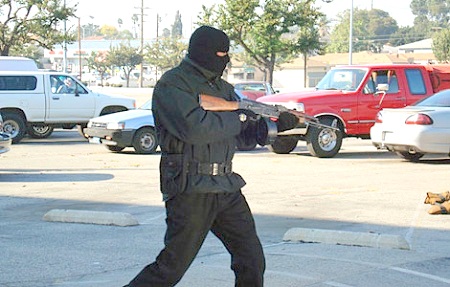
After months of planning and practice, on the morning of the 28th, Phillips and Matasareanu suit up in masks, body armor and gloves with time pieces sewn on their backs, load their equipment (five illegally modified automatic rifles, a pistol, and over 3,000 armor piercing rounds of ammunition in magazines and drums) into a white 1987 Chevrolet Celebrity, take hits of the muscle relaxer Phenobarbital as a calming agent, and head for the a branch of the Bank of America in North Hollywood located at the intersection of Laurel Canyon Boulevard and Archwood Street.  At approximately 9:17 AM, with the entrance of the desperadoes into the bank, forty-four minutes of mayhem and madness begins.

                 
                                                           Robbery

Giving themselves eight minutes to loot the establishment before they believe police can respond, the bandits' time table is immediately thrown off when they are spotted by police officers Loren Farrell and Martin Perello, who happen to be driving by on Laurel Canyon Boulevard in a patrol car.  "15-A-43, requesting assistance, we have a possible 211 in progress at the Bank of America."  Beyond possible, actual, and before the robbery ends over 300 members of law enforcement agencies of southern California will respond to the call.  And soon a second call goes out ... Shots Fired!

                                       
                                                   One of the guns

Using their usual tactics, the outlaws fire rounds into the ceiling of the bank to cow the occupants (thirty patrons and employees), force their hostages to lay on the floor, and blast through a bullet proof glass door to gain access to the teller and vault areas.  Filling a large money bag, the robbers' take is $303,305.00 ... a nice haul, but less than the $750,000.00 in cash the pair was expecting to find (causing the reduction, the bank has just altered its asset delivery schedule).  Enraged at the lesser payday, Matasareanu takes his frustration out on the safe, firing a full drum of 75 rounds into the inanimate object.  Bile drained, loot in hand, the pair then exit the bank.  Outside, the police are waiting.

                 
                                                               Matasareanu

All four corners of the bank surrounded and helicopters buzzing about overhead, officers repeatedly request that the pair surrender, but instead, Matasareanu and Phillips open fire on anything that moves.  In the gunfight that ensues, most of the rounds fired by the police from standard issued Berettas and Smith & Wesson revolvers fail to penetrate the body armor of the bandits (the 12-gauge Ithaca Model 37 pump-action shotgun of Officer James Zaboravan is also unable to cause any serious damage) ... unfortunately it is not the same for the slugs that come from the outlaws' weapons and several officers and civilians become bloody casualties over the course of the first eight minutes of action as the robbers engage targets making their way over to their getaway vehicle.  The only safety available, a Brinks armored car will be commandeered by police to evacuate the wounded from the shootout.

                 
                                               Insanity in North Hollywood

For unknown reasons, at the Chevy the pair split up, Matasareanu gets behind the wheel, while Phillips slowly walk beside, continuing to fire in all directions.  Wild West raw, eighteen minutes after the gun battle begins, members of the Los Angeles Police Department SWAT Team begin to arrive (coming from an exercise run, several wear shorts and tennis shoes under their body armor), and armed with AR-15s capable of holing the armor of the outlaws, the tide of the violent contest begins to turn.

                        
                                                   Holed police vehicle

Peeling away from the protection of the getaway vehicle, Phillips is hit in the shoulder as he turns east down Archwood Street.  Hoping to kill right until the end, the outlaw continues to fire at police with his AKM until the weapon finally jams.  Throwing the rifle away, he fights on with a Beretta 92FS pistol until a round strikes him in the hand, causing him to drop the gun ... then over and out realized, he picks up the gun, places it under his chin and commits suicide ... suicide as several killing rounds from the police also hit his body (ten SWAT rounds penetrate his armor).  It is roughly 9:52 in the morning.

                
                                                              Phillips after

Getaway vehicle rendered useless, holed, its windows blown out, all four tires flat, in a residential area of North Hollywood three blocks away from where his partner has just died, Matasareanu attempts to carjack a new ride, a yellow 1963 Jeep Gladiator pickup truck.  Unable to start the Jeep however, he soon finds himself engaged in a fresh gun battle with SWAT members.  A lifetime in the seconds of two-and-a-half minutes, the Romanian battles from behind the Jeep and Chevy until multiple hits to his legs put him down on the pavement.  Cuffed and swearing at the officers that have bested him, he will bleed out from over twenty leg wounds before an ambulance can make its way through the chaos to his position.  It is roughly 10:00 in the morning when the gunfire ceases. 

                      Picture
                                                     Last Stand

Battle over, millions that have watched the event live on local TV can't believe what their eyes have taken in ... approximately 2,000 rounds have been exchanged between outlaws and authorities, numerous buildings and cars have been damaged or destroyed, eleven police officers have been injured, seven civilians have been wounded, and two stone cold killers are meat morgue dead.  

                               
                                                     Gunfight

An incredible incident, in 1998, nineteen officers of the LAPD will receive the organization's Medal of Valor for their heroic actions in thwarting the robbery.