Wednesday, March 9, 2022

DUEL IN HAMPTON ROADS

3/9/1862 - Changing forever the way that military vessels are built and fought, harkening the coming age of multi-ton dreadnoughts, the ironclad Union warship USS Monitor, and the Confederate warship CSS Virginia (made from the carcass of the captured USS Merrimack), ineffectively pound each other with shells for four hours in the wet where the Elizabeth and Nansemond Rivers meet the James River just before they flow into Chesapeake Bay, near the city of Norfolk, Virginia, at an eight mile long channel of water called Hampton Roads.  No clear advantage gained for either side, at the end of the day both vessels withdraw, licking their wounds and the contest ends in a draw.

Monitor Vs. Virginia

The push into a new world of naval warfare is first driven by two men.  On the Confederate side, the emphasis to come up with a weapon that can break the blockade on goods and supplies that the North has placed around the coastal areas of the southern states comes from Confederate Navy Secretary Stephen R. Mallory, the prewar Chairman of the United States Senate's Naval Affairs Committee.  In May of 1861, Mallory proposes to the Confederate Committee on Naval Affairs that the U.S. Navy's huge advantage in ship's and sailors can be negated by the South building ironclads that the wooden hulled ships of the North won't be able to sink.  For help, he turns to three imaginative fellow Southerners, ordnance expert Lt. John Mercer Brooke (responsible for the craft's iron plating and cannonry), naval engineer William Williams (Chief Engineer of the Navy, responsible for the vessel's machinery), and naval builder Lt. John L. Porter (with overall responsibility for the conversion project).  Together, the foursome come up with a plan to get an ironclad in the water as soon as is possible by converting the bones of a scuttled U.S. warship into the blockade buster the South needs, the USS Merrimac (formerly a 350-ton, forty-gun frigate of the U.S. Navy).  Not fully destroyed when the Gosport Navy Yard (now the Norfolk Naval Shipyard) is evacuated by the Union in April of 1861, the charred remains of the ship are raised out of the shallows of the Elizabeth River, where the ship has been for 40 days, and it's conversion to metal begins.  Wounds repaired, atop the frigate's existing 22 foot draft, the vessel receives a new fantail and armored casemate, a massive V-shaped cast-iron bulwark at the bow weighing 1,500 pounds, and a new gun deck that gets covered by a fort-like structure of 20-inch pine timbers, planked by 4-inches of oak and plated with two layers of sheet metal, each two inches thick (railroad iron from the Tredegar Works in Richmond, Virginia).  The sides of casemate are angled at 35 degrees to cause enemy shells to glance off the structure, and the iron protection extends two feet below the water line to protect against near-miss shells, torpedoes, and the vessel being rammed.  For firepower, the ship houses 10 cannons in it's fortified casemate (there are firing ports for fourteen weapons) ... a 7-inch pivot gun at the bow and another at the stern (each weighing 14,500 pounds and capable of firing 104-pound shells), three 9-inch smoothbore Dahlgrens (weighing 9,200 pounds and capable of throwing a 72.5 pound shell over a distance of 1.9 miles), and one 6-inch piece on each side (also weighing 9,200 pounds and both fitted-out to fire furnace heated shot).  Additionally, the vessel includes two 12-pound howitzers with anti-personnel ammunition to hold off any potential unwelcome boarders  It is a formidable ship (though it is described as a "terrapin with a chimney on it's back"), but has design flaws in it's draft (22 feet, with the James River being only 24 deep in some spots), its weight will only allow its boilers to speed it along at 5 knots, and it has a turning radius of one mile, with completion of a full circle taking 45 minutes (one of her Confederate officers will describe her as "unwieldly as Noah's ark").  On February 17, 1862, after almost nine months of labor, the Merrimac is rechristened and launched as the CSS Virginia.  With an officer's complement of thirty men, and a crew of 300 sailors, supplies loaded aboard, the Virginia is ready for her trial run on March 7th of 1862.
Mallory

Brooke & Porter
CSS Virginia

   Seeking to bring the North into the dawning age of the ironclads is 59-year-old U.S. Navy Secretary from Connecticut, Gideon "Father Neptune" Welles (from prominent politic families in both Connecticut and Massachusetts, he owes his position to his strong support of Lincoln in the 1860 presidential election).  In 1861, he appoints an advisory board consisting of Commodore Hiram Paulding, Commodore Joseph Smith, and Commodore Charles H. Davis to look into the matter.  Considering 17 different designs, the commodores narrow the field down to two designs, one, a steam frigate called New Ironsides, proposed by Merrick & Sons of Philadelphia, and another, an ironclad gunboat called Galena from the ship builders of Cornelius Bushnell & Company of New Haven, Connecticut, the chief of which is the company's owner, 32-year-old Cornelius Scranton Bushnell.  In the running for the order, his patriotism wanting the best ship possible for the North, Bushnell meets with 58-year-old Swedish born engineer (he designs the first American warship, USS Princeton, to be driven by a screw propeller in 1842) and inventor, John Ericsson, to determine if the Galena design is viable ... a meeting in which Ericsson compliments Bushnell on his design for the Galena, but also shows the builder his own ironclad design (from 1854) for a craft he calls Monitor, which Bushnell will find he prefers to his own company's work.  Funds of up to $1.5 million approved by Congress for the build in August of 1861, getting the Ericsson's design approved however requires considerable effort as the inventor and the U.S. Navy have been at odds for over a decade since a 12-inch gun designed and installed on the USS Princeton explodes in 1844, killing six people, two of which are members of President John Tyler's Cabinet, and cause the Navy to refuse to pay Ericsson for the work he has already done on the ship (which in turn causes the embittered Ericsson to vow never to set foot in Washington D.C. again).  Design shot down by the Ironclad Board despite President Lincoln liking the craft Ericsson proposes, Bushnell convinces Ericsson to put aside his previous hurts and come to the capital to make a first hand pitch to the board.  Dazzling the board with his thoughts and an hour-long lecture on the physical principles that cause a ship to float (Ericsson states of his Monitor, "The sea shall ride over her, and she will live in it like a duck."), the board gives Ericsson the contract for his ironclad design when the inventor states he can build the ship in just 90 days for $275,000 (the group is so impressed that they give Ericsson an extra ten days to complete the project, but Welles also demands that its cost be paid back from the builders if the vessel is not a "complete success").  Throwing himself totally into the project, Ericsson returns to New York and churns out over 100 detailed drawings of the ship and it's accoutrements (there will be over 40 patentable inventions aboard the finished craft) and gets work started on the vessel by the Continental Iron Works of Brooklyn, New York.  The ship that makes it's maiden voyage on January 30, 1862 (18 days late to the contract, but done much sooner than anyone other than Ericsson thought possible, then goes back to port to correct the problems noted during her first trip out)) is unlike anything anyone has ever seen before (Welles is made aware of the construction of the conversion of the Merrimac by Mary Louvestre of Norfolk, a freed slave who works as a housekeeper for one of the Confederate engineers working on the project, at the risk of her life, she goes to Washington D.C., finds the Navy leader, who in turn, tells Ericsson to finish the work on the Monitor build as quick as is possible).  The ship produced by the Continental Iron Works is 172 feet long and 41 feet and 6 inches wide, flat-bottomed, with her hull made of iron, with a flat wooden deck covered by two layers of half-inch thick iron plates that is only 18 inches above the water.  The vessel can travel at 6 knots and needs water only ten feet and six inches deep to travel. Slightly off-center on the deck is a cylindrical revolving turret nine feet high with an inside diameter of 20 feet within which are two 11-inch Dahlgrens (the ship is crafted to hold two 15-inch cannons, but they have not yet been built when the ship is completed and steams south) weighing 16,000 pounds each, capable of firing a 136-pound round shot 3,650 yards.  Guiding the vessel, 55 feet forward of the turret is a small iron pilot house with slits on all sides for the captain and his helmsman.  Armor all over, including below the waterline, in locations deemed most critical, the iron is nine inches thick, and no area open to bombardment has less than five inches of metal density protecting it.  Completed, the USS Monitor will be crewed by volunteers from the U.S. Navy ... sixty souls in all (with eight men to each of the turret's guns).

Welles & Ericsson
Diagram
"Cheese-box On A Raft"

Showing the importance the Confederacy carries for the CSS Virginia, the man assigned to skipper the vessel is 62-year-old Commodore Franklin Buchanan from Maryland (thinking Maryland will secede from the Union, he resigns his commission, then tries to rejoin the U.S. Navy when the state stays a member of the Union, but is unsuccessful when Welles tells him he doesn't want traitors in his navy), the man whose plans are used in 1845 to create the United States Naval Academy at Annapolis, Maryland (known as the "Father of Annapolis, he is also the Academy's first superintendent), and the Confederacy's only full admiral.  Taking the Virginia down the Elizabeth River on her initial steam (accompanied by two small gunboats, Raleigh and Beaufort, which do not play a part with what soon takes place), changing plans when he comes in sight of open water on Saturday afternoon, March 8, 1862, and sees five Northern fighting ships ahead in Hampton Roads, on blockade duty, Buchanan decides what better way to test his new command is there than attacking his Union foes (to the cheers and singing of "Dixie" by Confederate soldiers lining the banks of the river, and the consternation of the Federal sailors aboard the sailing, 50-gun St. Lawrence and Congress, the 24-gun sailing sloop, Cumberland, and the 40-gun steam frigates Minnesota and Roanoke).  Moving slower than five knots to avoid grounding in the shallow waters, Virginia passes Craney Island, shrugs off her initial hits of the war from the Federal gunboat Zouave, and closes to within a mile of the Cumberland and opens fire with her bow gun.  First shot a hit, as is the ship's second, the shells kill everyone in the ship's forward gun crew save the crew's powder boy and it's gun captain, who loses both his arms in the blast.  Meanwhile, the Virginia's armor (made slippery with buckets of hot pork fat) rejects rounds from Cumberland, Congress, and the army batteries at the Union base of Newport News.  Deciding to try out the effectiveness of his ram, Buchanan continues plowing forward and smashes through the barrier of timbers surrounding Cumberland's anchorage, and crashes into the frigate's starboard side, creating a death hole that will be described as "wide enough to drive in a horse and cart."  It is a fatal blow to the Yankee ship, and almost also one for the Virginia; ram caught on it's victim, the ironclad begins to be drug down too, but with engines at full steam astern, the iron plow breaks off and Buchanan is able to continue his attacks (refusing to surrender when requested is made by Buchanan, the Cumberland's commander, Lt. George Morris, is still fighting the ship when the vessel gives a lurch and then plunges into the sand 54 feet below it's keel, a sinking that kills 121 sailors out of a compliment of 376 men).  One Union ship spoken for, the Virginia then gives it's full attention to the frigate Congress.
Buchanan
Cumberland Vs. Virginia
Morris (With Speaking Trumpet And Sword At Right Center)
Fights The CSS Virginia

Moving a short way up the James River to gain enough water to come about, Buchanan makes for the the Congress as the ship is towed into the shoals, where the deep-draft CSS Virginia can't get at it, by the gunboat Zouave.  The maneuver however is still in progress when Buchanan closes on his prey and begins firing round after round  into the wooden ship while taking no punishment in return, and things become even worse for the Union frigate when she runs aground at an angle that will allow only 2 of it's 50 guns to continue firing on her opponent.  Helpless, the ship's 35-year old commander, Lt. Joseph B. Smith killed, the ship strikes its colors, but Buchanan is prevented from taking possession of his prize by Yankee batteries ashore continuing to fire on the Virginia.  Incensed, Buchanan decides if the crippled vessel won't be his, Davy Jones can have it and orders his men to fire red-hot shot into the frigate.  Congress ablaze, Buchanan then makes the mistake of crawling out onto his ironclad's casemate to direct further operations against his foe and is struck in the thigh by a sharpshooter's bullet.  Falling to the deck badly wounded, Buchanan is replaced by his executive officer, 40-year-old Lt. Catesby ap Rogers Jones (the "ap" is a Welsh patronymic meaning "son of"), and leaves the battle unaware that gunfire from the CSS Virginia has taken the life of his younger brother, Union officer Lt. McKean Buchanan.  Burning into the evening, at 1:00 in the morning the USS Congress blows up when fire reaches one of her ammunition magazines.  Ebb tide, by the time the CSS Virginia sends a shot into the Zouave (attempting to come to the aid of the Confederates' next target, the frigate Minnesota) that carries away her rudder and one of her propeller blades, Jones (by the war's end he will officially be a commander in the Confederate Navy), not wanting his ship to become grounded, like all three remaining Union warships have become trying to get into the action against Virginia, or get away from it, drops anchor off Sewell's Point, removes his wounded and dead, and readies the ironclad for high tide on the morrow when the Confederates believe they will finish the removal of the U.S. naval presence at Hampton Roads.  It has been a good day for the Confederate Navy ... although the Virginia has been hit repeatedly by over 100 heavy Federal cannons, in four and a half hours of combat she has sunk two large Union warships, and damaged a gunboat, while inflicting over 300 casualties (261 are deaths) on the U.S. Navy, at the cost of a dented ship, two men killed, 19 more sailors wounded, and superficial damage that is fixed before dawn.   
Fighting The USS Congress

Lt. Joseph B. Smith & Lt. Catesby Jones
On Fire
Congress Blows Up

A disaster for the North, the news of what has taken place at Hampton Roads is soon telegraphed to Washington D.C., where President Lincoln calls for a special 6:30 Sunday emergency morning meeting with his cabinet to discuss how the government should react to the crisis.  At the meeting, the president frets, the secretary of state is glum, the secretary of the treasury is petulant, and the secretary of war, Edwin McMasters Stanton, almost becomes unhinged, ranting about "Ericsson's folly" letting the Union down and how, speaking of the CSS Virginia, he believes it, "Not unlikely, we shall have a shell or a cannonball from one of her guns before we leave this room " (though with her draft, there is no way the ironclad could ever get up the Potomac to achieve such an aim), and after the meeting he sends off telegrams to the governors of seacoast states that warn: "MAN YOUR GUNS. BLOCK YOUR HARBORS. THE MERRIMAC IS COMING."  Only Welles is at peace and seems composed during the meeting, believing the USS Monitor will soon arrive on the scene to blunt the Confederate's stunning new weapon (he has been advised that the vessel left New York on Thursday).  When the meeting ends, the cabinet adjourns to pray for miracle to save it's fleet, not knowing that the miracle has already begun at Hampton Roads. 
Stanton

At dawn of Sunday, March 9, 1862, as a light fog is lifting off the waters of Hampton Roads, Lt. Jones brings the CSS Virginia out of her anchorage, moves the ironclad slowly into the channel and makes his way towards the Minnesota as excited Confederate spectators watch from shore, expecting more favorable Southern fireworks.  In range to begin shelling Minnesota, the lieutenant instead receives a surprise when the USS Monitor, a vessel that will be called "a tin can on a shingle," comes out from behind the Minnesota and places itself between the Virginia and her next target.  Commanded by 44-year-old Lieutenant John Lorimer Worden, a veteran of 28 years with the Navy (he is fresh out of a Confederate prison where he has been kept for seven months, awaiting a prisoner exchange, after being arrested running secret dispatches to the Union fleet at Pensacola, Florida), the Union ironclad has arrived in time for battle (entering Hampton Roads on Saturday evening, Worden boards the USS Roanoke, acting fleet headquarters of the Union's North Atlantic Blockading Squadron of it's commanding officer, Captain John Marston, where the lieutenant receives orders to protect the Minnesota) after almost sinking in heavy seas on its journey south (she is accompanied by the tow ship, Seth Low, and the gunboats Currituck and Sachem), saved largely by the efforts of Chief Engineer Alban C. Stimers, First Assistant Engineer Isaac Newton Jr. and a handful of sailors that clear toxic air from the engine room.  Guided by the light cast by the burning Congress, the exhausted crew (no one has eaten more than hardtack or slept a wink during their two day journey south) of the USS Monitor drop anchor behind the Minnesota at midnight and await the coming day (they get little rest, readying for battle, they are horribly disturbed when the Congress violently explodes at around 1:00 in the morning).  Shortly after 8:00 a.m., the Monitor fires on the Virginia as she approaches, and the second day of the two-day Battle of Hampton Roads begins (missing, the round hits the Minnesota, which responds with a broadside at the CSS Virginia.).

Worden & Marston
Protecting Minnesota 

For the next four hours, with a break of some thirty minutes when the USS Monitor goes into the shallows to restock the ammunition for its two turret guns, the two ironclads move about each other like boxers seeking to deliver a knockout blow, and fire on each other from ranges of a few yards away to a half a mile (the CSS Virginia can fire and reload her guns every five minutes, while it take the USS Monitor eight minutes to reload and fire her twin cannons).  Neither ironclad is able to hurt the other decisively (chastised by Lt. Catesby for not continuing to fire on the Northern ironclad, the captain of the ship's gun crew, Lt. John Eggleston will declare in answer, "Why, our powder is very precious and after two hours' incessant firing, I find that I can do her about as much damage by snapping my thumb at her every two and a half minutes), but in retrospect, the battle is a near thing for both vessels.  The Monitor loses the voice tube that allows Lt. Worden in the pilot house to communicate with his executive officer in the turret, Lt. Samuel Greene, and Greene is forced to aim by looking out over the muzzles of his two guns (and with each shot, he must make sure that he doesn't misaim and hit the forward pilot house), chalk marks on decks used in targeting the guns can't be seen through the smoke of battle, screwheads breakoff and whiz around inside the turret after direct hits, and Acting Master Louis Napoleon Stodder becomes the USS Monitor's first casualty when leaning against the interior of the turret, it takes a direct hit and the mariner is knocked unconscious for over an hour.  Also, unbeknownst to it's builder, instead of being powered by a 30-pound dose of powder, fearing that the turret might blow up, the Monitor fires her rounds at the Southern ironclad using only 15-pound charges (it will later be demonstrated that had 30-pound charges been used, the iron of the Confederate vessel would have been penetrated).   On the Virginia, her sailors also suffer from the concussive forces pounding away on her armor, many bleeding from their ears and noses, thinking she will be fighting wooden frigates, she brings the wrong ammunition into the battle, and her lack of speed and need for deep water cause problems all day (at one point in the clash, the Virginia will run aground and be pummeled by the Monitor at an angle at which the Southern ironclad can not respond, but the vessel, running it's boilers hotter than recommended, manages to pull out of her predicament after 15 hair-raising minutes of taking hits).
Battle
Inside The Turret
Up Close And Personal

At the mid-point of the battle while the USS Monitor is in the shallows restocking it's turret guns (Lt. Worden uses the time to refresh himself by taking in the fresh sea air while he walks the deck of his ship), the Virginia is able to make one of her slow turns and closes once more on the Minnesota, hitting the still grounded ship with a shell from her bow gun (she also destroys the nearby Union tugboat, Dragon), but as she readies to deliver a devastating broadside on the wooden frigate, the Monitor once again interposes herself between the two ships and begins sending 180-pound shells at the Confederate ship once more.  Deciding to try something different, though it's ram is still at the gravesite of the Cumberland, Lt. Jones attempts to ram the Monitor (for his guidance of the ship and avoiding the Virginia's efforts to ram the Union ironclad, seaman Peter Williams, will receive a Congressional Medal of Honor on April 3, 1863), but the faster, more maneuverable vessel is able to dance away, taking only a glancing blow from the heavier, slower Confederate ship (and he also contemplates going to pistols and cutlasses and having a boarding party take the vessel, a form of attack that the Northerners are prepared to thwart by venting burning steam from the ship's boilers on to the deck of the ironclad).  Shortly after noon, the Virginia fires the most damaging shot of the battle from a distance of only ten yards, a 9-inch shell that explodes on the forward side of the Monitor's pilot house as Lt. Worden is looking out one of the eye slits in the structure.  Knocked backwards, stunned enough to believe the damage to his ship s worse than it is (the explosion cracks a crossbeam and partially lifts the iron lid off the top of the pilot house), ears ringing, beard singed, and partially blinded in his right eye, and permanently in his left, the lieutenant calls for his ship to shear away from the Confederate vessel and return to the relative safety of the nearby shallows.  Brought to his cabin, grimacing in pain as he turns command over to Lt. Greene, Worden asks, "Have I saved the Minnesota?" and when told his ship has whipped the Merrimac, states, "Then I don't care what happens to me," as the ship's doctor begins working on the lieutenant's wounds (battle survived, when Lincoln finds out that the lieutenant is recovering from his wounds at a local Washington D.C. home, he visits Worden, who recognizes the President's voice despite his still bandaged eyes, and tells him, "Mr. President, you do me a great honor by this visit," to which Lincoln instantly responds, "Sir, I am the one who is honored.").  Finally free of it's assailant, the Virginia once more turns towards the Minnesota, but discovers that once more the tide has turned and the waters in Hampton Roads are not deep enough again for the Confederate ship to get within range of it's prey.  Battle over, she heads south once more for her anchorage at Norfolk, as the Monitor comes out of the shallows, ready and willing again to do battle with the Southern vessel.
Williams
Officers And Some Of The Crew Of The USS Monitor
CSS Virginia

A draw, in the aftermath of the battle both sides will declare victory; the CSS Virginia for sinking two major fighting ships of the North (by battle's end, the Southern ship has had her port side anchor shot off, lost her iron ram, and has so many holes shot in her smokestacks that they draw almost no air to her boilers so that her already slow speed is cut in half, has two of her broadside cannons put out of commission by Union shells, both of her 22-foot cutters are shot away, and numerous iron plates on the ship have been loosened), and by the USS Monitor for remaining in Hampton Roads to keep the North's blockade intact (iron, speed, and low profile, in the four hour battle the Union ironclad takes 22 hits, including nine to the turret and two to the pilothouse, and survives them all).  The future seen and demonstrated, wooden warships now deemed obsolete, the Confederate Congress votes to give Secretary Mallory two million dollars for the purchase and construction of ironclads for it's Navy, and by February of 1863, eight are completed and several more have begun to be built, while on the Northern side, Secretary Welles receives thirteen million dollars for a U.S. Navy order of 56 monitors.  Though both ships have brought into being a new age of ship building and fighting, and have survived their battle with each other, neither vessel will survive the year of 1862.  Events on land influencing it's fate, on May 10th, when Southern troops withdraw from the area and the Grosport Navy Yard falls back into Union hands, the Virginia, after attempts to lighten her for a run to Harrison's Landing fail (the vessel is now commanded by Commodore Josiah Tattnell III, who will be court-martialed for the act, but acquitted), is set fire and scuttled near Craney Island to prevent her from becoming a Northern asset again.  
Tattnell
The End Of CSS Virginia

The USS Monitor lives a little longer, lasting until the evening of December 30, 1862.  After four changes of command, unsuccessful participation in the Battle of Drewry's Bluff (the Monitor's guns can not be elevatd enough to hit Confederate batteries ashore), and a period of harbor time for repairs and a refit, the Monitor, commanded now by Captain John Pyne Bankhead, is ordered on Christmas Day (the men of the ironclad will enjoy a holiday meal of chicken stew, stuffed turkey, mashed potatoes, gravy, rolls, plum pudding, and apple fruitcake), to join USS Passaic and USS Montauk off North Carolina in the Union's efforts to blockade the Confederate harbor of Charleston.  Remembering how the vessel almost sunk on her first sea voyage, members of her old crew are extremely worried about putting into the Atlantic Ocean again ... and with good cause.  Under tow from 236-foot long USS Rhode Island (under the command of Commander Stephen Decatur Trenchard), the two ships move south into the heavy storming seas off Cape Hatteras, North Carolina.  Waves breaking over the ironclad, all of the vessel's pumps soon prove inadequate at keeping water out of the ship, and a red lantern sends a distress signal to the Rhode Island for help, while Bankhead asks for volunteers to cut the tow rope with their side-wheel steamer companion.  Three men volunteer, Acting Master Louis N. Stoddard, seaman John Stocking, and seamen James Fenwick.  Climbing down from the turret, Stocking and Fenwick are almost instantly swept overboard, while Stoddard manages to hang on to a safety line, and eventually accomplishes the task of cutting the 13-inch towline with a hatchet.  Going under, former commander (for a few hours), Lt. Greene, Stoddard, and finally Bankhead leave the floundering craft barely in time (the U.S. Navy will not press charges against any of the officers and crew of the Monitor, despite it's designer claiming that the ship went down because it's personnel was drunk ... a charge Stoddard and the others will vehemently deny) as the ship sinks 16 miles southeast of Cape Hatteras.  In all, sixteen men, including four officers, will perish in the tragedy (most suffering from exposure, the Rhode Island will rescue 49 men from the icy Atlantic.
Looking Down At Drewry's Bluff
Bankhead
The Death Of The USS Monitor

Resting on the bottom for over a century, in August of 1973, an expedition funded by Duke University, the National Geographic Society, and the National Science Foundation finds the disintegrating Union ironclad upside down off Cape Hatteras.  Announcement of the find made on March 8, 1974, so the site will not be plundered by private divers for personal gains, the wreck and the area for .5-nautical miles around it, in 1975, is designated to be the Monitor National Marine Sanctuary, the first U.S. marine sanctuary, and in June of 1986, the Monitor is officially designated a National Historic Landmark.  Deemed too expensive an enterprise (in 1978, Captain Willard F. Searle Jr. will estimate raising the wreckage would cost between $20 to $50 million), it is decided to leave the Monitor where she rests, but some artifacts are raised.  To date, raised items include an engine, a condenser, a propeller (it takes three years to bring it to the surface), the two Dahlgren guns, and most importantly, the vessel's 120 iron turret (the artifacts reside at the Monitor Center of the Mariner's Museum of the U.S. National Oceanic and Atmospheric Administration (NOAA).  Raised after 41 days of effort, the heavy iron turret structure is found to have two skeletons inside (one wearing a gold ring).  Though all the best modern forensic techniques are used (including flying the remains to the Joint POW/MIA Accounting Command at Hickam Air Force Base in Hawaii for testing), the remains are never fully identified, with the possibilities narrowed down to the bodies being either crew members Jacob Nicklis, Robert Williams, and William Bryan.  Whoever the two skeletons were, on March 8, 2013, the remains are buried with full military honors at Arlington National Cemetery.
Upside Down
Out Of The Water
Funeral
USS Monitor Tombstone

3/9/1862 ... the age of wooden fighting ships ends when the USS Monitor takes on the CSS Virginia  on the waters of Hampton Roads.
Clash Of The Ironclads


Wednesday, March 2, 2022

THE HUNDRED POINT GAME

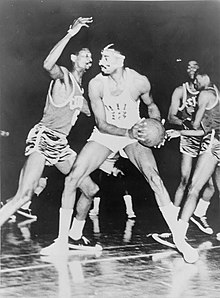
3/2/1962 - Growing more mythical with each passing year (to the point where thousands and thousands of fans will eventually claim to be at Hershey Sports Arena (a band-box gym smelling of chocolate originally built to house the local hockey team) in Hershey, Pennsylvania on the historic evening), 4,124 fans are on-hand (capacity is roughly 8,000 people) when 7'1" center Wilt Chamberlain scores an unprecedented 100 points (still the NBA record for most points in a single regular season or playoff game) for the Philadelphia Warriors against the New York Knicks in a game that the Warriors win, 169-147.

After

Born on August 21, 1936 in Philadelphia, Pennsylvania to the large family (there will be nine children altogether) of domestic worker Olivia Ruth Johnson and welder, custodian, and handyman William Chamberlain, the youngster that will one day be known as "Wilt the Stilt," "Goliath," and "The Big Dipper" (his personal favorite), Wilton Norman Chamberlain is at first a very frail child, almost dying of pneumonia and so sick that he misses a full year of schooling.  But once he gets healthy (his six feet tall at the age of 10, and 6'11" when he enters Philadelphia's Overbrook High School), he grows into one of the country's finest athletes.  Thinking basketball is "a game for sissies," he first shows his physical prowess for sports by becoming something of a black Jim Thorpe in track and field ... he high jumps 6'6", runs the 440 in 49.0 seconds, runs the 880 in 1:58.3, puts the shot 53'4", and long jumps 22'.  But at the time, basketball is king in Philadelphia and eventually Chamberlain decides to give the game a try ... a try that changes the way the game, and the position of center is played.
4th Grade - Can You Find Wilt?
At Overbrook High
With Coach Cecil Mosenson

At Overbrook High, the huge Panther average 31 points per game for the 1953 season.  Winning the Public League title, Overbrook finishes second for the Philadelphia city championship, losing to the eventual champion, West Catholic, 54-42 (in the game, Chamberlain is quadruple-teamed, and yet scores 29 of his ream's 42 points).  And that is just first year!  In his second season for Overbrook, Chamberlain sets a city record by scoring 71 points in a game against Roxborough High, guides the Panthers to a 19-0 record in which the squad beats South Catholic for the city title with Wilt scoring 32 in the championship game.  In his third season for the Panthers, Chamberlain continues to tear his opponents apart, scoring 74, 78, and 90 points in three consecutive games (after the 90 game, the Philadelphia Inquirer states that Chamberlain might have scored 100 points if he'd played the entire 32 minutes of the game), the team wins its third Public League title, its second city title beating West Catholic 83-42 (he scores 35 in the game), as Wilt ends his Overbrook career with three league championships, two city championships, a 56-3 record and breaks the high school scoring record of Tom Gola with 2,252 points, averaging 37.4 points a game.  Noticed by all the big college basketball programs (more than 200 schools will try to recruit the talented center), not wanting to play for a southern school because of the myriad of racial issues haunting the region at the time, and wanting to escape big city living and the East Coast, Chamberlain selects Kansas for his college matriculation (it is said that UCLA offers to find him work in Hollywood if he chooses the Bruins, and that to get him to stay home, the University of Pennsylvania offers him diamonds and a position for his high school coach if he will play for the Quakers).  
Overbrook
Under The Hoop
Dunk
Long Jump

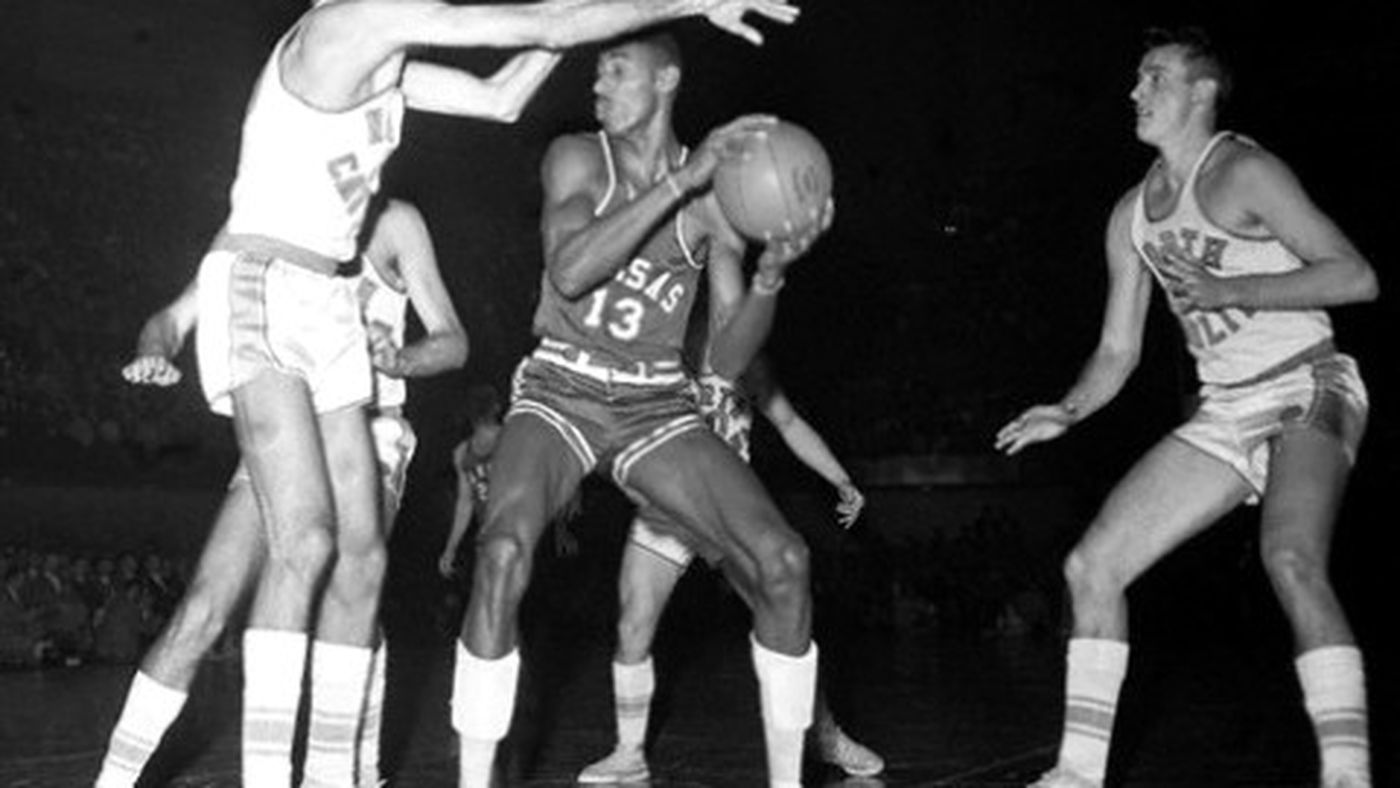
Freshman unable to play on the varsity at the time, Chamberlain stars on the freshman team led by legendary coach, Phog Allen (at Kansas, he will win 24 conference championships and three national titles).  In his first game at Kansas, in a game against the varsity squad (a group favored to win yet another conference championship), Chamberlain leads the freshman to victory while scoring 42 points, grabbing 29 rebounds, and blocking four shots.  Despite the retirement of Allen following the 1955 season, Chamberlain makes his debut at center for the Kansas Jayhawks on December 3, 1956; a contest in which he breaks two Kansas basketball records by scoring 52 points and hauling in 31 rebounds.in a 87-69 triumph over Northwestern.  Successful despite being double and triple teamed in every game and having many coaches run stalls at the Jayhawks (the shot clock will not become a constant of NCAA games until 1984), Chamberlain leads the team to a meeting with the North Carolina Tar Heels of Hall of Fame coach, Frank McGuire (there are 23 teams in the field).  In the championship game, McGuire has his smallest starter, 5'11" guard Tommy Kearns, jump tip-offs against Chamberlain just to mess with the big man's mind, triple-teams the center with one man behind him, one in front, and a third rushing into the coverage once Wilt receives the ball, and stalls for significant periods of time ... with Kansas shooting only 27% from the field, the Jayhawks trailed North Carolina, 29-22 at halftime, but catch the Tar Heels at 46-46 when regulation play ends, despite a ten minute stall by McGuire with the game in his favor at 40-37.  In the first overtime, both teams score only two points, in the second overtime North Carolina gets the ball and stalls for the entire extra period, and in the third overtime stanza, the teams swap the lead.  Trailing 54-53 with ten seconds left to go, Kansas sets up for a potentially game winning shot by Chamberlain, but loses the game when Ron Loneski's pass into the low post is intercepted (North Carolina will finish the season at 31-0, while Kansas completes it's season with a 24-2 record).  A devastating loss for Chamberlain, he nonetheless has 23 of his team's points, grabs 14 rebounds, and is named the Final Four's Outstanding Player of the tournament (he is also named to NCAA's first team basketball squad for the year, and should anyone forget that he is more than just a basketball player, for the Jayhawk's track and field varsity, he runs the 100 yard dash in 10.9 seconds, hurls the shot-put 56 feet, triple jumps over 50 feet, and thrice, takes the conference title in the long jump event).  In Chamberlain's junior season at Kansas, Wilt is again named an All-American as he leads the Jayhawks to an 18-5 record (he misses three of the losses due to a urinary tract infection) while averaging 30.1 points a game.  Sadly for the squad though, the team finishes in second period during a time period in which the NCAA invites only conference champions to its championship tournament and after a junior season in which he has taken a monstrous amount of racial insults from opposing fans, has too frequently batted heads with Allen's replacement, Coach Dick Harp, and has the fun of the game taken away by triple-teams and stalls, he decides to leave Lawrence and amateur play behind by turning professional (already profiled in Time, Look, Newsweek, and Life by the time he turns 21, Wilt receives $10,000 dollars for the article he writes for Look, entitled, "Why I'm Leaving College," during a period in which pro basketball players are only making about $9,000 a year), signing with the Harlem Globetrotters for the 1958-1959 season for $50,000 (at the time, NBA teams will not sign players until their college class graduates).                

Allen & Harp
Surrounded By Tar Heels
Kansas
Globetrotter

College class graduated, Chamberlain becomes the highest paid player ($30,000) in the NBA, playing for his hometown team, the Philadelphia Warriors, in 1959.  As before at the high school, college, and with the Globetrotters, he immediate becomes a dominating presence in the league.  In his very first game against the New York Knicks, the rookie center scores 43 points and takes down 28 rebounds. in game #3 against the Syracuse Nationals, he gets 41 points and 40 rebounds, in his fourth game he plays against the reigning champion Boston Celtics for the first time and throws down 30 points against Hall of Fame center, Bill Russell, playing the Knicks again, he scores 39 points and ups his single game high for rebounds to 43, then as the season moves into 1960, he gets 58 points, 42 rebounds, and 4 assists in a game against the Detroit Pistons.  For his rookie NBA season, Chamberlain averages 37.6 points and 27 rebounds a game, breaking the rookie and regular season scoring records (he will set 8 NBA records in his first year), wins the Rookie of the Year Award, wins the NBA MVP, is on the winning team for the NBA All-Star game, is the MVP of the All-Star game (with a 23 point, 25 rebound performance), and leads the Warriors to the championship series against the Boston Celtics (which the Celtics take 4 games to 2, despite a game in which he becomes the only player thus far to get 50 points and 35 rebounds in a playoff game) ... he also faces constant double and triple teaming defenses, takes a hammering of hard fouls (along with those the officials miss), and shows he is vulnerable at the free throw line, shooting barely 50% at the line.  In his second year, Chamberlain just gets better, besting all his rookie year stats, becoming the first player to score over 3,000 points in a season (the only other player to score as much will be Michael Jordan in 1987), and getting over 2,000 rebounds, breaking the season mark there too, and he moves his own single game rebounding record to 55.  And then the 1960-1961 season begins and Chamberlain posts and even finer year.  Coached now by the man who ruined his chance for a NCAA championship, Frank McGuire, Chamberlain puts together a year in which he averages 50.4 points and 25.7 rebounds a game, becoming the first and only player to score 4,000 points in a season.  Incredibly, he plays 48.53 minutes a game and is in 3,882 minutes of the Warriors 3,890 minute long season!  And on a cold, rainy night in Pennsylvania, he puts down an almost perfect game.
All-Star
Finger Roll

Putting down games in which he scores 67, 65, and 61 points, in an triple overtime game against the Los Angeles Lakers (the only NBA team at the time located west of the Mississippi River), he breaks forward Elgin Baylor's sine game point record of 71, with a 78 point performance and the rumbling begins over what Chamberlain might do someday.  Baylor says he doesn't mind having his record broken, because someday Chamberlain is going to score 100 and Bill Russell states that Chamberlain has the size, speed, and talent to score 100 some night ... and they are right.  With only five games remaining in the regular season though, no one is expecting fireworks out of the Friday night game in Hershey between the second place Warriors (eleven games behind the first place Boston Celtics) and the last place Knicks.  Treating the contest as just another game (no members of the New York press corps even attend the game and no known film of the game exists, two still photographer's are sent to the game), the night before, Chamberlain is in New York City, partying all night with a female friend (in his autobiography he will claim to have pollinated 20,000 women ... a tale for another time) he drops off at her home at 6:00 in the morning.  With no sleep and suffering from a hangover, he takes the 8:00 a.m. train to Philadelphia, meets friends at the Philly train station and then has lunch with them, barely making the team bus to Hershey.  Still struggling to establish itself as a major sport in it's 16th season, most of the fans that show up for the game are actually there for a preliminary exhibition basketball game between players from the NFL's Philadelphia Eagles and the Baltimore Colts.  Knicks regular center, 6'10" Phil Jordon from Whitworth University in Spokane, Washington, out with the flu (though there will be rumors that he is suffering from a monster hangover), Chamberlain will be opposed by second year player, 6'10" center Darrall Imhoff (an NCAA champion in 1959 with the California Golden Bears, and a member of the Olympic gold medal basketball team of 1960 that also includes Walt Bellamy, Bob Bozer, Terry Dishinger, Jerry Lucas, Oscar Robertson, and Jerry West), backup power forward, 6'9" Cleveland Buckner, and 6'6" forward, Dave Budd.
Hershey Sports Arena
Imhoff
Buckner
Budd

Not intending to go after any kind of records, Chamberlain makes his first five shots as the Warriors open up a 19-3 lead, and when the quarter ends, the Knicks trail 42-26, with Chamberlain having 23 points, including going 9-for-9 on his free throws (McGuire has converted Chamberlain into shooting his free throws underhanded).  By halftime, the Warriors lead over the Knicks is at 79-68, Chamberlain has 41 points, and Imhoff is in foul trouble (believing Chamberlain is getting preferential treatment, after one foul, Imhoff screams at the officials, "Well, why don't you just give the guy a hundred now and we'll all go home!").  Having already scored 60 points or more in 15 previous games, there is still no thought of Chamberlain going for 100, but the door to that destination opens in the locker room when future Hall of Fame point guard, 6' Guy Rodgers (passing the ball to Chamberlain, the guard will record 20 assists for the game) goes to McGuire and tells the coach, "Let's get the ball to Dip.  Let's see how many he can get."  Plan agreed to by their coach, the Warriors keep feeding the ball to their Hall of Fame center, and when the third quarter ends, Wilt has pushed his scoring total 69 and realizes he has a chance to beat his own personal bests of 71 (for a regulation game) and 78 (for an overtime contest).  Dunks, fadeaway jumper, finger rolls, free throws ... everything is working for Chamberlain as he beats up on Imhoff (before fouling out, the center will score 7 points and have 6 rebounds), Buckner (the forward will score 33 points and 8 rebounds in 33 minutes of play), Budd (13 points and 10 rebounds) and any other Knick trying to stop him.  Stirring up the crowd, arena announcer David Zinkoff begins calling out Chamberlain's point total after every basket by the center and the crowd is soon chanting "Give it to Wilt!" over and over until the end of the game.  With eight minutes to go in the game, Chamberlain needs 25 points to reach 100, a pace that for a regulation would have him scoring 150 points.  No problem for the Big Dipper ... with 7:51 left in the game, Chamberlain establishes a new best for a single game when he scores his 79th point of the game.  Team ball be damned now in pursuit of an incredible record, the Warriors support Chamberlain completely and continue feeding him the ball (at one point, guard Al Attles passes up an easy layup so that Wilt can get his 88th and 89th points), while in opposition, the Knicks, trying to prevent Chamberlain from reaching his goal, play as slow as possible when they have the ball, and begin fouling Warriors not wearing Wilt's #13!  With five minutes left to go, responding to the strategy of the Knicks and safely in the lead, McGuire surrounds Chamberlain with bench players so that they can get the ball back by fouling Knicks and then toss it into Chamberlain afterwards for more scoring by the big man (for the game, the Warriors will foul 25 times, while the Knicks are whistled for 32 fouls, with both Imhoff and 31-point scoring forward, 6'6" Willie Naulls from UCLA, fouling out of the game).  With 2:12 left in the game, Chamberlain gets his 94th point, then scores on a fadeaway jumper to hit the 96 point mark, and then with an emphatic dunk (off a lob pass from guard York Larese), reaches 98 points scored as the crowd goes crazy.  
Zinkoff
Attles
Rodgers Guarding Bob Cousy
Larese

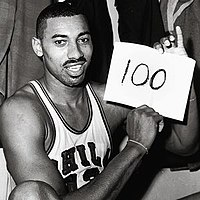
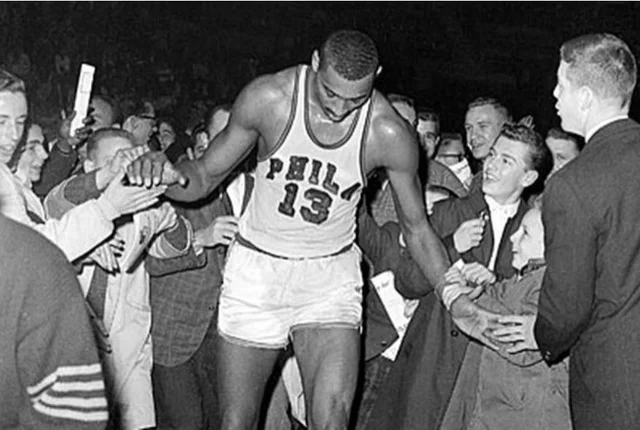
Time for the record running out, with about a minute left in the game, Chamberlain sets up in the lane as forward Joe Ruklick passes the ball to Rodgers, who passes it to Wilt ... who misses his shot, but has the ball rebounded by teammate Ted Luckenbill.  Luckenbill in turn passes the ball back to Chamberlain, who misses his second shot at immortality.  Luckenbill to the rescue again with another rebound (he will only have the two for the game), the forward passes the ball to Ruklick, who passes up a layup to lob the basketball back to Chamberlain.  Surrounded by five smaller Knicks, Chamberlain gets the ball, leaps in the air, and sends a dunk into the basket that scores point 100 with 46 seconds remaining in the contest.  100!  As the crowd explodes, with over 200 fans running on to the floor to congratulate and touch the Big Dipper, Ruklick goes to the scorer's bench to make sure he receives credit for the assist on the record basket.  After the officials clear the fans from the floor (it takes nine minutes), the game ends with Ruklick missing two foul shots on purpose (so that Wilt might have a chance at 102 points), while Wilt stands motionless in the mid-court circle, done for the evening believing 100 points sounds better than 102.  Game concluded, along with Chamberlain's record of 100 points (still the record, the closest anyone has come so far is Los Laker Kobe Bryant's 81 points against Toronto in 2006 when he shoots 28-46 from the field and makes 18 of 20 free throws), records will also be set for most free throws made in a game by a player (28 for 32 ... tied by Adrian Dantley in 1984), most points scored by two teams in a regular season game (316 ... still the record), most field goals by two teams in one game (120) most shot attempts from the field by a player (63 ... still the record), most shots made (36 ... still the record), most points in a quarter (31 ... broken by David Thompson's 32 in a 1978 game in which the forward gets 73), most shots in a quarter (21), most points scored in a half (59 ... still the record), most field goals in a half (22), most shots in a half (37) ... and of course, Chamberlain plays all 48 minutes of the game.  It is truly an amazing game and performance, and it's importance echoes to this day (playing the Warriors again at Madison Square Gardens on March 4, 1962, Imhoff, thought to be the goat of the game for allowing Chamberlain's 100 point performance (despite his fouling out of the game and only playing 20 minutes), receives a standing ovation from Knick fans when he "holds" Chamberlain to 55 points in the team's rematch).
Luckenbill, Wilt, And Fans
Ruklick & Chamberlain
Coming Off The Court
Locker Room

Trying to stay alive, the game is a turning point in professional basketball being accepted as a major league sport that can hold it's own with football, baseball, and hockey.  As Hall of Fame guard Oscar Robertson will state, "People heard about Wilt scoring a 100, averaging 50 a night, and they wanted to see the guy do it ... I believe Wilt Chamberlain single-handedly saved the league" (others are not so thrilled with the game, Hall of Fame player and coach, Richie Guerin, who scores 39 in the game for the Knicks, felt the Warriors and Chamberlain break an unwritten code of conduct by embarrassing their opponent and trying to set a record outside the normal flow of a game, while his coach, Eddie Donovan is more succinct, stating simply, "The game was a farce.").  And as if giving truth to Robertson's statement, two days after the game, Chamberlain appears on the Ed Sullivan Show, while for years while he is the commissioner of the NBA, when someone calls Daniel Stern's office and is put on hold, they hear the radio call of Bill Campbell on Wilt making his last field of the game, "He made it!  He made it!  He made it!  A Dipper Dunk!" ... a bit of basketball and radio history that in 2016 is added to the National Recording Registry for it's "cultural, artistic, and/or historical significance to America society and the nation's aural legacy" (only the fourth quarter call exists).  And the ball with which Chamberlain scores his 100th point of course becomes magical ... 14-year-old Kerry Ryman, an attendee at the game, claims Wilt gives him the special basketball, which is put up for auction by Leland's Auction in 2000, with a starting asking price of $551,844, but because of authenticity issues (in the form of Al Attles claiming Chamberlain gave him the actual 100 point ball), sells for "only" $67,791.
Campbell
The Ball

As for Wilt, he goes on to other milestones and honors (his favorite game of his career is a 1960 game in which he sets the NBA record for rebounds in a single game by grabbing 55 against his Boston Celtics nemesis, Hall of Fame center Bill Russell) in a NBA playing career that lasts from 1958 to 1973 in which the Big Dipper scores 31,419 points (a 30.1 average), pulls down 23,924 rebounds (a 22.9 average), and 4,643 assists ... two world championships (one with the Philadelphia Warriors and one with the Los Angeles Lakers in which he will be voted the Finals MVP), four NBA MVP awards (1960, 1966-1968), thirteen NBA All-Star game appearances (he is the MVP of the 1960 contest), first-team All-NBA seven times (and he is second team three times), first-team All-Defense twice, seven NBA scoring championships, eleven times he leads the league in rebounding, nine times he leads the league in minutes played (he never fouls out of any regular season game), leads the league in assists in 1968, is picked as a member of the NBA 35th, 50th, and 75th Anniversary teams, and his #13 retired by the Golden State Warriors, Philadelphia 76ers, and the Los Angeles Lakers (and of course he is inducted into the Naismith Memorial Basketball Hall of Fame in 1978).  When he retires, Chamberlain has records for most points scored in a game and a career, the same for rebounds, and is the only player to average 30 points and 20 rebounds for a season, a feat he pulls off seven times, and he is also the only one to average 30 points and 20 rebounds for his entire career (and he has a huge influence on how the game is played, his size and success forcing changes that widen the lane around the basket, make it illegal to inbound the ball by tossing it over the backboard, and forcing a free throw shooter to stay behind the foul line (to prevent Wilt from dunking the ball from that distance).
The Philly Championship 
Playing Against Russell In 1966
1972 - The Los Angeles Lakers
First Championship

And after the NBA, Chamberlain does not slow up at all.  For a single season, Chamberlain is the coach of the ABA's San Diego Conquistadors (going a mediocre 37-47) before deciding to move to greener pastures (and promote his latest book, the autobiography, "Wilt: Just Like Any Other 7-Foot Black Millionaire Who Lives Next Door.  No more basketball, Wilt becomes a successful businessman and makes money in real estate and stocks, invests in bloodmares, buys a popular Harlem nightclub that he names "Big Wilt's Smalls Paradise, sponsors professional volleyball and track and field teams, appears in ads for TWA, American Express, Volkswagen, Drexel Burnham, Le Tigre Clothing, and Foot Locker, becomes a board member and then president of the newly created International Volleyball Association and plays occasional matches for the league's Seattle Smashers (playing in the league's all-star game so it will be televised, Chamberlain is declared the MVP of the match) and is voted into the International Volleyball Hall of Fame, establishes Wilt's Athletic Club to support a number of athletes in their quests to win Olympic gold (among the Club's members are sprinter Florence Griffith, Greg Foster, Andre Phillips, Alice Brown, and Jeanette Boldin), takes on Arnold Schwarzenegger's Conan as the villain Bombaata in 1984's Conan the Destroyer, attends Martin Luther King's funeral with former president Richard M. Nixon (what a difference a few decades make ... Chamberlain denounces the Black Panthers and other black nationalist groups and considered himself a Republican), turns down offers to play for the Cleveland Cavaliers when he is 45, and for the New Jersey Nets when he is 50 (it is said that in Magic Johnson's rookie year with the Los Angeles Lakers that Chamberlain humiliates the Hall of Fame guard in a one-on-one contest after a team practice), runs marathons, collects cars that include a Ferrari, a Bentley, and custom made Le Mans-style racing he calls Searcher One that has a value of $750,000 in 1996, builds a million dollar mansion in Bel-Air he names "Ursa Major" that has a pivoting 2,200 pound door, no right angles, and an X-rated room that features mirrored walls and a fur-covered waterbed, writes a 1997 book critical of the NBA and its latest players entitled, "Who's Running the Asylum? Inside the Insane World of Sports Today," and at the time of his death is writing a bio-pic screenplay about his life for NCH Entertainment.  Never another, after dental surgery the week before, the big man passes away at his Bel-Air home at the age of 63 on October 12, 1999 as a result of congestive heart failure.
Bombaata
At His Nightclub
At Home For Life Magazine

3/2/1962 ... Wilton Norman Chamberlain becomes the only man to get 100 points in a single NBA contest!
Once Upon A Time


.