Thursday, July 2, 2020

SAVING THE DAY!

7/2/1863 - Union forces reeling from a day and a half of battering at the hands of General Robert E. Lee's Gettysburg invaders, Cemetery Ridge defensive line about to be breached, 262 men of the First Minnesota Infantry Regiment cover themselves in forever martial glory by fixing bayonets, and though horribly outnumbered, charging into the advancing Alabama Brigade of Confederate Brigadier General Cadmus Wilcox (the 9th, 10th, 11th, and 14th Alabama regiments, 1,400 soldiers) ...saving the day for the Union Army and saving the nation itself ... 262 men!
Sacrifice: Remembering the 1st Minnesota at Gettysburg - The Daily ...
Dave Geister - Painter, Illustrator, Time Traveller . . . Geek
Charge

Answering President Abraham Lincoln's call for troops to defend the Union following the fall of Fort Sumter in Charleston Harbor, the day after the battle Minnesota Governor Alexander Ramsey creates the First Minnesota Volunteer Infantry Regiment from 1,009 men of the city of St. Paul and other nearby towns (lots of loggers and farmers, one man, Newton Brown, will walk 65-miles barefoot to enlist).  The unit is mustered into existence (for three years of service) at Fort Snelling, Minnesota on April 29, 1861 and by the Fourth of July they are stationed in Alexandria, Virginia, completing their training under the command of Colonel Willis A. Gorman.  The unit sees action for the first time at the First Battle of Bull Run (7/21/1861) ... in the thick of the afternoon fighting that takes on Henry House Hill supporting the artillery guns of Captain James B. Ricketts, the unit has a casualty loss of 20%, with 49 killed, 107 wounded, and 31 missing.  At the Battle of Antietam (9/17/1862), still the bloodiest day in American history, the unit fares even worse during Major General John Sedgwick's ill-fated morning assault on Confederate forces positioned within the battlefield's infamous West Woods ... contributing Minnesota crimson to the carnage with a 28% casualty rate consisting of 16 killed, 82 wounded, and 24 missing (122 casualties out of 435 soldiers engaged).  Nowhere as desperate and deadly as at First Bull Run or Antietam, the men from Minnesota are also present for the Battle of South Mountain (9/14/1862), Major General George McClellan defeat at the Battle of Ball's Bluff (10/21/1861), McClellan's bungled Peninsula Campaign of 1862 (March to July), the Seven Days Battles outside of Richmond, Virginia (6/25/1862 to 7/1/1862), the disastrous Battle of Fredericksburg (12/11/1862 to 12/15/1862), and Major General Joseph Hooker's defeat at the Battle of Chancellorsville (4/30/1863 to 5/6/1863).  It is at Gettysburg however that the First Minnesota has its finest day.
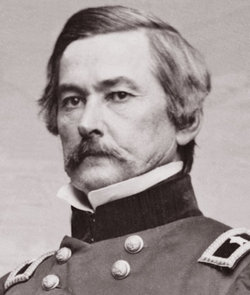
Willis Arnold Gorman (1816-1876) - Find A Grave Memorial
Gorman
First Minnesota Volunteer Infantry Regiment | MNopedia
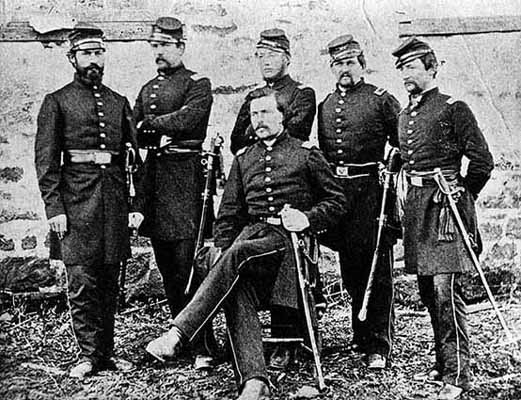
First Minnesota Officers - Left To Right Back Row - Captain Wilson Farrell, Lt. Samuel
Raguet, Captain Louis Muller, Lt. Charles Zurenberg, And Captain Henry Coates -
Center - Major Mark Downie

Part of the 12,000 men in the II Corps of the Union Army (their new commander as of 5/22/1863 is Major General Winfield Scott Hancock who will become known as "Hancock the Superb" for his actions during the battle), the 262 men of the whittled down First Minnesota (three companies are on detached duty, Colonel William Colvill Jr. is in command of the rest of the unit) arrive on the Gettysburg battlefield shortly after sunrise on the second day of the clash (it is Thursday and the weary men have averaged a daily fourteen mile march for two weeks) and are assigned a place on the Union's line to protect and support Battery C of the 4th U.S. Artillery.  Disaster impending when the line is compromised by "political" soldier Major General Daniel Sickles moving his III Corps forward without orders (the man is also the murderer of Philip Barton Key II for the man having an affair with Sickle's wife), Hancock spends the day trying to stave off disaster as he moves units about the field to help at crisis areas ... by late afternoon though, he has a last crisis to deal with and is almost out of troops to commit, there is a gap in the Union line that is about to be attacked by Confederate troops..
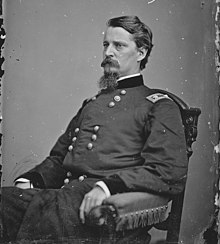
Gen. Winfield S. Hancock - NARA - 529369.jpg
Hancock
William Colvill.jpg
Colvill

Another snap decision (if the gap is exploited, Confederate troops will split the Union Army in half and can roll up the segmented flanks of the northerners), Hancock orders the divisions of Brigadier General John Gibbon and Brigadier General Alexander Hays into the opening, but the movement of men will take five minutes of time, time Hancock doesn't have unless he can find a means of stopping the immediate southern advance.  He finds his means in the men of the First Minnesota.  Seeing a regiment of blue soldiers moving towards him, Hancock gallops up to the officer commanding the column and asks, "What regiment is this?"  The answer comes back immediately, "First Minnesota, Sir!" (a regiment that belongs to Hancock's II Corps, and that is commanded by a man only three days before, Hancock had placed under arrest for allowing his men to slow their advance by staying dry and crossing a river single file over a log instead of everyone wading the three-foot-deep wet, 33-year-old Colonel William J. Colvill Jr.).  "Colonel, do you see those colors?" Hancock calls out, pointing to Alabama flags approaching, with Colvill stating his acknowledgment of the colors, the general then gives his orders, "Advance, Colonel, and take those colors."  One regiment against a brigade, murder (Irish-born lawyer Lt. William Lochran will later write, "Every man realized in an instant what that order meant - death or wounds for us all; the sacrifice of the regiment to gain a few minutes of time, and probably the battlefield ... but unwilling to face Hancock's wrath again, Colvill orders his men forward on double-quick.
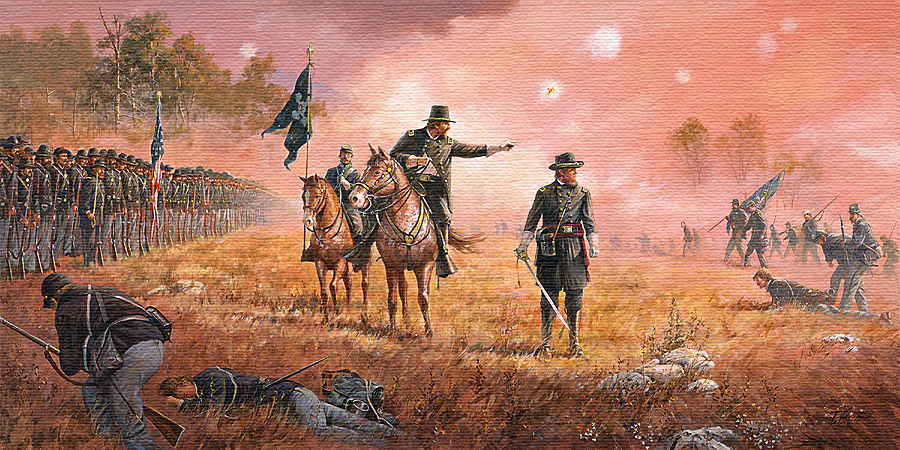
Licensed Battlefield Guide Rich Goedkoop: Union Counterattacks ...
"Take Those Colors!"

Born in Forestville, New York on April 5, 1830, Colvill is the son of Irish-Scottish parents.  Intellectually gifted (he graduates from Fredonia Academy and teaches at a country school for a year before studying law), he reads law out of the offices of 13th U.S. President, Millard Fillmore and in 1851 passes the bar.  For three years he practices law in New York before migrating to Minnesota, where along with opening up a law office, Colvill becomes active with Minnesota's Territorial Council and establishes the Red Wing Sentinel in the town of Red Wing.  When the Civil War breaks out with the shelling of Fort Sumter, Colvill becomes the first man to volunteer from Goodhue County and is elected captain of Company F of the First Minnesota Volunteer Infantry.  Wounded in the shoulder at the 1862 Battle of White Oak Swamp (he is an easy target, measuring 6'5" in his stocking feet), by the time of Gettysburg Colvill is a colonel in command of what is left of the First Minnesota.
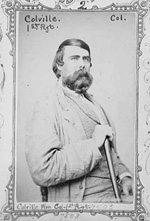
Minnesota and the Civil War' Exhibit Experience & Images ...
Colvill

Opposing Colvill is the brigade of 39-year-old Brigadier General Cadmus Marcellus Wilcox.  Born on May 20, 1824 in Wayne County, North Carolina, Wilcox is raised and educated in Tennessee (his family moves there when he is only two), attending Cumberland College before matriculating at West Point with its class of 1846 (among his classmates are future generals, George B. McClellan and Thomas J. "Stonewall" Jackson, he finishes #54 out of a class of 59).  During the Mexican-American War, Wilcox gallantly fights at the Battle of Veracruz, the Battle of Cerro Gordo, the Battle of Chapultepec, and the Battle of Mexico City.  After the war, he remains in the army, teaches at West Point, spends a year in Europe, and writes a manual on rifles and rifle firing.  He is a captain in the New Mexico Territory when the Civil War begins and he joins the Confederacy.  On the other side of many of the battles Colvill is also in, by the time of Lee's Gettysburg Campaign, Wilcox is a brigade commander reporting to Major General R. H. Anderson, belonging to the III Corps of Lt. General A. (Ambrose) P. (Powell) Hill (for the day, he is on loan to Lt. General James Longstreet for use in the attack Lee has ordered his I Corps to make against the left of the Union line atop Cemetery Ridge).
CMWilcoxCSAright.jpg
Wilcox

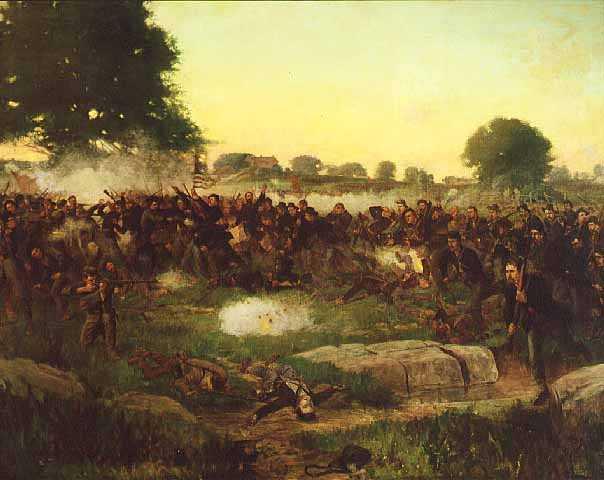
Off without hesitation, Colvill's men charge down the rise, level their bayonets, shout "HURRAH," and then crash into Wilcox's brigade .  Already tired from a run of over a mile and the fight they have made reaching the Union line, surprised at being attacked themselves, the Alabamians recoil as the First Minnesota hits them just as they are crossing a small creek (the infamous Plum Run which will turn crimson during the battle), but after a few moments, come on again and pour devastating fire on to Colvill's command.  In the blood bath that takes place, five times the Minnesota flag goes down, and five times it rises, Colvill is hit three times and severely wounded (hit in the right shoulder and ankle, a bullet will clip off a piece of vertebra in the colonel's back and he argues doctors out of amputating his damaged foot ... making a slow recovery first in a Private Gettysburg home, then at a Harrisburg, Pennsylvania hospital, Colvill is not out of bed until February of 1864 and walks with a cane for the rest of his life ... mustered out of the army as a brigadier general in 1865, he spends the next forty years in Minnesota as a member of its legislature, as the state's attorney general, practicing law, as register of the Duluth Land Office, and running his farm, which will one day be the small community of Colvill.  He dies in his sleep at the age of 75 while attending a reunion of First Minnesota veterans in 1905.  At the dedication of the statue that stands at his grave, President Calvin Coolidge will state, "Colonel Colvill and those eight companies of the First Minnesota are entitled to rank as saviors of their country."), and all but three officers are hit.  Needing five minutes for supports to arrive, the men of the First Minnesota Volunteer Infantry instead give Hancock (he will later praise the men for their unsurpassed gallantry and heroism, the highest known in the annals of warfare) fifteen minutes (seeing Union troops approaching his flanks, with no supports behind him, Wilcox will retreat back down the hill).  But the time comes at the grisly cost of 215 casualties (retreating with discipline and their faces forward, Captain Nathan Messick will lead the 47 unscathed survivors of the clash back to the Union line), an 82% rate, still the largest percentage of casualties to be taken by any U.S. regiment in a single day of battle!
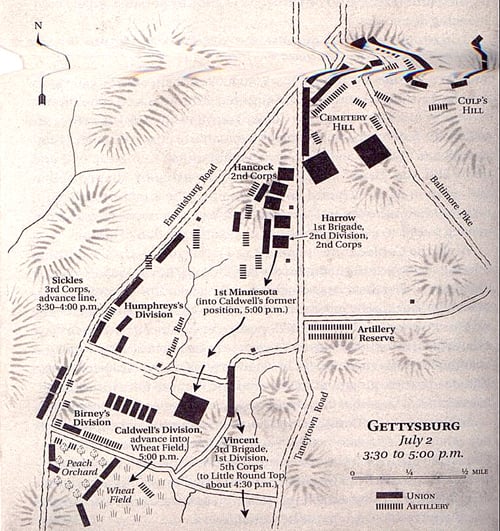
No grander heroism: The story of the 1st Minnesota, and Winona's ...
Map Of The Charge
THE FIRST MINNESOTA, BATTLE OF GETTYSBURG - DON TROIANI — Horse ...
First Minnesota
Kill the Jellyfish: The First Minnesota's Last 5 Minutes
Charge
The Last Full Measure: 1st Minnesota Regiment at Gettysburg-Keith ...
Last Full Measure
Heroes of Gettysburg: First Minnesota Volunteer Infantry Regiment ...
Attack (Colvill Is Slightly To Right Of Flag, Arm Upraised)
Not a Man Wavered by Dale Gallon: 1st Minnesota at Gettysburg ...
Retiring With Order

Union line saved for a third day of mayhem, the survivors of the charge are reinforced by one of its detached companies returning to the unit (Company F) and moved slightly north on Cemetery Ridge to rest and recuperate ... right at one of the spots in the line Picketts Charge of 7/3/1863 will try to breach.  Again at the seemingly epicenter of the battle's carnage, the men of the First Minnesota will charge an advancing enemy of superior numbers ... and once again southern attackers can not get past the men of the Land of 10,000 Lakes.  But again, there is a cost to pay ... attacking the attackers (the First Minnesota will lose seventeen more men on the third day of Gettysburg), slightly wounded twice the day before, 36-year-old Captain Messick is killed by a shell fragment that just above his right eye, and then his replacement, 33-year-old Captain Farrell, is mortally wounded and goes down too (at the end of the day, Captain Henry C. Coates will be in command). 
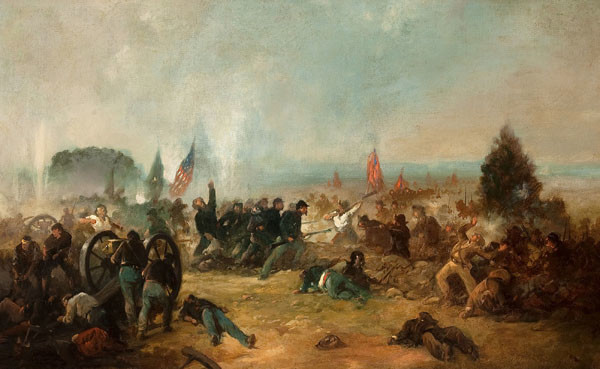
 Pickett's Charge - Battle of Gettysburg - Woodmere Art Museum
Pickett's Charge
Nathan S. Messick (Cpt.) · Hall of the Dead · Civil War In ...
Messick
Great Victory Won!
Coates

And once again there is glory for the men of Minnesota.  Picking up the unit's flag when the last color bearer falls, 21-year-old St. Anthony Falls miller, Corporal Henry O'Brien wins a Congressional Medal of Honor for leading the charge to the right, carrying the flag throughout the rest of the battle despite taking a grazing round to the head and a second bullet that punches through the soldier's hand (it will cut the flagstaff in half after blowing out of the back of O'Brien's palm).  And 41-year-old Private Marshall Sherman of St. Paul (where he is a house painter) also receives a Congressional Medal of Honor for capturing, at the point of his bayonet, the battle flag of 28th Virginia Regiment of Brigadier General Richard Garnett (who is yet another casualty of the battle).

O'Brien

Sherman And Flag   
 
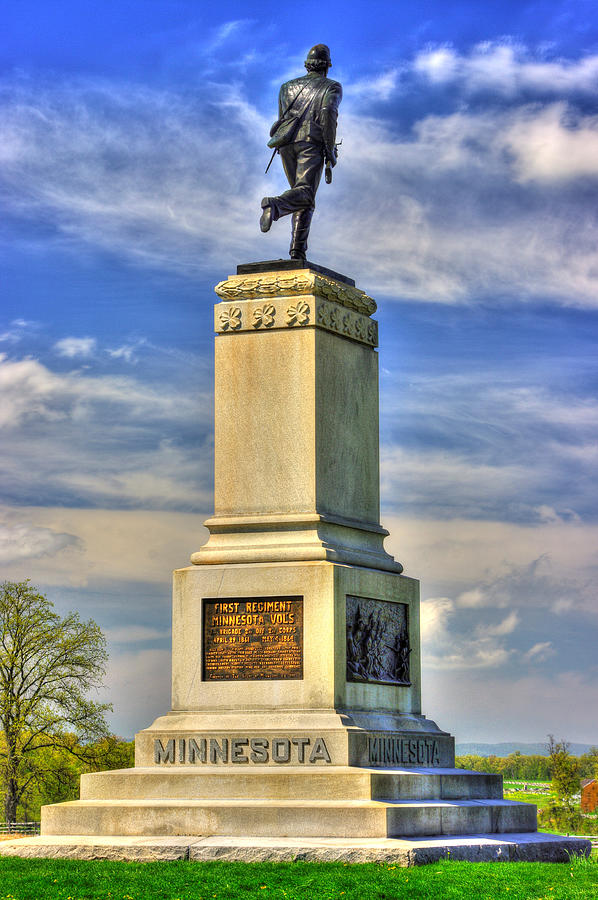
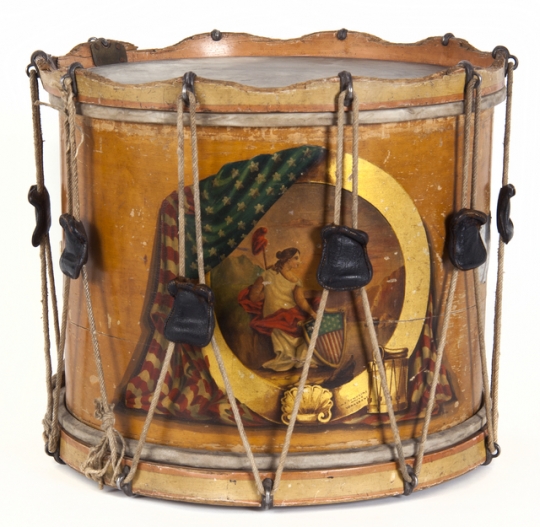
Heroes over a century ago, the men of the First Minnesota Volunteer Infantry remain heroes to this day!  On the Gettysburg battlefield there are three memorials to the northerners ... one is a statue of a soldier running forward that stands at the spot where Colvill's charge began, another is an obelisk marking where Minnesota met the Virginians of Garnett during Pickett's Charge, and there is a memorial urn in the national cemetery on the battlefield that honors the First Minnesota.  And back in Minnesota itself, the souvenirs and trophies of the Civil War include the battle flag Private Sherman captured (with the Minnesota Historical Society despite Virginia's repeated attempts to get it back), the First Minnesota badge Sgt. Chesley Tirrell wears into battle, an officer's hat insignia, and the Minnesota men's battle flag ... along with having a statue in the Minnesota State Capital honoring his deeds, Colonel Colvill has a park named after him in the town of Red Wing, and there is a section of State Highway 19 between the towns of Gaylord and Red Wing named for the First Minnesota's gallant commander.
TCMthoughts – Gettysburg (1993) forgets 1st Minnesota | Tim Russo
Where The Charge Took Place
Minnesota at Gettysburg - Monument to the 1st Infantry Regiment ...
Charge Monument
1st Minnesota Volunteer Infantry Regiment - The Battle of Gettysburg
Where The Men Met
Pickett's Charge
1st Minnesota Volunteer Infantry Regiment - The Battle of Gettysburg
Bronze Bas-Relief On Obelisk
1st Minnesota Volunteer Infantry Regiment - The Battle of Gettysburg
Memorial Urn At Gettysburg National Cemetery
Minnesota has a Confederate symbol — and it is going to keep it ...
Captured Battle Flag
First Minnesota Regiment Civil War snare drum
Snare Drum Of The First Minnesota
Flag of First Minnesota Volunteer Infantry Regiment: The first ...
Battle Flag Of The First Minnesota

First Minnesota Badge Worn By
Sergeant Chesley Billings Tirrell

Colvill

7/2/1863 ... the largest and bloodiest battle to take place on North American soil enters its second day, a second day in which a few men from Minnesota help decide the fate of their nation ... may their sacrifices never be forgotten.
Capitol art: First Minnesota at Gettysburg is a must-keep | Star ...
Charge Painting Detail - Colvill To Right Of
Flag With Arm Raised
Colors of valor : the 28th Virginia Regiment's flag in Minnesota ...
1905 Reunion Parade
1st Minnesota Volunteers 1905 Reunion Badge | Cowan's Auction ...
Reunion Medal With Colvill Badge
Brigadier General William Colvill - U.S. Civil War General Statues ...
Colvill Grave & Statue

Wednesday, July 1, 2020

THE STRANGE DEATH OF CLAY ALLISON

7/1/1887 - In a lonely area of Texas, near where the Pecos River separates Texas from New Mexico, the violent life of cattle broker, rancher, and sometimes gunfighter, Robert Andrew "Clay" Allison, comes to a sudden and abrupt end by way of heavy roll of a wagon wheel.
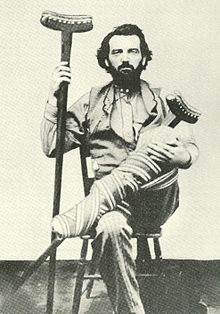
Image result for clay allison
Allison

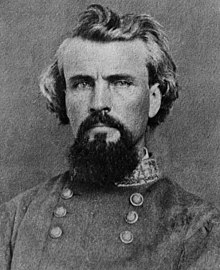
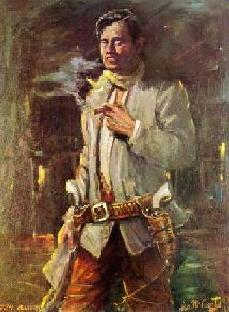
Born near Waynesboro, Tennessee on September 2, 1841 to a Presbyterian minister and farmer, Jeremiah Scotland Allison (he passes away when Clay is only five years old), and his wife, Mariah Ruth Brown Allison, Clay grows up as the fourth of nine children the couple produce.  Just in time for the American Civil War, though he has a club foot, Allison enlists in the service of the Confederate states at the age of 21 on October 15, 1861.  A member of Captain W. H. Jackson's light artillery battery, the youth is discharged though after only three months due to an old head injury that causes him to easily anger, have terrible headaches, and suffer wild mood swings ... both his peers and superiors fear him, because when drink is added to the mix, he can display psychotic behavior in the blink of an eye (while home, Allison will kill a corporal in the Third Illinois Cavalry that tries to loot his mother's home).  Bodies needed by the South, in search of as many violent men as possible, his condition is ignored by the men he next rides beside, the horsemen of the 9th Tennessee Cavalry, led by the man who will become known as the "Wizard of the Saddle," General Nathan Bedford Forrest.  During his time with Forrest's cavalry, Allison participates in the battles of Chickamauga, Fort Pillow, Brice's Cross Roads, Tupelo, Second Memphis, Third Murfreesboro, Nashville, and Wilson's Raid, surviving them all and surrendering with Forrest on May 4, 1865 at Gainesville, Alabama.  Briefly held as a prisoner of war and sentenced to be shot as a spy, Allison escapes after being said to kill one of his guards.  Civil War over, seeking a fresh start, and distance from the rumored killing of a corporeal in the 3rd Illinois Cavalry that comes on to the family farm looking for booty and breaks a vase given by his father to his mother to commemorate the couple's wedding anniversary, Clay and some of his family next take up residence in the Brazos River Country of Texas.  There, the wild tales of his malicious temperament continue. 
Nathan B. Forrest - LOCc.jpg
Forrest
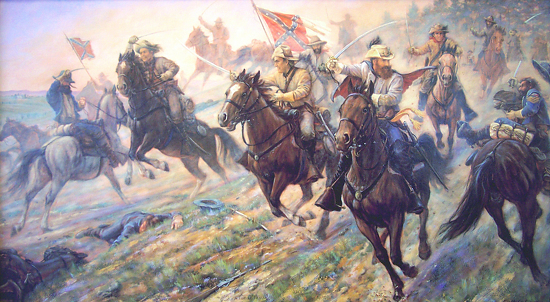
Image result for the battle of brice's crossroads
Brice's Cross Roads

Not agreeing with the price Zachary Colbert is asking to take customers and their freight across the Brazos River, he beats the ferryman unconscious and crosses to the other side for free.  Cowboying for Charles Goodnight, Oliver Loving, M. L. Dalton, Lewis Coleman (Allison's brother-in-law) and Irwin W. Lacey, he rides through portions of Texas (on a return trip to the state in 1878, Allison will lead a group of local citizens in fighting off a Comanche raid), New Mexico, and Colorado, taking time to engage in a fight with a man named Johnson over rights to a water hole ... a fight in which a single grave is dug, the two men jump in, and then go at each other with Bowie knives, with only Allison leaving the hole.   Paid off in product after driving a cattle herd to New Mexico in 1870, Clay and his brothers, Monroe and John, begin their own ranch with a herd of three hundred cattle in 1870 in New Mexico near the junction of the Vermejo and Canadian Rivers.  Moving from cowboy to rancher does not settle down Clay at all, and tales are soon told about the territory of town visits in which he drunkenly shoots out lights and makes individuals he doesn't like "dance"with his six-shooters.  Black heart on display, in 1871 Clay leads a lynch mob that pulls suspected killer Charles Kennedy out of his Elizabethtown jail cell ... he then wraps a rope around the man's neck and rides up and down the town's main street until Kennedy is way beyond being dead ... corpse in tow, Allison then decapitates his victim and stakes the man's head on a fence post.  He is also a menace to himself ... after a successful summer robbery of mules from the command of General Gordon Granger at Fort Union, Allison returns to the scene of the crime in the fall, and in barely getting away, accidentally shoots himself in the foot.  Wound and robbery survived, beyond the clubfoot he already possesses, for the rest of his life he will walk with a pronounced limp.
Image result for clay allison
Allison

Ready for his next bout of drunken mayhem after recovering from his wound, Allison takes a disliking to a local Wilson, but when Wilson quickly makes his presence scarce, Clay finds alternate victims at the County Clerk's office, pinning the clerk, John Lee, to a wall with a flung knife through the man's sleeve, then crossing the street to where Lee has run, and performing the same trick on a young lawyer named Melvin Mills ... like Wilson, both men survive by vanishing from the area.  Hardly a great catch, and yet, in 1873 Allison meets, woes, and marries Dora McCullough from Sedalia, Missouri (his brother meanwhile marries Allison's sister) ... by all accounts of the times, the two love each other madly, and at least when Dora is around, the maniac is a different man (there is a 21-year difference in their ages, 39 to 21, with Allison the older, when the pair marry ... they will have two children, Jeremiah and Mariah)..
Clay Allison
Allison

In 1873, Allison also meets the only man he is unable to out-draw with a gun, Colfax County Deputy Sheriff Mace Bowman.  Friends (as much as Allison can be friends with anyone other than his own family), one evening the men are having drinks at Lambert's Inn when booze addled talk turns to the speed of Wild Bill Hickock's draw is discussed ... with Allison claiming he could outdraw the pistolero, and Bowman laughing, claiming Allison couldn't even outdraw the lawman.  Almost fighting words, the men then make a bet of a gallon of whiskey as to who is the fastest draw and move to the center of the saloon to see who is faster.  Pace off and then draw, when Allison goes for his gun he is shocked to see that Bowman's weapon is already out and pointing at his chest ... game over if Bowman was the homicidal maniac Allison is, instead of a killing, Allison never draws, but he does pay off the bet ... and for a modest fee, then begins taking gun fighting lessons from Bowman (whom he never confronts again).  Or there is the more involved story in which after Allison acknowledges Bowman superiority with a pistol, the men strip and begin dancing in their underwear, then to see who is the better dancer, as if they are bullying dudes from the east coast, fire at each other's feet until they run out of ammo and the night's festivities come to an end.
Shadowlands: May 2015
Bowman

Gun fighting lessons he puts on display in January of 1874 when he meets gunfighter Chunk Colbert.
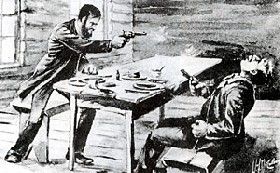
Wanting a new notch on his duelist resume (he is said to have killed seven men in Texas) or seeking revenge for Allison beating up his uncle nine years before when Zachary Colbert was a ferryman on the Brazos River, on January 7, 1874, Colbert shows up in Cimarron, New Mexico and buddies up to Allison ... the men spend the day together drinking and gambling on local horse races, then have dinner together at the Tom Stockton's Clifton House (an inn and a general store on a river crossing near Allison's ranch).  A large meal spread out before the men, Colbert lays his gun on his lap while Allison puts his pistol beside himself on the day.  Meal devoured, Colbert makes his move by suddenly pulling his weapon out from under the table as he reaches for another cup of coffee, but in the process he nicks his weapon on the piece of furniture ... a split-second delay that gives the wary Allison the moment he needs to shoot Colbert fatally in the head.  Asked later why he accepted Colbert's supper invitation if he knew the man was an enemy, Allison responds, "Because I didn't want to send a man to hell on an empty stomach."  It is also believed that two weeks later Allison additionally does away with Colbert's friend, Charles Cooper, who is a witness to the gun fight and is never seen again after being last spotted riding out of Cimarron with the gunfighter (two years later Allison will be charged with Cooper's murder, but will later be released for lack of evidence in the death).
Early day Cimarron, New Mexico
Early Cimarron

The Clifton House
New Mexico Bad Boy – Clay Allison – Legends of America
Allison Vs. Colbert

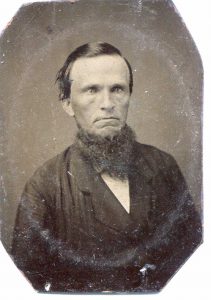
A magnet for trouble, Allison is soon involved in the series of disputes involving the region's Maxwell Land Grant (1.7 million acres) that will come to be called Colfax County War (a clash that will take over 200 lives over the course of the decade) ... and as these things naturally seem to go, he is on the side opposite the power hungry group of corrupt politicians, judges, and lawmen (many of the same men who will provoke the Lincoln County War of Billy the Kid infamy) known as the Santa Fe Ring that includes the lawyer he threw a knife at (now a state legislator) and the doctor that initially treats Allison's leg wound and has patched up Allison victims in the past (now a probate judge).  Also against the "Ring" is Parson Franklin J. Tolby of the Methodist Circuit Riders who delivers sermons throughout the region.  When the 33-year-old Tolby is found shot in the back in September of 1875, Allison is enraged.  Asked to help discover the parson's killer by the man that replaces Tolby, Allison leads a masked mob that grabs and beats the alleged murderer, new Cimarron Constable Cruz Vega, before lynching him from a telegraph pole (Vega denies involvement, but claims that the murder was done by Manuel Cardenas, at the behest of Vega's uncle, Francisco Griego and a mail contractor named Florencio Donaghue ... then, after Vega's hung corpse is taken down, Allison pours more gas on the already ignited situation by refusing to let the constable be buried in the local cemetery (he is unworthy of being buried in the same place as Tolby per Allison) or within the city limits of Cimarron.  Outraged, Griego, Vega's 18-yer-old son, Luis, and Griego's partner, Florencio Donaghue ride into town and begin making threats as to what they will do to the killers of Cruz.  Finding Allison at the town's St. James Hotel, Griego talks to Allison about the death over drinks, which of course eventually leads to Griego pulling his gun while fanning himself with a hat to distract Allison ... who undistracted (the shooting will be ruled self-defense), clears leather quicker and puts three fatal bullets in Griego (a killing which Allison will celebrate by getting drunk, stripping, and on the spot where Griego goes down, performing a war dance with a red ribbon tied around his private parts.
Rev. B. Franklin Tolby
Parson Tolby
Clay Allison Kills Pancho Griego in Lambert's Saloon!!! – Fiction ...
Griego
Clay Allison, 2018 Winter Cover Story – New Legends Magazine
Allison In Action

The situation in the region does not improve when alleged assassin Manuel Cardenas is arrested and questioned by authorities in nearby Elizabethtown ... the Hispanic gunman will claim that Vega killed Tolby on orders from Allison's two long time enemies, the lawyer and the doctor, Melvin Mills and Robert Longwell (the two men flee the area and barely survive lynch mobs looking to mete out a little rope retribution, and will eventually be cleared when Cardenas retracts his statements).  Not believed by many, a vigilante group (most suppose is led by Allison and his brother) shoots Cardenas to death being escorted to the local jail (the true story is that Tolby witnessed Griego shoot a man during an argument, and is killed because he can testify to what he has seen).  And this killing in turn leads to the Mexican-American community in the area seeking payback, hunting Allison.  For a time, the Cimarron gunman will be hidden by Sheriff Orson K. Chittenden on the lawman's nearby ranch, and when in town, Allison is escorted by a group of more than forty armed cowboys (seething about an editorial documenting Allison's depredations on the region, two assistants will help Allison blowing up the office of the News & Press, and throwing the newspaper's press into the Cimarron River.  Finally, Governor Samuel Beach Axtell gets involved, and after Allison is promised a fair trial and gets acquitted of Cooper's murder (the trial takes place in Taos, New Mexico), the area returns to a semblance of normality ... a normality in which Allison can once more be a drunken cowboy maniac! 
Cruz Vega – Fiction and Fact From Old New Mexico
Dr. Longwell
Samuel-Beach-Axtell-1876.jpg
Governor Axtell

No charges pending against him or Hispanic horsemen looking to string him up, Allison decides to celebrate his good fortunes of the moment with his brother John, and so the two men join a raucous dance at the Olympic Dance Hall in Las Animas, Colorado.  Sloshed, the two men ignore a request to check-in their guns, then draw complaints from the assemblage for dancing with unwilling partners, insulting various revelers, and deliberately stepping on the toes of other couples.  Fed up at the drunks, town marshal and deputy sheriff Charles Faber leaves the dance, grabs a shotgun, and then with two freshly recruited deputies, returns to the Olympic to arrest the Allisons.  John out on the floor dancing while Clay imbibes at the bar, Faber steps into the dance hall with his weapon at the ready as someone in the crowd, seeing his weapon, shouts, "Look out!"  Spinning at the warning, John is hit by a blast from Faber's shotgun that hits him in the chest and shoulder.  At the same time, Clay pulls his revolver and sends four bullets Faber's way, one of which hits the lawman in the chest and kills him, though in falling, the shotgun goes off again and now John also has multiple leg wounds.  Immediately recognized they are over-matched, the two deputies flee as Allison empties his guns at the men (and hits nothing but air), then drags Faber's body over to where his brother is bleeding on the floor, assuring John that he has been avenged (John will recover from his wounds, and an arrested Clay will get off once again because witnesses testify that Faber fired first).  Deciding to change the base of his operations, in 1877 Clay sells his ranch and stock to his brother John and moves first to Sedalia, Missouri and then to Hays City, Kansas where he establishes himself as a cattle broker.
Las Animas City become the original county seat – Loveland ...
Las Animas, Colorado
Clay Allison was born on September 2nd 1840. His father w...
Allison Six-Shooter 

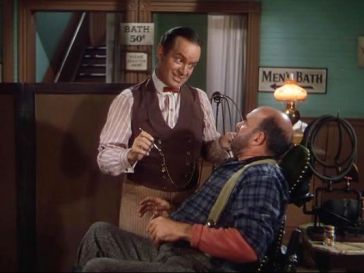
Reputation proceeding him, there are soon tall tales of Allison backing down Dodge City's Wyatt Earp and Bat Masterson when the pair demand that Allison and his cowboys check their guns at the jail while in town and the order is refused, along with rumors that instead, Earp cause Allison to back down.  Whichever the case (another rumor has cattle rancher Dick McNulty and Long Branch Saloon co-owner, Chalk Beeson talking Allison and his men into giving up their guns), Allison moves again in 1880, this time to Hemphill County, Texas, where a new tale of Allison lunacy is soon added to his already large resume ... riding nude down the streets of Mobeetie and screaming about drinks are on him at the local bar, Allison ignores the sheriff's order to get off his horse, takes another ride about town, then at gunpoint, forces the sheriff into the saloon and pours rotgut down the lawmen's throat until the man is too drunk to stand, before remounting his horse and riding out of town.  A human tumbleweed, in 1883 Allison is back in New Mexico, ranching in the state's Seven Rivers region.  And of course, there he creates yet another incident of violence.  Stopping after a long trail ride in Cheyenne, Wyoming to get a terrible toothache fixed, a nervous dentist becomes flustered and starts working on the wrong tooth ... causing Allison a second toothache.  Up and out of his chair in a flash, Allison locates another dentist in town who pulls the right tooth, relieving Allison's pain, but not his rage.  Returning to the first dentist, Allison forces the man into his own chair, then uses a pair of forceps to pull a healthy molar from the man's mouth ... he is just attacking another tooth, when drawn by the dentist's screams, citizens send Allison on his way (a bowdlerized version of the incident will be recreated in the 1948 Bob Hope comedy, The Paleface).
The Paleface (1948) – The Movie Crash Course
The Dentist Scene

One more move before the end, in July of 1887 Clay Allison is in Pecos, Texas, about 50 miles south of the state's border with New Mexico.  Forty-seven years old, Allison skips the usual gunman abrupt leaving of meeting a quicker shootist or becoming the guest at a neck-tie party, and instead accidentally crafts a more fitting ending to the bizarre life he has led.  Drunk as usual, Allison is hauling a load of supplies from Pecos to his ranch when a sack of grain falls off the wagon.  Trying to stop the sack from falling, Allison reaches back but becomes unbalanced and falls to the ground, which causes the wagon's horses to rear and then gallop forward ... carrying the wagon right across Allison's neck, which is instantly snapped, killing the gunman (and almost decapitating Allison).  A violent life ended violently, just not by bullets or rope ... 7/1/1887.
New Mexico Bad Boy – Clay Allison – Legends of America
Clay Allison
Robert Clay Allison | Tombstone, Epitaph, Headstones
Tombstone.  .