Monday, February 17, 2020

THE GREATEST

2/17/1936 - One of the greatest athletes EVER is born in St. Simons Island, Georgia to Swinton (a professional boxer) and Theresa Brown ... James Nathaniel "Jim" Brown.
Image result for jim brown
Brown

After moving to Long Island in New York at the age of eight (where his mother finds work as a domestic), the legend of Brown begins at Manhasset Secondary School, where he earns thirteen Varsity letters for the Indians in the sports of football, lacrosse, baseball (he will throw two no-hitters and be scouted by the Yankees), basketball (he averaged a then record 38 points per game), and track.
Image result for jim brown in high school
Baseball

Recruited to become an Orangeman for the University of Syracuse, Brown plays running back with the Varsity for three years (freshmen are not eligible to play back then) in a college career that has him being a second-team selection to the All-America team as a junior, becoming a consensus first team All-American in his senior year as he leads his team in rushing and scoring in only an eight game season as he averages 6.2 yards a carry, and sets a school record in his last regular season game against Colgate by rushing for 197 yards and scoring 43 points on six touchdowns and seven extra points), gets 132 yards in a one-point Cotton Bowl defeat (on a blocked extra point) to TCU (28-27) in which he gets three touchdowns and three extra points, has his #44 retired, and comes in fifth in the 1956 Heisman Award balloting (behind quarterback Paul Hornung of Notre Dame, running back Johnny Majors of Tennessee, running back Tommy McDonald of Oklahoma, and offensive lineman Jerry Tubbs of Oklahoma), and eventually is inducted into the College Football Hall of Fame (in 1995).
Image result for jim brown at syracuse
Brown

But football isn't the only sport he letters in at Syracuse, excelling again in basketball, track, and lacrosse (though he never goes out for the sport, the school's boxing coach, Roy Simmons Jr.,  believes he could have become the heavyweight champion if he'd pursued becoming a pugilist).  As a sophomore, he is the second highest scoring player (averaging 15 points a game ... picked by some to have a shot at the national championship in his senior year, Brown skips playing for the team in his final year at Syracuse, protesting the college's then rule that only three blacks can start for the team), in 1955 he finishes fifth in the national decathlon championship, as a junior he is named to the second team of the All-American team in lacrosse, and as a senior is a first-team member of the team after scoring 43 goals in ten games (and coming in second in scoring nationally) ... in 1983 he will be inducted into the lacrosse Hall of Fame.
Image result for jim brown basketball
Basketball
Image result for jim brown lacrosse syracuse
Lacrosse

In the 1957 NFL draft, Brown is the sixth pick of the first round (behind Paul Hornung of the Green Bay Packers, Jon Arnett of the Los Angeles Rams, John Brodie of the San Francisco 49ers, Ron Kramer of the Green Bay Packers, and Len Dawson of the Pittsburgh Steelers), the selection of legendary Coach Paul Brown and the Cleveland Browns.  His domination of the running back position from his spot at fullback is immediate and overwhelming.  In the ninth game of his rookie season, in a game against the Los Angles Rams, Brown rushes for 237 yards, setting an NFL game record that will stand for 14 years, and a rookie record that will last for 40 years (and he of course wins the NFL's Rookie of the Year for 1957).  In his second season, Brown breaks the record for rushing in a 12-game season (1,527 yards) that had been set by Steve Van Buren in 1949, wins the MVP award (he will win the award twice more), and leads the league in touchdowns with 17 (besting second place Raymond Beery's 8 tallies). 
Image result for jim brown playing football
Brown

Brown plays in the NFL for nine years before retiring and trying his hand at being an actor (his first seasons the league has each team play 12 games, in his final five seasons the yearly total is upped to 14).  When #32 leaves Cleveland, he has the record for single season (1,863 yards in 1963) and career rushing (12,312 yards), rushing touchdowns (106), total touchdowns (126), and all-purpose yards (15,549), the record for leading the league in all-purpose yards for five different seasons, is the only rusher in NFL history to average 100 yards or more a game, is voted to the Pro Bowl team every year he is in the league, sets the record for most games scoring four touchdowns (6, still the record), leads the league in rushing in eight times, becomes the first player in league history to rush for 10,000 yards, averages 5.2 yards per carry (still the record), is first-team All-Pro eight times (the only year he misses, he is on the second team), and wins a NFL championship in 1964 (and is on two squads that come in second).  The measuring stick for running backs, Brown is consequently a member of the NFL's 1960s All-Decade Team, the NFL's 75th Anniversary All-Time Team, the NFL's 100th Anniversary All-Time Team, has his #32 retired by Cleveland, is selected as the second best player in NFL history (behind Jerry Rice), and is among the twelve players picked at the running back spot for the NFL's most recent 100 All-Time Players.  The greatest running back to play football, then and since ... 6'2" and 232 pounds of muscle, speed, agility, and aggressiveness ... the greatest!
Image result for jim brown playing football

Happy Birthday Mr. Brown!
Image result for jim brown playing football


Monday, February 10, 2020

GALIURO MOUNTAIN GUNSMOKE

2/10/1918 - Modern violence still going strong in Europe to the tune of millions of deaths while WWI enters its final year, Old Wild West gunfight bloodshed breaks out in the rugged Galiuro Mountains of southeast Arizona when lawmen try to arrest a group of miners for evading the military draft of able bodied men the United States government has instituted.
Image result for the galiuro mountains
The Galiuro Mountains

Trying to extract a bit of Arizona's mineral wealth from the area for nine years is the Power family from Texas ... father Jeff, known as "The Old Man" (he is born in 1863), his wife, Martha, Jeff's mother, "Granny Jane" Power, and Jeff's progeny, three sons, Charles, John, and Tom, and a daughter, Ola May, all homesteading south of the settlement of Klondyke, on a patch of land in lower Rattlesnake Canyon (a community of over 300 individuals at the time, the area is now a ghost town of only five souls).  After two years of hard work, the family has "upgraded" to a goat farm Charles buys, which in turn becomes a small cattle "ranch" that will become known as "Power Garden."  Tragedy strikes the family though when Martha is killed when she is crushed by a collapsing cabin roof while visiting a neighbor in 1915 ... and it comes calling again when "Granny Jane" is killed in a run away buggy accident and then 22-year-old Ola May dying "from an unknown cause" (according to the Graham county coroner) on December 6, 1918 (there are rumors of poison, death from badly canned beans, a botched abortion and a broken neck, but no one seems to know for sure why the girl dies).  For good or bad, the men of the Powers Family (less Charles, who moved away to New Mexico) are on their own.
Image result for power's cabin shootout
The Powers Family - L to R - Jeff, Martha, Charles, Ola May, Tom, John

Goats and cattle both losers as viable enterprises for the family, by 1918 the Powers clan (with the assistance of a cowboy friend named Tom Sisson, a former U.S. Army scout) have become miners (made a dry state in 1914, they also dabble in bootleg liquor).  Putting muscle and huge amounts of sweat into the effort of bettering themselves once again, Jeff purchases a quarter interest in an old abandoned gold mine in Keilberg Canyon, the family builds a twenty-five mile road to the mine, and after gaining control of three-quarters of the property, raises a cabin overlooking the mine's entrance (about two hundred yards away from the shaft) and acquire a second-hand stamp mill.  Ready to begin operations in January, trouble instead comes their way when the United States government puts in a claim for the labor of Tom and John.  American fighting in Europe about to begin, by the passage of the Selective Service Act of 1917, all able-bodied men between 21 and 30 are required to register for a military draft ... which the two Power boys do not do, either because they are told they don't have to by a local recruiter, or because their father convinces them that they are needed more personally for the family's mining operations (the maximum sentence for failing to register is one year in jail if found guilty ... a crime over 3,000,000 men will be guilty of during the war).
Image result for kielberg canyon arizona
Keilberg Canyon
Power Cabin.jpg
Power Family Cabin

Believing if they stay away from the authorities nothing will come of their noncompliance with the draft, the men ignore the warning they receive from the local county sheriff, two years in office, 43-year-old Robert Frank McBride (given to the men by the sheriff's proxy, a man named Jay Murdock), to come into town to register, and continue readying the site for ore extraction.  But McBride is as serious as a heart attack in wanting his demands met and instead of ignoring the matter, with the Ola May mystery also in mind, arrest warrants are sworn out for Tom and John Power, and for questioning in the Ola May matter, against Jeff Power and Tom Sisson too (for perjury testifying about Ola May's death), and a compliance posse is formed consisting of McBride, Deputy Marshal Frank Haynes, and sheriff's deputies, 39-year-old Martin Kempton and 36-year-old Thomas K. "Kane" Wootan (heavily active in the area, unlike the Power clan, all four are members of the Mormon Church ... and there are rumors that Wootan had the hots for Ola May).  Leaving Klondyke on February 9, the posse quietly arrive at the mine site after the sun has set, take up positions around the Power cabin and decide to await dawn before making their arrests.  Spending their last peaceful night at the site, inside the cabin are all four of the men the posse are after.
Image result for Sheriff robert frank mcbride
McBride
Image result for Deputy Marshal Frank Haynes
Haynes
Image result for sheriff deputy martin kempton
Kempton
Image result for sheriff deputy martin kempton
Wooton

Unaware of the lawmen outside, just before dawn of Sunday, February 10, 1918, Jeff Power wakes up, gets a fire going in the cabin's fireplace and then starts a second blaze in the structure's wood burning stove.  While he is engaging in readying the cabin for the morning (cold, it will begin snowing shortly after the gunfight concludes), the horses corralled outside begin making noises of agitation, which puts the  men's dogs into a barking frenzy.  Sensing something is wrong outside (he is thinking either a bear or a mountain lion is prowling about), the "Old Man" (he is 55-years-old) grabs his rifle and then steps through the east facing front door of the cabin.  What happened next varies depending on what side is giving its "eyewitness" testimony later.  Per the authorities, Jeff Power is told to "throw up your hands," twice by Wootan ... a request greeted by gunfire from someone within the cabin, but per Tom and John Power (and Sisson who claims to be sleeping when the battle begins and says he never fired a shot), their father is gunned down with no surrender demand given at all.  Whomever started the clash, what is known is that gun chaos in the lightening dark soon follows (there is about a minute delay as everyone wakes up to what has just happened), and with bullets flying all about (at least 25 slugs are exchanged during the minutes long clash), Jeff Power goes down with a mortal wound to his chest, Tom Power receives wounds to the left side of his face after looking out a window for a target, Wooten is shot in the back and killed while running to a new firing position, Kempton is dropped outside the front door with a round to his stomach, wooden splinters wound John Power's eye and nose when a round hits the doorjamb the miner is lying beside, and McBride is killed while positioned at the northeastern corner of the cabin (he is hit by four bullets).  Realizing he is outgunned, Haynes retreats from behind the cabin, reaches the posse's horses, mounts up and rides for Klondyke help as quickly as is possible (so fast and without rest that the horse he is on dies upon reaching the town).  Over in just a few minutes, (most accounts have the encounter lasting between two to four minutes) the gunfight is the deadliest to the time in Arizona history with four men killed (only three men go down at the legendary Gunfight at the O.K. Corral) and leaves nineteen children fatherless.
John Power, left, Tom Power, right
John (L) And Tom (R) Power
Image result for tom sisson
Sisson

The Cabin
Image result for power family gunfight
O.K. Corral Dead

Realizing for the first time (according to the Power Brothers) that the corpses outside are wearing badges, the three survivors make the snap decision to flee retribution and move south into Mexico, taking only their horses, weapons (for which they have 600 rounds of ammunition, chiefly from the posse's supplies), and a few meager supplies ... a decision which causes the biggest manhunt in the Arizona territory to that date.  With posses roaming the state (there are thousands of dollars of reward money available), and three hundred soldiers from El Paso in on the hunt (in all, over 1,000 men will participate in the chase, along with the help of phones, telegraph lines, Apache scouts, pickup trucks, automobiles, bloodhounds, horses, and two airplanes), the men ride out of the area's canyons, gain the San Pedro River Valley, enter the Dragoon Mountains, cross Sulphur Springs Valley to the Chiricahua Mountains, move into New Mexico, and finally, south of the American town of Hachita, move into Mexico ... a winter odyssey over hundreds of miles of rugged wilderness terrain that lasts almost a month.  But even in Mexico, the Power brothers and Sisson are not safe.
Image result for power family gunfight headlines
Headlines
Image result for tom sisson
Reward Poster

Blood up, despite their prey seemingly gaining international sanctuary, a small, unauthorized six-man unit of the 12th U.S. Cavalry, led by Lt. Wolcott P. Hayes continues the chase into Mexico ... more than 20 miles into the country.  Cold, weary, hungry, dehydrated, clothes beginning to disintegrate, still injured from the gunfight (John has maggots in his wound and will lose his eye, Tom will keep his eye but lose sight from the damaged orb), Tom Power convinces his traveling companions that they should surrender.  Stepping out of the scrub brush they are hiding in with arms raised, they so surprise and startle Hayes that he jumps off his horse trying to avoid gunfire that never comes, admitting the fugitives could have killed him with little trouble (asked later why the Power brothers and Sisson didn't, they will state they weren't murderers and wouldn't shot down a "soldier boy").  Brought back to the United States (there is almost another gunfight at the border between the soldiers and Mexican authorities irate at their border being violated), the men are put in the Safford, Arizona jail, but fearing a lynching when the jail is surrounded by an angry mob, moved north to the town of Clifton.  Tried for first degree murder, the men plead self defense (they are defended by local lawyer, James Fielder), but it is their words against the testimony of Haynes, and Haynes is believed (during five days of testimony, Jeff Powers' dying statement to his sons about being shot by Wooton when his hands are up is not allowed, nor is evidence that McBride dies from bullets only one weapon is firing, a rifle belonging to one of the dead posse).  Death penalty eliminated the year before by the new state (Arizona is admitted to the Union on February 14, 1912), a jury takes less than thirty minutes to reach guilty verdicts against all three or the men ... guilty and sentenced to life in prison without the possibility of parole (the wives of the dead lawmen are given the Power mine, which Mrs. McBride eventually running operations on the property for three decades).  Off to their fates, only one of the three men will not leave the state prison at Florence. 
mug shot of Tom Powers
Tom Jefferson Power
mug shot of John Power
John Grant Power

Life in prison ... and yet the men eventually are allowed to participate in the prison's honor system (despite the brothers escaping to Mexico for three months while serving their sentence ... for which they will spend three months in solitary upon returning to the prison), helping milk cows, harvest nearby fields, build roads, and craft spurs and tack for sale (they receive $15 for every $100 they sell ... the state gets the rest), and Tom teaches himself how to read and write.  And they all solely grow old.  Never causing any problems, still a prisoner, Sisson eventually dies at the age of 87 in 1957.  The brothers, however, live long enough that their cause is taken up by Arizona Republic journalist Don Dedra,  After decades behind bars, at a 1960 hearing in which Morman hatred for the men is changed into Mormon forgiveness (three Morman bishops ask that clemency be granted the men, and Morman elder, a man in his 70s, orates in favor of releasing the brothers), Tom and John Power are both released from prison.  Old men released into a modern world, highlights of the Power freedom include taking care of the goats and horses at a children's summer camp outside of Prescott, Arizona, a visit to Disneyland by Tom, and a 1970 full pardon from Arizona Governor John "Jack" Richard Williams in 1970 (an act that they respond to be immediately registering to vote).  Tom dies in 1970 in San Francisco, California a the age of 77.  His brother John, passes at the age of 85 in 1976 while living in Arizona's Aravaipa Valley.
two men sitting on bed
Tom And John Just Before Their Release
Jack Williams (Arizona politician).jpg
Williams

And least anyone forget the bloody morning in Arizona history from so long ago, in 1975 the Power Cabin is placed on the National Register of Historic Places ... and in the Klondyke cemetery where "Old Man" Jeff Power is buried, the long dead miner's tombstone reads, "Shot down with his hands up in his own door."
Image result for power family gunfight
The Historic Site
           

Monday, January 27, 2020

HELL ON EARTH - LENINGRAD

1/27/1944 - Barbarity on an epic level, the monstrous human tragedy known as the Siege of Lenningrad finally comes to a end, two years, four months, two weeks, and five days after it begun on September 8, 1941 ... sadly, 3,436,066 Soviets will become casualties (1,017,881 are killed, captured, or go missing) before the Axis blockade is broken (additional to Soviet losses, 579,985 German soldiers also become casualties during the many battles around the city's perimeter).

Soviet Ski Troops At The Hermitage Museum

The city of Lenningrad begins its existence as a fort for Swedish colonists at the mouth of the Neva River in 1611 and is called Nyenskans.  Seeking a better seaport for expansion of his empire, Peter Alexeyevich, now known to history as the Russian Czar, Peter the Great, the city is captured by the Czar on May 12, 1703 and the "new" city of Saint Petersburg is built by conscripted peasant serfs and Swedish prisoners of war in an effort that kills thousands of workers.  In 1712, Peter moves his capital from Moscow to the rapidly growing city.  Capital returned to Moscow following Peter's death in 1725, the city is made the center of the Russian Empire once more by Empress Anna in 1732, and will remain the seat of the Romanov dynasty, Imperial Court, and the Russian government for the next 186 years (in 1914 though, the city briefly becomes known as Petrograd).  In November of 1917, when the Bolshevik revolution comes to Russia (in the form of Vladimir Lenin and his followers), it begins with the storming.of Petrograd's Winter Palace.  Revolution and the war that follows successful (and Moscow back as the capital), five days after Lenin dies on January 26, 1924, the city is rechristened, Leningrad.  In 1941, the location is famous for its history and wealth of cultural delights (the Hermitage is one of the largest museums in the entire world), and is home to over three million souls.  As main base of the Soviet Baltic fleet and the source of 11% of all Soviet industrial output, it is also one of three strategic goals for the Third Reich's Operation Barbarossa, Nazi Germany's invasion and conquest of Russia.

St. Petersburg

Allies at first when there is Polish territory to divide and conquer, turning away from efforts to knock Great Britain out of the World War II, on June 22, 1941, Nazi forces make the mistake of beginning a two-front war with their surprise invasion of Russia by over three million soldiers.  As part of the invasion plan, the conquest of Leningrad (and its destruction, Hitler has plans to raze the city to the ground) is assigned to the Wehrmact's Army Group North, commanded by Field Marshal Wilhelm Ritter von Leeb (supported by elements of the Finnish Army, seeking payback for territories lost in the three month Russo-Finnish War that ends on March 13, 1940).  Gobbling up men, equipment, and territory, the efforts of Army Group North are extremely successful at first, but when Hitler moves the wing's 4th Panzer Group south prematurely to help in the campaign to take Moscow, plans to conquer Leningrad change from an open push through the city, to ones in which siege warfare will cause the former capital to fall, with starvation being the German's principal weapon (it is at first believed that it will only take a few weeks).  On September 8, 1941, the city is officially encircled, cut off from supplies, and begins starving.
Anti aircraft Leningrad 1941.JPG
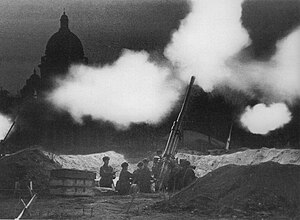
1941 Air Raid On The City

Ordeal begun with disruptions of water and energy utilities, death comes to the citizens of Leningrad by aerial bombardment, artillery shells, soldier bullets, exposure to winter (the temperatures during winter will drop to -22 fahrenheit), disease, starvation, and even residents murdering each other (killing for ration cards, with some cannibalism also occurring) in a quest to merely survive another day ... days that become weeks, weeks that become months, and months that become years as the slaughter goes on.  Young, old, middle-aged, man or women, no one within Leningrad's defensive perimeter is spared the siege's horrors (from November of 1941 to February of 1942, citizens will receive an allotment of only 125 grams of bread a day, bread that is 60% composed of sawdust and other inedible additives).  Reached by only a trickle of supplies that move across frozen Lake Ladoga in the winter (the dangerous route will be called The Ice Road and The Road of Life), the economic destruction and loss in human lives (people die on the streets and there are bodies everywhere as over 100,000 a month begin perishing) will exceed what takes place at the Battle of Stalingrad, the Battle of Moscow, and the fire bombing of Tokyo (historian Michael Walzer will declare that the siege kills more civilians than the deadly bombings of Hamburg, Dresden, Hiroshima, and Nagasaki combined), and will be considered the most lethal siege in history, and by some historians, no siege at all, but just an outright act of genocide.
Image result for leningrad dead
Searching For Food
Image result for leningrad dead
Another Day
Image result for leningrad starvation dead
And Another
Image result for leningrad starvation dead
Young Victim
Image result for starving in leningrad
Slowing Starving

Death everywhere, it is no different on the perimeter of Leningrad than within the city as German forces battle with Soviet troops over encirclement.  In August of 1942, Soviet troops launch Operation Sinyavino to relieve the city, but that offensive fails by October (at a cost of 113,674 casualties).  More successful, but inadequate to supply the total needs of the city, Operation Iskra, set in motion in January of 1943, opens up a small land corridor (between six and seven miles wide that remains within range of German artillery) to the south of Lake Ladoga into the besieged location (its cost are another 100,000 casualties).  Tide finally turned with German defeats at Stalingrad and Kursk in 1943, another offensive of over 800,000 Soviet soldiers to break the siege begins on January 14, 1944.  A success (at a cost of another 300,000 Russian casualties that also push German forces back from Moscow), troops liberate enough of the southern section of Leningrad to allow supplies to be received once more from the Moscow-Leningrad Railroad line.  Soviet dictator, Joseph Stalin, declares the siege officially lifted on January 27, 1944 ... a terrible victory that is celebrated by a 324-gun salute by Katyusha rocket launchers and artillery pieces at 8:00 in the evening.

Attacking Soviets

Gathering Water From A City Shell Hole
Image result for leningrad victory celebration
Broken Siege 

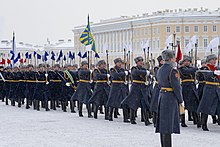
Bloodbath finally ending, the city almost immediately begins rebuilding itself (Stalin will name Leningrad a "hero city" on May 1, 1945) ... repairing damaged buildings and making new monuments and museums to the victory of its citizens.  Renamed Saint Petersburg by a vote of its citizens on September 6, 1991, the city and region at the head of the Gulf of Finland on the Baltic Sea is now Russia's second largest city (behind Moscow) and home to over five million citizens, along with being the home to the Constitutional Court of Russia, the Heraldic Council of the President of the Russian Federation, the National Library of Russia, and the planned location of the Supreme Court of the Russian Federation.  It contains the Lakhta Center, the tallest building in Europe, and in 1991 is declared a World Heritage Site by UNESCO ... but it has never forgotten its WWII ordeal, and how could it when every January 27th, the lifting of the siege is celebrated by a military parade, featuring troops of the Western Military District and the St. Petersburg Garrison, historical reenactors, WWII equipment such as T-34 tanks, wartime flags and banners, and martial music, at the city's famous Palace Square.

Lakhta Center

St. Petersburg

Winter At Palace Square

Hero City Obelisk

Defenders Monument In Victory Square

2019 Celebration 

1/27/1944 ... the siege of Lennigrad is lifted.
Image result for leningrad victory celebration
Siege