Thursday, November 7, 2019

DYNAMITE DICK IS DONE IN

11/7/1897 - Picked off one by one by law enforcement after shooting up the streets of Ingalls, Oklahoma in 1893, another member of the Doolin-Dalton Gang (also known as the Wild Bunch and the Oklahombres) is blasted into eternity near Checotah, Oklahoma ... this time the Swiss-cheesed desperado is Charles Daniel "Dynamite Dick" Clifton.
Image result for dynamite dick clifton
Clifton

Left without a gang to be a part of after the Daltons are wiped out trying to rob two Coffeyville, Kansas banks on 10/5/1892, Bill Doolin puts together a new band of killer cowboys that will include Clifton (the band's co-leader is Bill Dalton).  His early years mostly a mystery (it is believed he is born in Texas around 1865), by 1892 Clifton has a criminal resume that includes cattle rustling around Pauls Valley in the Chickasaw Nation, the town of Ardmore, and along Oklahoma's border with Texas, safe cracking, and whiskey peddling, and surviving an Osage gunfight with U.S. Deputy Marshal Lafayette "Lafe" Shadley that leaves the outlaw with a permanent scar the size of a silver half-dollar where one of the lawman's wounding bullets needs to be cut out of his neck.  His moniker of "Dynamite Dick" is said to come from his explosive temper, or from blowing himself out of a train trying to break into a safe, or his younger days as a miner, or from his penchant for modifying his bullets into explosive rounds.  And or is also attached to the identifying characteristic of having three fingers blown off his right hand, or is it his left, and do the digits leave in a childhood accident, or leave thanks to a safe cracking error, or do lawmen blow them off during the 1893 Battle of Ingalls in which U.S. Deputy Marshals Thomas Hueston, Richard Speed, and Lafayette Shadley are all killed.
Image result for dead daltons
Dead Outlaws - L-to-R - Bill Powers, Bob
Dalton, Grat Dalton, Dick Broadwell
Image result for bill doolin
Doolin
Image result for lafe shadley   
Shadley

Quite the coming-out party, Clifton's first gun moment with the Doolin-Dalton Gang is the Battle of Ingalls (about fifty-four miles west of Tulsa, Oklahoma).  Drinking and playing poker with other members of the gang in Ransom's Saloon, Clifton is as surprised as any of the other outlaws when the quiet of the morning is broken by lawman bullets being fired at Bittercreek Newcomb.  Gun out and firing back at the lawmen positioned about the town (there are thirteen before the deaths begin), Saloon beginning to be shot to pieces, Clifton, along with Tulsa Jack Blake, provides cover fire for Doolin, Bill Dalton, and Red Buck Waightman as the outlaws run to the nearby barn where their horses are stabled, then with their covering fire, moves there himself with Tulsa Jack.  Horse bridled, though wounded in the hand, with Doolin, Clifton mounts up and spurs his horse out of the barn's back door (the three remaining bandits charge out the front door), dashes down a draw to the southwest, and quickly vacates the town, eventually arriving at the town of Alfred.  Wanted for murder like the rest of the boys, Dynamite Dick is now a full fledged member of the outlaw gang.
Image result for the battle of ingalls
Barn Dash

Wounds somewhat healed, and in need of cash, Doolin and Clifton next rob a businessman named Mr. Higginbotham in the town Blackwell on November 16, 1893 ... the robbery is problematic though as the man has only two dollars on him, and not wanting to clean him out, Doolin gives him one of his dollars back.  Attempting a much more respectable haul, on May 20, 1895, at 3:00 in the afternoon, the gang robs the Southwest City Bank of Southwest City, relieving the financial institution  of $3,700, but the ill gotten proceeds are not won easily.  Slugs flying about as the bandits leave the bank, Oscar Seaborn is wounded, while the same bullet kills his brother, former Missouri State Senator J. C. Seaborn, standing in Baker's saloon, M. V. Hembre is struck in the ankle by a bullet and loses his foot, U.S. Deputy Marshal Simpson Melton is shot in the leg, Doolin is bloodily wounded in the left temple, and three outlaw horses are hit (about a hundred shots are fired during the holdup).  Hiding out in a dugout at the "Rock Fort" of the Dunn Brothers, Clifton is one of eight gunmen that don't kill U.S. Deputy Marshal William Tilghman when the lawman shows up at the hideout alone (Doolin is suppose to have said, "Bill Tilghman is too good a man to shoot in the back.").
Image result for dynamite dick
Dynamite Dick

Next on the gang's dance card is the robbery of the Rock Island Railroad at the town of Dover.  Engineer and fireman covered by Clifton and Little Dick West, a robbery that is said to net the Doolin Gang (by 1895, Bill Dalton has been killed by a posse) $35,000, but puts U.S. Deputy Marshal Chris Madsen on their trail, an eventuality that will result in the death of Texas Jack when the fleeing outlaws are found by the lawman's posse (after a pitched battle of almost an hour in which over 200 rounds are exchanged, the gang is able to escape without further damage).  Using Texas Jack's sacrifice, Doolin, Little Dick West, and Clifton take up cowboying for awhile at the Rhodes Ranch in the San Andres Mountains of New Mexico, and Dynamite Dick also hides in the Arizona camp of a couple of Mexican sheepherders ... until they have a spat and the outlaw kills both men and heads back to Oklahoma.
Tulsa Jacks body.jpg
Texas Jake Trophy Shot

Back in Oklahoma, Clifton is instantly once more a target of law enforcement, and he doesn't help matters by being arrested by two Federal marshals on bringing illegal whiskey into the territory as a crook named Dan Wiley.  Tip received Wiley is actually Clifton, U.S. Deputy Marshal Frank Canton rides to Paris, Texas, correctly identifies Wiley as Dynamite Dick, then takes charge of the prisoner and returns him to Guthrie, Oklahoma to stand charges for murder.  There is a problem though, in taking Clifton to Guthrie, Canton has reunited Dynamite Dick with Bill Doolin, also in the local jail after being arrested by U.S. Deputy Marshal Bill Tilghman in a Eureka Springs, Arkansas bathhouse.  Bad news to have the outlaws together, the men soon come up with a plan to escape which they launch on the evening of July 5, 1896.  Using the way water is distributed to the prisoners inside their cells and the gun of night guard J. W. Miller, Doolin, Clifton, and twelve other bad eggs take control of the jail (it is about 9:00 in the evening), slip down the structure's steel stairs, and vacate the premises, with Doolin and Clifton (for awhile they are accompanied by a hatchet holding counterfeiter named Bill Jones) highjacking a buggy from Alva W. Koontz (a county clerk) and Miss Winifred Warner (a local schoolteacher) as they make their way north and east out of town.  Despite the search for the fugitives being the biggest manhunt in the history of the territory, the desperadoes gain tobacco, whiskey, and $50 by robbing a bar in the town of Morrison (when the bartender at the establishment protests, Doolin shoots off the man's ear), before making their way to an old hideout about twelve miles west of Ingalls on the north side of the Cimarron River, where they once more hook up with Little Dick West.  Free, but not for long, returning from a night visit with his wife, Doolin is killed on August 24, 1896, by a posse led by U.S. Deputy Marshal Heck Thomas.
Image result for lawman frank canton
Canton
Image result for dead bill doolin
Doolin   

Leaderless, West and Clifton foolishly continue operating in Oklahoma, with Dynamite Dick almost cashing in his chips when he and two other outlaws are found camped in a ravine twenty miles west of Sapulpa, Oklahoma by a Heck Thomas posse but mange to shoot their way out of danger.  Use to being members of a gang (there is now a $3,500 reward, dead or alive, for Clifton), West and Clifton  hook up with the Jennings Gang, consisting of novice bandits Al and Frank Jennings, and Morris and Pat O'Malley.  Hoping for more major robberies, the Doolin alumnists are sadly disappointed at the chump change they lift from The Corner Saloon of Pottawatomie County, and their failed train robbery outside of Edmond in which they are unable to blow open the Wells Fargo safe holding the cash they want ... twice.
Image result for al jennings
Al Jennings

The end of the trail finally comes for Clifton on a Sunday in November.  Under the direction of Chris Madsen, U.S. Deputy Marshals George Lawson and W. H. Bussey locate the refuge of Dynamite Dick on the Sid Williams farm near Checotah.  Surprising the outlaw on the trail, the marshals call for Clifton's surrender, the outlaw refuses and goes for his guns, and the lawmen open fire, with a round from Lawson's rifle breaking the outlaw's arm and knocking him out of the saddle ... where he escapes on foot into the brush.  But not for long!  Tracking the outlaw, the lawmen discover Clifton in a remote, forest sheltered cabin.  Cornered, just as night is beginning to fall, Dynamite Dick bursts out of the door of the cabin, firing as best he can at his opponents with his one good arm ... which is not good enough.  Ready for the request surrender to be refused again, the officers gun down the bandit before he can make it back into the woods and Clifton dies a few minutes later.Image result for the death of dynamite dick clifton
The End Of Dynamite Dick Clifton

Sunday, November 3, 2019

THE VIOLENT DEMISE OF NEDE WADE

11/3/1892 - Whether he was a hero to the Cherokee people, or a maniacal Indian outlaw, or some variation between the two positions, the life of NeDe WaDe, better known since to Wild West historians as Ned Christie, comes to a abrupt and violent end near Tahlequah, Oklahoma, when dynamite and fire chase him out of his fortified home and he confronts a posse of sixteen to twenty-five lawmen and enemies.
Image result for ned christie
Christie

On December 14, 1852, Christie begins life in Wauhillau, Going Snake District of the Cherokee Nation in what will one day be the state of Oklahoma.  He is the son of Trail of Tears survivors (the government forced removal of Native Americans from ancestral homelands in Georgia and North Carolina ... in the movement out to Indian Territory of Oklahoma, over 4,000 Cherokees will lose their lives, among them, Christie's Irish grandmother), Watt (he will become a Civil war veteran, fighting for the Union) and Lydia Thrower Christie, members of the tribe's most traditional band, the Keetowah (which translates into English as "the real people").  Growing up in a family of loving parents and siblings, Christie learns the blacksmithing trade from his father, along with his dad's abilities with firearms, becoming a crack shot, many feel the best in the entire Cherokee Nation, by the time he is ten.  As a youth, he is also a marble champion, a popular local fiddle player, a well regarded stick ball player, and learns to speak English fluently.  Growing into a handsome man of 6'4", he is well regarded within his community, and in 1885, follows in the footsteps of his brothers and father, and is elected to represent the Going Snake District in the Cherokee National Council (he will serve as one of three advisers of Chief Dennis Wolf Bushyhead).  Only his hot temper, especially after drinking, gives anyone any qualms (he is brought to trial in 1884 for the liquor-related murder of William Palone, but declared not guilty of the killing).  Sadly, he has been drinking a lot on Easter of 1887, April 10th.
Image result for ned christie
Christie And His Half-Brother, Jim

Bushyhead

Living in Rabbit Trap with his third wife, Nancy, and his son, 13-year-old James from a previous marriage, as a member of the Executive Council, on Sunday, Christie finds himself in Tahlequah, the Cherokee Nation's capital for an emergency session of the legislature to see what can be done to rebuild the recently fire destroyed Cherokee Female Seminary.  As usual when in town, he stays at the home of one of his wife's relatives, Senator Ned Grease, and also in habit. after completing the demands of his office, with a friend named John Parris (a half blood troublemaker known for selling illegal whiskey), goes out seeking liquid refreshments, booze the men find in the Dog Town northern end of town, at the home of Nancy Old Lady Shell, bought from whiskey runner, Thomas Bub Trainor, Jr.  Imbibing massive amounts of hooch (the pair meet up with friends, John Hogshooter, George Paris, and Charley Bobtail), Christie for the rest of his life will claim to spend the rest of the night passed out cold in a clump of bushes (a tale that will be verified years later, in 1918, by traumatized witness, Dick Humphreys).  Unfortunately though, someone is awake, and that person murders 41-year-old U.S. Deputy Marshal Daniel Maples when he goes into Dog Town that night looking for whiskey runners (he has arrest warrants for both Parris and Trainor), shot in the chest while crossing a log footbridge.  Waking the next morning, Christie is stunned to discover he is a suspect in the death of the lawman, and after attending to his duties with the National Council, he takes the advice of his father and Senator Grease, and flees back to his home in Rabbit Trap, very aware that it is a death sentence for an Indian to kill a white man (writing to the authority for the region, Jude Isaac C. Parker, the infamous "Hanging Judge" of Fort Smith, Arkansas, Christie offers to surrender if he will be granted bail to prove his innocence in the death of Maples, but his request is denied by the judge).  Warning system in place of friends and relatives, he hides from authorities, eventually losing his position on the National Council and his blacksmith business, and needing funds, begins bootlegging whiskey, transformed into the criminal he wasn't, warning all that will listen that he will not be taken into custody without a fight.  What follows will be known in Oklahoma's history as Ned Christie's War.     
Image result for ned christie's fort
Daniel Maples
Image result for judge isaac parker
Parker

The first attempt to arrest Christie takes place in 1885 when Deputy Joe Bowers is sent on his way with a bullet in his leg, the next try is by Deputy John Fields, who leaves the property with a Winchester slug (Christie's weapon of choice is an always chambered 1873 Winchester rifle that firs .44/40 bullets) in his neck (he survives), and then, in 1886, a group of lawmen attack and are chased away when three of them are wounded approaching the Cherokee's cabin.  Tired of the situation, in 1889, newly appointed U.S. Marshal Jacob "Blake Jake" Yoes orders U.S. Deputy Marshal Henry Andrew "Heck" Thomas (in his storied career as a lawman, Thomas will engage in an 1878 shootout with the Sam Bass Gang as they try to rob a train in Texas, death best killers Pink and Jim Lee with his Winchester, get shot bringing moonshiner Aaron Purdy to justice (\<knocked off his horse, the crook is killed by the rest of Heck's posse>, quick-draw robber Jim July to death in 1890, dog the Dalton Gang into their disastrous Coffeyville retirement try, be part of the team that kills Doolin Gang member Ol Yantis on the farm of the bandit's sister <he is accompanied by U.S. deputy Marshals Chris Madsen and Tom Houston>, with his Winchester, shatters the hand of Doolin Gang member Little Bill Raidler <brought in later by U.S. Deputy Marshal Bill Tilghman>, gets into a gun battle with Doolin Gang member, Dynamite Dan Clifton, that forces the outlaw out of Oklahoma, and leads the group of men that turn Bill Doolin into a bleeding piece of Swiss Cheese as the outlaw is leaving the home of his father-in-law outside of Lawson, Oklahoma in 1896) to bring in Christie (by this time, there is a $500 reward for the Indian's arrest).  On a late September morning, led to Christie's home by Bub Trainor himself, Thomas, U.S. Deputy Marshals L. P. Isbel and David Rusk, along with an officer named Salmon, creep up on the location, but are noticed by the sleeping man's watchdogs.  Alerted by the howling the dogs produce, Christie opens fire on the posse (after uttering the turkey gobble he has stated he will use before aiming in earnest at his opponents), who respond in kind, while also setting the out building where the Indian plies his trade as a blacksmith on fire, a fire that eventually jumps to the main cabin.  Gun fire and smoke, Christie's wife is allowed to vacate her home, but James is shot in the back climbing a fence to escape the conflagration (he will survive his wound), lawman Isbel takes a round in his shoulder, and Christie is hit with a round that smashes his nose and blinds him in the left eye.  Thought dead when gunfire from the house ceases, the posse rides away, seeking help for Isbel, and unknowingly allows the Cherokee renegade to escape when Nancy Christie and other friends pull Ned out of the burning building.
Image result for jacob yoes
Yoes
Heck-Thomas-c1900.jpg
Thomas

Hidden in the woods by friends, recovered from his wounds, seeing his son shot and his home burnt to the ground, Christie moves into a virtually impregnable rock fortress on a hilltop (it will soon be known in the region as Ned's Fort Mountain) about a mile to the west ... a cliff structure with two-log thick walls, augmented with cushioning sand and lined by Oak two-by-fours, with a loft for improved shooting at enemies (along with fields of fire denuded of trees), that is fully stocked with food, water, and plenty of ammunition.  Weeks later, when another Thomas posse returns, the lawman sees what he is up against and decides it might be more conducive to his health if he withdraws from the area and concentrates on bringing down the Dalton Gang (returned to civilization, the lawman will state that it would take a fully armed regiment to remove Christie from his new home).  Other lawmen however are not as wise as Thomas (emboldened perhaps by the reward on Christie's head being raised to $1,000).  Blamed for almost every crime that takes place in the region (there are rumors he has murder eleven men), in November of 1890, Christie is next confronted by legendary African-American lawman, Bass Reeves and his posse ... another failure that leaves two more men wounded.

Reeves.

Christie

Next up to have a go at Christie is U.S. Deputy Marshal David Rusk, a member of the Heck Thomas attempt to bring in the Cherokee warrior.  In 1892, with Yoes emphatic about not letting Christie get away, Rusk, five other deputies, and a small group of Indians attack the fort, with the same kind of results that previous posses have had ... no Christie and four more wounded men.  Not dissuaded despite the setback, one at least two more occasions, Rusk sneaks back into the area alone and tries to ambush Christie, with each attempt ending with rifle fire from the Indian marksman sending him on his war.  Any thought about a third attempt on Rusk's part is only increased when Christie, knowing the name of his antagonist, slips away from the stronghold, slips in to the town of Oaks, to the north of Tahlequah, and burns Rusk's general store to the ground (though not in charge, Rusk will be in on the final assault on Christie's fort).  Undaunted, another group of lawmen go after Christie in October, a group that includes Charley Copeland, Milo Creekmore, and D. C. Dye ... their try ends with two officers wounded, a wagon filled with flaming brush meant for the cabin instead setting fire to an outhouse on the property, and lit sticks of dynamite bouncing off the walls of the fort and detonating harmlessly causes the posse to leave in disgust.
Image result for winchester 1873 .44/40
Winchester 1873 

Like Lincoln looking for the right Northern general to win the American Civil War, Yoes next puts together a battle plan that will include his marshals, led by U.S. Deputy Marshals Gideon "Cap" White and Paden Tolbert, and a group of local lawmen, including Dan Maples' son, Sam, all under the direction of bounty hunter Gus York.  Plan simple for the twenty-five men involved, one group of men will establish a perimeter around the fort to keep Christie's friends away, while the other group will attack the fort using pistols, rifles, dynamite, and a borrowed cannon that fires three pound bullet shaped balls.  The posse pierces the Cherokee Nation in darkness, and by 4:00 in the morning of the next day, has taken up positions around the fort; sleeping inside, unaware of what awaits them at first light (the dogs that warn Ned of previous posses are off hunting with Christie's son) are Christie, his wife Nancy, his daughter Mary, his granddaughter Charlotte, Charles Hare, a young full-blood Cherokee new to the area, 7-year-old Charles Grease, Nancy's nephew, and an Indian fugitive named Little Arch Wolf. 
Image result for ned's fort oklahoma
Some Of The Posse - After

Players in place, the battle of Christie's fort begins in the early dawn of 11/2 when Wolf ventures outside for some water and is immediately called on to surrender.  Refusing the order, Wolf fires at the voices in the brush as he runs back to the cabin, making it despite being wounded in the leg, arm, and head.  After Christie's notorious gobbling, the battle is on.  Bullets exchanged, in a pause in the action, Nancy, Mary, and Charlotte are all allowed to leave, but for some reason Grease stays behind in the root cellar.  Frustrated by the bullet battle (Christie is asked again to surrender, in Cherokee, by full-blood local, Sheriff Benjamin Knight ... in response, the renegade laughs at the lawmen), at about 1:00 in the afternoon the cannon is brought into play.  Set up on an oak stump across a creek and out of range of Christe's rifle, thirty-eight balls are sent at the fort with little effect (the balls bounce off the structure's stout walls), so it is decided to increase the weapon's powder charge ... a mistake that blows the cannon apart with its next firing.  Last chance improvising, the lawmen discover the remains of the wagon that burnt the outhouse down and jury-rig the remains into a barricade that allows Charley Copeland, when the moon goes down in the evening to place a grouping of six dynamite sticks against the south wall of the fort (by this time, family and friends of Christie have gathered in a hollow below the fort, watched the entire time by armed and ready members of the posse ... there are no disturbances from the group other than a couple of half-hearted attempts to get more ammunition up to the fort). 
Image result for ned's fort oklahoma
More Posse - Back Row L-to-R - Tom Johnson, Bill Smith, John Tolbit, Abe Allen, and Wes Bowman - Front Row L-to-R - Gideon White, Charley Copeland, Paden Tolbert, Heck Bruner, and David Rusk

Surrender requested and refused once more, in the morning of 11/3 the charge is lit.  Big boom created as hoped (it is said it can be heard in Tahlequah), the consequent explosion takes out a wall and corner of the fort, and sets the entire structure on fire.  Retreating to the root cellar, Wolf's hair catches on fire (he will lose all of it) and burning timbers strike Hare as the place comes apart ... and both men flee the structure (arrested, they will both spend time in jail for resisting arrest and attempted murder, with Wolf eventually ending up in an insane asylum).  Grease already dead in the root cellar, Christie is the last to leave, trying to slip away in the chaos and smoke ... and he almost makes it.  Running through the thick smoke, he suddenly comes face-to-face with Wes Bowman ... snapping off a shot, Christie barely misses the lawman (he does succeed in giving Bowman a powder burn on his face that he will wear the rest of his life).  Spinning, Bowman gets off a shot of his own that hits the tall 39-year-old Indian behind the ear, killing him instantly ... the war is over, but the victors have some final indignities to put the Cherokee to anyway.  Running up to where Christie lays, young Sam Maples empties his pistol into the corpse, then, the posse lashes Ned to his own front door and takes their trophy to Fayetteville, Arkansas (where his killers are photographed with their prize and postcards for sale are created), then on to Fort Smith (Judge Parker will personally congratulate each member of the posse) for the reward money (the $1,000 is given to bounty hunter Gus York, but after paying for expenses and divvying up the bounty, he makes only $74 for the kill).
Image result for ned christie's death
Posing With Ned

Body eventually returned to his family, Christie is interred at the Watt Christie Cemetery in Wauhillau, Oklahoma.  And as these things go, his life and death soon turn him into a Wild West legend, suitable for magazines, books (Lonesome Dove author Larry McMurty will tell his tale in his novel, Zeke and Ned), television, and movies ... and in Tahlequah, Oklahoma, at the Cherokee Court House, the oldest public building in the state, a memorial plaque on the wall of the structure simply notes, "... assassinated by U.S. Marshals in 1892."  A hero to the Cherokee people now, rest in peace Ned!
Image result for ned christie grave
Final Resting Place


Monday, October 21, 2019

TRAFALGAR

10/21/1805 - Ending the threat of England's invasion by Napoleon's Grand Army, in the Atlantic Ocean off the southwest coast of Spain, just west of Cape Trafalgar, near the coastal town of Los Canos de Meca, the epic naval clash, The Battle of Trafalgar was fought this day.  
Joseph Mallord William Turner 027.jpg
Victory By J. M. W. Turner

Twenty-seven British ships-of-the line commanded by one-armed Admiral Horatio Nelson (he loses his right arm in the Canary Islands at the Battle of Santa Cruz de Tenerife in 1797), aboard his 104-gun flagship, HMS Victory, against a Spanish and French fleet consisting of thirty-three vessels led by Admiral Pierre-Charles-Jean-Baptise-Silvestre de Villeneuve (he is assisted by Admiral Federico Carlos Gravina y Napoli, the senior Spanish flag officer), aboard his 80-gun flagship, Bucentaure.  The battle for naval supremacy will be a clash of 30,000 men and 2,568 French and Spanish guns against Nelson's 17,000 men and 2,148 guns.  
HoratioNelson1.jpg
Nelson
Amiraldevilleneuve.jpg
Villeneuve
FedericoGravinaYNápoliAnónimoHacia1810.jpg
Gravina

Seeking a conclusive triumph over his enemies (who sail out of Cadiz, seeking to move the fleet's operations to Naples, Italy), Nelson relates his unorthodox battle plan to his captains over two October dinners aboard HMS Victory ... instead of attacking in a line parallel to the Spanish and French, the British will seek to cut the enemy fleet into three pieces by sending two columns of ships into the battle line on a perpendicular course (the second column is under the command of Nelson's second, Vice-Admiral Cuthbert Collingwood) that will negate any attempts of the enemy escaping, the tactic will bring about a ship-to-ship melee in which superior seamanship, quicker and more accurate gunnery, and better crew morale give the British a huge advantage, and bring a concentration of firepower on the rear of the Spanish and French fleet which they will be forced to deal with, disrupting the enemies' own plans.  English ships painted to help their gunnery efforts with a distinctive yellow and black pattern that will later be called the Nelson Chequer, captains are told that "No captain can do wrong if he places his ship alongside that of the enemy."  
Victory Portsmouth um 1900.jpg
HMS Victory
Cuthbert Collingwood, Baron Collingwood by Henry Howard.jpg
Collingwood

At 11:45 in the morning, Nelson sends out his now famous flag order to his fleet, "England expects every man to do his duty" ... and for the most part, that is exactly what happens.  At noon, Admiral Villeneuve signals, "Engage the enemy" and the battle is on with Collingwood's ship, the 100-gun HMS Royal Sovereign being first to engage the enemy (all sails out and her bottom recently cleaned, she outruns the rest of the British fleet) in the form of five enemy ships, Fougueux, Indomptable, San Justo, San Leandro, and Santa Ana.  Shortly afterwards, the second British ship in the lee column, HMS Belleisle (she will eventually be demasted and unable to maneuver, will be rescued by other British ships forty-five minutes into the clash), takes on L'Aigle, Achille, Neptune, and Fougueux and the HMS Victory becomes engaged with Heros, Santisma Trinidad, Redoutable, and Neptune.

Nelson's Signal To His Fleet

The Attack  

Carnage at sea, the battle becomes a bloody holocaust of cannon fire, deadly wooden splinters, sniper fire, exploding grapeshot, and screaming wounded men.  Locking masts with the Redoutable (74-guns), shortly after 1:00, Admiral Nelson is leading the defense of his ship when he is struck by a bullet fired from 50 feet away by a sniper in the mizzentop of the French ship ... a round that hits the admiral's left shoulder, passes through the warrior's spine (at the junction of the sixth and seventh thoracic vertebrae), and comes to rest two inches below the right scapula in his back muscles.  "They finally succeeded, I am dead," Nelson exclaims before being taken below for treatment (but there is no treatment for Nelson's wound, fanned and given sips of lemonade and watered wine, he passes away at the age of 47 about three hours after being shot, aware that the British fleet has been victorious with last words that mark his heroic personality ... "Thank God I have done my duty ... God and my country.").  About to be boarded, the HMS Victory is saved from being taken by the French by a broadside from the HMS Temeraire (98-guns) that rakes the Redoutable's exposed crew (when the battle is over, there will be only 99 fit sailors out of a crew of 643).
Image result for battle of trafalgar  
Bucentaure Demasted
Image result for battle of trafalgar
Firing On The French
Image result for battle of trafalgar
Nelson Is Shot

The Death Of Nelson By Daniel Maclise
Image result for battle of trafalgar
Trafalgar

Battle as planned as more and more British ships attack into the center and rear of the Spanish and French fleet, the gunnery of the British eventually overpowers their enemies and the decisive victory is completed by the late afternoon (helped along the next day by a storm that sweeps over the fleets, sending many captured ships to the bottom of the Atlantic) ... at a cost of 458 men killed and 1,208 men wounded, but the loss of no English vessels, Nelson's sailors, soldiers, and ships capture 21 ships, destroy a French frigate, kill over 4,000 Spanish and French, wound an additional 2,400 men, and capture over 8,000 members of the enemy fleet.  Rule Britannia ... though the victory is decisive, giving Great Britain command of the seas until World War II, it does nothing to keep Napoleon from controlling the European continent (fighting the War of the Third Coalition against the Holy Roman Empire in the form of Austria, Russia, Great Britain, and other European countries, out numbered, Napoleon will win his greatest battle in December near a village in Moravia called Austerlitz), he will, and wars with various countries and coalitions with the French emperor will last another ten years.  
Image result for battle of trafalgar
Trafalgar
Image result for battle of austerlitz
Austerlitz

Victorious but dead, Nelson is placed in a cask of brandy mixed with camphor and myrrh, and returned to England where glowing tributes to his heroism are given, and monuments are built for Great Britain's greatest captain (including creation of Trafalgar Square, honoring his greatest victory, at the center of which is Nelson's Column, a 148 foot tall column with an 18 foot statue of the admiral at its top) ... at his funeral in London on 1/9/1806, Nelson procession to his final resting place at St. Paul's Cathedral consists of 32 admirals, over a hundred captains, and an escort of 10,000 soldiers.  The two admirals that lose to Nelson will not be as well regarded.  Spanish Admiral Gravina has his ship, the Principe de Asturias (112-guns), shot to pieces by three British warships, has his left arm shattered by grapeshot, and flees back to Cadiz, where he dies six months later from his wounds.  Admiral Villeneuve, will survive the battle, be kept a prisoner in England, and then get paroled back to France in 1805, where he attempts to reclaim a career in his country's navy ... attempts which proves fruitless.  Depressed, at a country inn in Rennes on the road to Paris, in 1806, Villeneuve will commit suicide at the age of 42 by stabbing himself in the left lung and heart seven times with a kitchen knife.

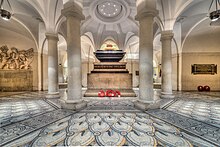
Nelson Sarcophagus

Trafalgar Column

The Admiral Ascends To Heaven

10/21/1805 ... Great Britain wins a monumental victory over the navy of Napoleon Bonaparte at the Battle of Trafalgar.
Image result for battle of trafalgar
Trafalgar