Monday, May 18, 2020

ALMOST UNVEXED

5/18/1863 - Following his victory at Champion Hill on 5/16, after months of failed military experiments on the Mississippi River and its tributaries, Major General Ulysses S. Grant's Army of Tennessee successfully completes its encirclement of the Confederate fortress city of Vicksburg, Mississippi and begins a siege of the town that will last until the Fourth of July.
Naval History Blog » Blog Archive » The Navy Runs the Guns at ...
The Vicksburg Campaign

A strategic spot blocking Union navigation on the Mississippi River (Confederate President Jeffereson Davis will call the city "... the nail that holds the South's two halves together" ... and Union President Abraham Lincoln will state, "Vicksburg is the key.  The war can never be brought to a close until that key is in our pocket.") called "The Gibralter of the Confederacy," in the fall of 1862, the newly appointed commander of all Union armies, Major General Henry W. Halleck, orders Grant to take the town.  Orders for the 77,000 strong Army of the Tennessee that are fraught with challenge, Grant and his men march south and begin a crucial campaign that will be one of the turning points in the American Civil War.  Opposing Grant and his men are the 40,000 men of the Army of Mississippi commanded by former Union officer, Pennsylvania born Lt. General John Clifford Pemberton.
Grant's Vicksburg Supply Line | American Battlefield Trust
Grant
John C. Pemberton (cropped).jpg
Pemberton

Initially planned as a two-prong attack on the fortress town with Major General William Tecumseh Sherman advancing along the Yazoo River from the northeast (they will be stopped by the Confederate defenses at Chickasaw Bayou) while Grant marches on Vicksburg from the line of the Mississippi Central Railroad (to the forward base of Holly Springs, a base that will be destroyed by the cavalry of Brigadier General Nathan Bedford Forrest), the plan is redesigned once both forces fail to meet their goals.  In their place, Grant will try a number of military "experiments" that also fail to come to grip with the town ... there is an attempt to build a canal across the region's De Soto Peninsula, another canal attempts to link the Mississippi to Lake Providence, after blowing up a levee near Moon Lake (150 miles above Vicksburg) the Yazoo Pass expedition is launched (low hanging trees will block the way), another expedition fails due to trees at Steele's Bayou, and another canal is tried between Duckport Landing and Walnut Bayou.  Months of failure, success is finally achieved when Grant marches his command down the west side of the Mississippi River, moves south of Vicksburg, and then crosses back over to the Vicksburg side of the river on the troop transports and gunboats of Rear Admiral David Dixon Porter's Mississippi River Squadron (on 4/16/1863, a clear night with no moon, seven gunboats and three empty troop transports get by the guns of Vicksburg with the disabling of only one vessel, the Henry Clay, and the wounding of thirteen men, a success matched by six more boats filled with supplies on 4/22) in the largest amphibious operation in American military history (until being topped by the 6/6 D-Day in Normandy during WWII).  Army and Navy in cooperation, with Confederate forces confused by a Sherman feint against Snyder's Bluff and a cavalry raid through central Mississippi by Colonel Benjamin Grierson, on 4/29/1863, Grant and Porter are able to move 17,000 soldiers from Disharoon's Plantation across the river to Bruinsburg, Mississippi.
William Tecumseh Sherman - Wikipedia
Sherman
Nathan Bedford Forrest - Wikipedia
Forrest
David Dixon Porter - Wikipedia
Porter
Benjamin Grierson - Wikipedia
Grierson
Battle of Vicksburg Facts & Summary | American Battlefield Trust
Gunboat Run

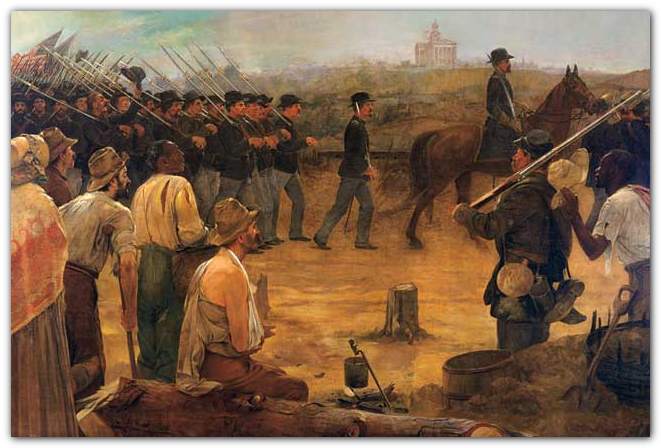
Moving inland, Grant makes the decision not to link up with the soldiers of Major General Nathaniel P. Banks in New Orleans (Grant will be under Banks' more senior command should the two forces combine) and begins a series of maneuvers that force Pemberton's troops back into Vicksburg.  Trying to stop the juggernaut moving towards the fortress town, there will be battles against the Mississippi Confederates at Port Gibson (5/1), the town of Raymond (5/12), the Mississippi state capital of Jackson (5/14, after General Joseph E. Johnston command flees the city), Champion Hill (5/16), and Big Black River Bridge (5/17).  Trapping Pemberton's forces inside Vicksburg (he is ordered to save his command and fight his way to Johnston's men near Jackson but waits too long to even make the attempt), after two frontal assaults that take place on 5/19 (157 men killed and another 777 wounded) and 5/22 (502 men killed and another 2,550 wounded) fail to break the strong Confederate defenses (a 6.5 mile long line of gun pits, lunettes, forts, redoubts, and trenches on hills and steep knobs manned by 18,500 soldiers), Grant begins siege operations against the city.
Battle of Vicksburg Facts & Summary | American Battlefield Trust
Assault

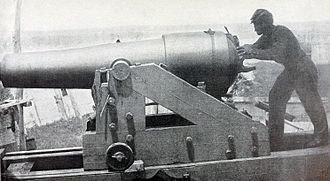
Vicksburg Confederate 18-Pounder
The Vicksburg Campaign, November 1862-July 1863
Assault

Siege ... on 5/25 Grant makes it official with orders that read, "Corps Commanders will immediately commence the work of reducing the enemy by regular approaches.  It is desirable that no more loss of life shall be sustained in the reduction of Vicksburg, and the capture of the Garrison.  Every advantage will be taken of the natural inequalities of the ground to gain positions from which to start mines, trenches, and advance batteries" ... Union gunboats on the water (they will lob over 22,000 shells into the city before the siege ends) and Grant's men on land (who will send even more shells into the city, a bombardment that causes the citizens to start digging into Vicksburg's yellow, clay hills ... eventually taking a degree of shelter in over 500 caves that earn the town a new name, "Prairie Dog Village" ... and to a degree it works, only 12 citizens will be killed in the town's bombardment), Pemberton decides to hold out as long as he can, but encirclement completed (with reinforcements sent south by Halleck, Grant will have roughly 77,000 men under his command in the Vicksburg region, some inching Union positions forward and others preventing Pemberton from receiving help from Johnston), the city's days as a Confederate bastion are numbered.  Plenty of ammo but little in the way of food, the city's residents and soldiers are soon suffering from scurvy, diarrhea, dysentery, malaria, other diseases, and starvation to the point where horses, mules, cats, and dogs vanish into dinner pots and some begin eating boiled shoe leather.

Union Artillery
Siege of Vicksburg - Wikipedia
Then
Battle Of Vicksburg
Now   

A daily grind for both sides as May gives way to June and then July approaches, the only events that break up the monotony of inching into Vicksburg are the explosions the Union sets off at a strongpoint called the 3rd Louisiana Redan.  There, on 6/25/1863, 2,200 pounds of dynamite is exploded, forming a crater 40 feet in diameter and 12 feet deep that the 45th Illinois Regiment of Colonel Jasper A. Maltby charge into ... but not through as Confederate rifles once more stop the Union advance.  Crater widened for another attack, before another explosion/assault cycle takes place, Pemberton asks for terms of surrender on 7/3 (unconditional surrender that Grant has made a reputation on is not requested as the Union officer does not want to have to guard and feed 30,000 soldiers and citizens), and the issue of soldier paroles resolved, surrenders his command to Grant (and becomes one of the most hated men in the South) on the 4th of July (rumors will soon have the town not celebrating the Indepence Day holiday again until 1945), along with 172 cannons and 50,000 rifles.  Over, a major supply artery for the Confederacy becomes a Union possession, cutting off Louisiana, Texas, and Arkansas from the other rebel states.  As Lincoln will say, "The Father of Waters again goes unvexed to the sea."  But not without a price ... in the campaign for Vicksburg and its siege, the Union will suffer 10,142 casualties, while along with losing the strategic position on the river, the Confederates will take losses of 9,091 soldiers. 
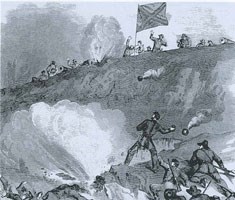
Siege of Vicksburg (May 26-July 3) - Vicksburg National Military ...
Fighting At The Crater
2 1863 CIVIL WAR newspapers ULYSSES S GRANT & the SIEGE OF ...
Sniping
Signalwriter: The Formal Surrender of the Confederate Fortress ...
Surrender

5/18/1863 ... the siege of Vicksburg begins (portions of the battlefield are now preserved by the National Park Service at the Vicksburg National Military Park that includes 1,325 historic monuments and markers, 20 miles of trenches and earthworks, a 16 mile tour road, a 12.5 mile walking trail, two antebellum homes, 144 cannons, the restored Union gunboat, USS Cairo, sunk 12/12/1862 on the Yazoo River during the campaign)., and the failed experiment of Grant's Canal.
Surrender of Vicksburg 1863
Victory

Grant Monument At Vicksburg


;, .
Surrender of Vicksburg 1863
Victory


   XXXXXXXXXXXXXXXXXXXXXXXXXXXXXXXX

Tuesday, May 5, 2020

HAPPY ENCHILADAS?

5/5/1862 - The Monroe Doctrine unenforceable due to the United States of America focusing on trying to destroy itself with a civil war over the issue of slavery and states rights, France looks to take over Mexico by military force, but instead finds it's nose bloodied by the Hispanic troops of the country's recently elected president, Benito Pablo Juarez Garcia, at the Battle of Puebla ... a victory that over the years will morph into an excuse for a day of tequila cocktails and massive amounts of rice, beans, and cheesy delights known as Cinco De Mayo Day!
Benito Juarez (cropped).jpg
Juarez
Third Battle of Puebla - Wikipedia
Puebla

New leadership taking over Mexico's future after the War of Reform ends in 1860 with the ouster of legendary politician and general, Antonio de Padua Maria Severino de Santa Anna y Perez de Lebron (he flees to exile in Cuba), Juarez starts a new batch of dark days for his country in 1861 when he is forced to suspend interest payments on the state's debts for two years.  The decision causes Spain, France, and the United Kingdom to form a Tripartite Alliance that invades Mexico at the port of Veracruz to force its government to renegotiate new terms for paying off its outstanding debts and for giving reparations to abused foreign citizens living in the country.  A tenuous alliance at best of often enemies, the coalition breaks up when Spain and Great Britain receive the payment promises they were seeking, but France, in the form of Emperor Napoleon III decides to use the debt as an excuse for gobbling up Mexico and turning it into a puppet regime under the dubious direction of Austrian Archduke Ferdinand Maximilian (of the House of Habsburg-Lorraine, he is the younger brother of Emperor Franz Joseph of Austria).  He also intends to use the country as an outlet for receiving Confederate goods like cotton and tobacco, while supplying the South with weaponry.  War with Mexico sought and found (though negotiations between France and Mexico continue), in April of 1862, the expeditionary force of 38-year-old General Charles De Lorencez begins making preparations for marching on Mexico City (following the same path that American General Winfield Scott took to victory in 1847 during the Mexican-American War).
Franz Xaver Winterhalter Napoleon III.jpg
Napoleon III
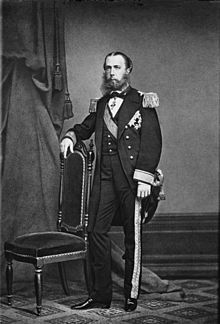
Maximilian of Mexico bw.jpg
Maximillian I
Charles de Lorencez Photos, News and Videos, Trivia and Quotes ...
General de Lorencez

Misunderstandings once again a catalyst for battle, the truce in place between Mexico and France breaks when French troop movements back to Mexico's east coast are interpreted as a sign that hostilities have begun again, and de Lorencez gets upset at Mexican protests over his movements and decides to not fall back, but instead, occupies the town of Orizaba, a move which forces 33-year-old Mexican General (born in Texas, he resigns as the country's Secretary of War to fight the French) Ignacio Zaragoza Seguin to fall back to Acultzingo Pass.  Unwilling to risk battle in the open with the French, when a bloody small skirmish called the Battle of Las Cumbres takes place on April 28 that puts French troops in the first line of Mexican entrenchments, Zaragoza retreats into the nearby fortified city of Puebla.
Ignacio Zaragoza.png
Zaragoza
La Batalla de Las Cumbres | Historia de México
Las Cumbres

Located in the eastern-central region of Mexico and bordered by the states of Veracruz (north and east), Hidalgo, Tlaxcala, and Moreles (to the west), and Guerrero and Oaxaca (to the south), the city of Puebla is founded in a mountain valley of in 1531 by Toribio de Benavente and Juan de Salmeron to protect the trade route between Mexico City and the port of Veracruz.  Protected on its northern side by two hill top forts named Loreto and Guadalupe (connected by a trench along the ridge line between the forts), foolishly believing that the citizens of the city are friendly towards the French and will rise up in revolt when French troops arrive, ignoring the advice of his staff officers, de Lorencez presses forward and attacks the city on May 5, 1862, from the north.
The history of Cinco de Mayo
Contested Area
The Battle of Puebla marked one of the most significant episodes in Mexican military history.
Puebla

Scheduling a morning attack, the battle goes bad for the French almost immediately as instead of attacking, the Europeans try and intimidate the Mexican force in front of them with screeching bugles and bayonet drills.  No uprising in answer, morning becomes afternoon before the French launch their attack at the twin forts and their connecting defensive positions, up the slopes of steep Cerro de Guadalope, the worst spot for the attack to take place.  Hubris.  Up and then down, up and then down, up and then down ... though they outnumber the Mexican force (Zaragoza has 4,500 men to de Lorencez's 6,500 soldiers) and have superior weapons, three times de Lorencez's soldiers are stopped at the trench (firing away at the defensive position in front of Puebla so repeatedly that they run out of artillery ammunition before the infantry can begin its third attack), while future Mexican president, Brigadier General Porfirio Diaz stops a French flanking attack.  Afternoon rains turning the field of battle into a quagmire, the French finally withdraw after the failure of a the third charge and the subsequent actions of Zaragoza who launches flanking attacks to the right and left with his cavalry, while troops concealed along the road into Puebla reveal themselves and begin sniping on the retreating French.  Victory, at a cost of 83 dead soldiers (the French lose almost a thousand men), Zaragoza has defeated the French for the first time since Napoleon I's debacle at Waterloo (he will not enjoy his triumph for long, dying from typhoid fever later that same year).
French-Mexican War 1861-1867
At The Trench
Battle of Puebla | Mexican artwork, Mexican folk art, Mexican art
Mexican Snipers

Diaz

Battle won, but the war will end up being lost (with reinforcements, the French will finally take Puebla in 1863) and it will take Juarez until 1867 to oust the French and their Austrian lackeys from the country (a fifteen man firing squad will execute Emperor Maximilian I and Generals Miramon and Mejia at 6:40 in the morning of June 19, 1867).  Throughout the bloody years, the Battle of Puebla is used as a rallying call to what determined men can do, and on May 9, 1862, Juarez declares that henceforth, the anniversary of the clash will be a Mexican national holiday (it is not Mexico's Independence Day, that day is considered to be September 16, 1810 with the "Cry of Delores," when Roman Catholic priest Miguel Hidalgo y Costilla rings the bell of his church to call the local people to arms to break away from Spain.). 
Battle of Puebla - Wikiwand
Third Battle Of Puebla - 1863
Great works: The Execution of Emperor Maximilian, 1867, by Édouard ...
Execution Painting By Edouard Manet
François Aubert | The Shirt of the Emperor, Worn during His ...
The Emperor's Clothing 

Celebrated mostly in the state of Puebla, the annual anniversary of the clash includes military parades, recreations of the battle, and lots of music, dancing, and food.  Growing from word-of-mouth of the victory passing to the Mexican communities in California, Arizona, New Mexico, and Texas, the celebration of the battle, pushed by Chicano activists in the 1960s, will transform in the United States into a kind-of annual St. Patrick's Day for Mexican culture and heritage featuring parades, block parties, mariachi music, folk dancing, and lots and lots of delicious eating.  Celebrated by more people in the States than it is in Mexico, there are huge festivals for the day, every year, in Houston, Chicago, and Los Angeles.  5/5/1862 ... shocking the world, a rag-tag force of Mexican warriors stop the French at the town of Puebla, remember that as you start munching today on your refried beans, rice, and beef enchiladas!
The history of Cinco de Mayo
Battle
Beef enchilada plate with 2 sides: refried beans and lime ...
Celebration!


,