Headlines!
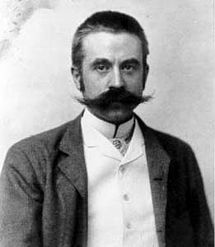
Born in New York City to Shakespearean scholar Richard Grant White and his wife, Alexina Black Mease, on November 9, 1853, Stanford White, with no formal architectural training, begins his career as a designer at the age of eighteen as the principal assistant of Henry Hobson Richardson (the greatest architect of his day, creator of a style today called "Richardson Romanesque"). An excellent springboard for his life's work, after six years with Richardson and another year and a half in Europe, White returns to New York City and along with Charles Follen McKim and William Rutherford Mead, starts the architectural firm of McKim, Mead and White. In 1884, White marries 22-year-old Bessie Springs Smith, a member of a socially prominent Long Island family (they will have one son, Lawrence). Public places and private resident designs equally successful, with the wealth he acquires, the tall, flamboyant, red-headed architect becomes a sophisticated collector of antiquities, and beautiful female conquests (one of his residents includes a green-hued room containing a red velvet swing hung from the ceiling that naked women are encouraged to dangle on and among his friends he is known for being a "predatory satyr," along with libertine friends, the architect will start "The Sewer Club," a place for boozing and sexual excess) ... one of those conquests is Florence Evelyn Nesbit.
White - 1892

McKim, Mead and White

President Roosevelt Sitting In Chair
Designed By White For The White House
State Dining Room - 1903

White's Washington Square Arch
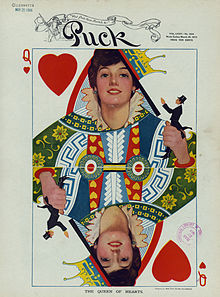
Florence Evelyn Nesbit is born on Christmas Day of 1884 in the small town of Natrona, near Pittsburgh, Pennsylvania. Early, there are music and dance lessons, and intellectual reading adventures from a diverse library of books, but the family loses almost everything when her lawyer father passes away at 40 in 1895 and the family's home and possessions are auctioned off to pay outstanding debts. Living off charity, Nesbit's mother fails to earn money with her dressmaking abilities or in running a small boardinghouse, and by 1898, the family has moved from Pittsburgh to Philadelphia where Mrs. Nesbit, Florence, and her brother Howard all eventually find jobs working for Wanamaker's Department Store (working 12 hour shifts, six days a week). Just blossoming at 14, Florence is "discovered" at work by a female artist that pays her one dollar to pose for five hours. Door opened, she soon becomes the favorite model of Philadelphia artists and poses for portraits, posters, and even stained glass windows. Moving to New York City in 1900, Florence uses her connections to the art world and receives even more modeling assignments, adding magazines (including covers for Vanity Fair, Harper's Bazaar, Ladies' Home Journal, and Cosmopolitan) souvenirs, commercial products (her likeness will help sell beer trays, sheet music, toothpaste, face creams, and pocket mirrors) postcards (she will be featured on calendars from Prudential Life, Swift, Coca-Cola, and other companies), and private commissions to her portfolio (and she becomes one of the era's famous Gibson girls posing for artist Charles Dana Gibson). Arguably the first super model and pin-up girl, the modeling soon becomes too tedious of an occupation for the bubbly teenager, and with her mother's reluctant okay, Florence cashes in on her looks to become a chorus girl in the musical "Florodora" on Broadway (during this period, she drops the Florence and becomes Evelyn) ... and comes to the attention of Stanford White.

Nesbit

Sketch By Charles Dana Gibson

Selling Chocolates
On A Playing Card

The Florodora Girls
Lust at first sight, after seeing a performance of Florodora, White begins courting the young 16-year-old with gifts, introductions to his wealthy friends, and money for Evelyn to support her family (the architect pays for the family to live in the Wellington Hotel and for Howard to be sent off to the Chester Military Academy). Just trying to help, mother's and daughter's trust gained, during Mrs Nesbit's vacation to Pittsburgh, White gets Evelyn drunk on champagne, has her change into a yellow, silk kimono and shows her his 10'x10' "Mirror Room" before she blacks out. Waking up nude the next morning under silk sheets, blood on her leg, her virginity gone, the wealthy architect gets his latest conquest (in the morning, a naked White will tell Evelyn, "Don't cry Kittens. It's all over. Now you belong to me.") to keep the pair's coupling a secret (gift bribes include a pearl necklace, a white fox fur coat, and an assortment of diamond rings). Mission accomplished, White moves on to other female encounters (the pair break up when Evelyn finds a black book listing various showgirls' and models' addresses and birthdays), but will remain friendly with Evelyn, a mentor of sorts ... even after she starts dating the man she will marry, lunatic heir, Harry Kendall Thaw.

White
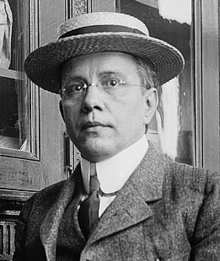
Thaw
Born in Allegheny City, Pennsylvania on February 12, 1871 to Pittsburgh coal and railroad baron, William Thaw, and his second wife, Mary Sibbet Copley, Thaw grows up a pampered and spoiled brat, observing the abuse his hot-tempered mother turns on her servants. Off early, Thaw is subject to insomnia, temper tantrums, and incoherent episodes of babbling baby talk, and is moved from private school to private school when his trouble making antics require punishment or restitution. Though a poor student, with his family's connections, he dabbles at studying law at the University of Pittsburgh, and then after a transfer at Harvard College. A wastrel instead of a scholar, Thaw spends excessive hours playing poker, lights cigars with hundred dollar bills, attends illegal cockfights, believing he has been cheated out of a dime, chases a cab driver down a Cambridge street with a shotgun, and romances a number of young women. Not surprisingly, Harvard eventually expels the young playboy for "immoral practices" and gives Thaw three hours to leave the campus. School now behind him, Thaw leads a narcissistic existence on a monthly allowance from his father of $2,500 a month (at a time when the average working man makes $500 a year and an excellent meal at Delmonico's restaurant costs $1.50). Upon his father's death in 1893, mommy increases the 22-year-old Thaw's monthly stipend to $8,000 (he also gets three million dollars in his father's will and is in line to inherit an estate of forty million dollars upon his mother's death) ... an amount he will pull down for the next eighteen years. She also sets up a group of "fixers" that help buy her son out of his many troubles (like when $5,000 is used to silence a London hotel bellboy that Thaw has restrained naked in a bathtub, then beaten with a riding crop). A sociopath before the term exists, Thaw hides his madness behind a mask of being a gentle and caring soul with deep pockets (in 1895 Paris, he throws a $50,000 party for 25 prostitutes that features a military band playing John Philip Souza marches and a desert course for each lady in attendance that consists of $1,000 pieces of jewelry tied around each female reveler's liqueur glass), while actually enjoying inflicting sadism on his partners while restraining them with handcuffs and other bondage devices (the vice exacerbated by booze and chemicals). In 1902, Thaw goes to a Broadway performance of The Wild Rose at New York City's Knickerbocker Theatre and becomes obsessed with possessing Evelyn Nesbit (he will see her over forty times in her star role as the gypsy girl, Vashti).
Thaw
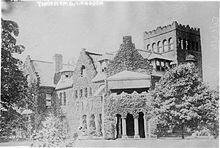
Falling even harder than White, the young heir gets an introduction to meet Evelyn, and introducing himself at first as Mr. Munroe, begins a courtship of the actress that features him showering her with gifts and money. It also includes an extended visit to Europe with Evelyn and her mother. In Paris (her chaperone mother is in London), Thaw finally torments Evelyn into telling him the story of how White took her virginity (already convinced that White has kept him from the social circles he believes he should move in, Thaw is not a happy camper and grows more and more vehement about his hate for the architect, calling his enemy "The Beast"). Thaw finally shows his true personality when he rents Katzenstein Castle in the Austrian state of Tyrol, locking Evelyn in her room and over a two-week period, sexually assaulting her and beating her with a whip (the servants are kept in another portion of the castle. Afterwords there is a tearful fake apology coupled with promises it will never happen again ... and a lot more presents! For four years Thaw shows only his "good" face to Evelyn, and estranged from her now married mother, seeking financial stability, Evelyn gives in and becomes Mrs. Thaw on April 4, 1905. Expecting a life of entertaining and travel, living in the home of his mother in the Pittsburgh suburb of Lyndhurst and subject to her whims, Evelyn instead is forced to listen and watch as Thaw pours more and more of his time into exposing White as a rapist (believing White is out to "get him" by hiring the Monk Eastman Gang for his assassination, Thaw also begins carrying a gun everywhere he goes).

Nesbit - 1903

Katzenstein Castle
Lyndhurst
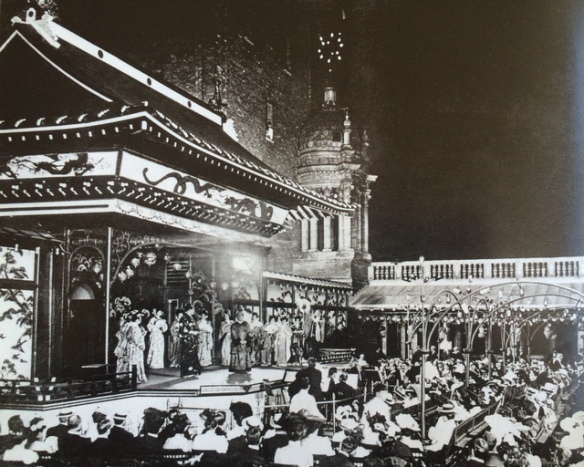
Fate steps in on a hot New York City Monday, as all the players, White, Nesbit, and Thaw, come together in close proximity to each other at Madison Square Garden and violence ensues. Stopping in New York City before boarding a luxury liner taking the married couple to Europe for a vacation, Thaw procures tickets for the couple (and two of Thaw's male friends) to take in the new show opening at Madison Square Garden's rooftop theater, Mam'zelle Champagne (fuse of his rage already lit, Thaw's mood will grow extremely dark when the couple stop at the Cafe Martin for lunch and see White dining in the restaurant). Also deciding to take in the show at the last minute is Stanford White. Scheduled to be in Philadelphia on business, White cancels his plans when he discovers his 18-year-old son Lawrence is in town to spend some quality time with his father ... quality time in the form of a visit to White's Madison Square Garden apartment (in the 32-story tower White has designed as part of the complex) and taking in the newest show in town from the table left reserved for the architect (also attending the performance with White and his son is White's friend, New York society figure, James Clinch Smith), five rows off the front of the theater's stage. Players in place, none of the threesome will enjoy their evening at the theater (despite the high heat, Thaw is attired in a tuxedo and long black overcoat which he refuses to take off).

Madison Square Garden

Smith
The Rooftop Theater
Opening Night
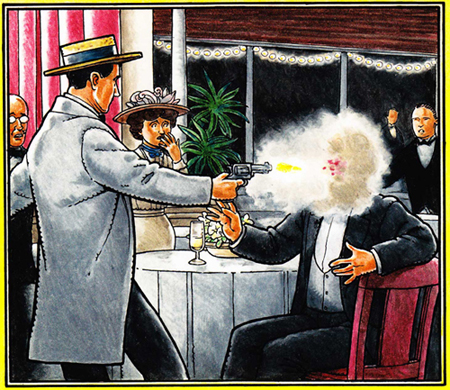
Agitated throughout the evening by the presence of his enemy, at about 11:00 pm as the show (it will be a flop and soon fold) is coming to its conclusion with the singing of "I Could Love A Million Girls," sensing what is coming, Evelyn suggests the couple leave early, and the pair get up to make their way to the elevator exit for the theater floor. Pausing to say hello to a friend, when Evelyn turns around her husband has slipped away and is heading for where White is sitting. Standing before the man he believes has defiled his wife and has kept him out of high society, Thaw stands over a sitting White, pulls out the .22-caliber pistol he purchased for "protection," and from two feet away, rapidly fires three bullets into the architect. The first round hits White in the left shoulder, but the other two are instantly lethal ... one hits the architect in the face, just below his left eye, while the other fatal round hits him in the mouth, destroying most of White's front teeth. Blood, gunpowder, and wounds make the architect unrecognizable as he slides on to the table and then down to the floor as his killer yells epitaphs at his victim (various witnesses will have Thaw saying something along the lines of "You ruined my wife!" and "He had it coming!" and "He took advantage of the girl and then abandoned her!"). Over in seconds (the crowd at first believes the "action" table side is part of the show ... part of the show until the screaming starts), the young century has it first "crime of the century" to dither over ... and soon it will have a matching trial.
Point Blank Range
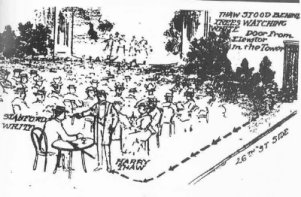
Newspaper Sketch
Newspaper Illustration

Recreation
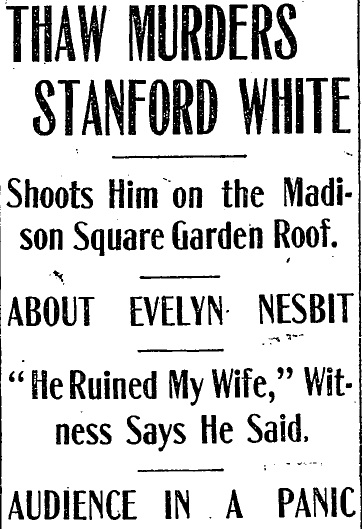
Headlines
Entertainment for the masses (a week after the killing, a nickleodeon film, "Rooftop Murder," is released by Thomas Edison) the newspapers of the time run hundreds of stories on the crime and its aftermath (escorted from the theater and arrested by the police, with bail denied, Thaw gets preferential treatment as he spends six months at the notorious Tombs jail awaiting trial ... instead of sleeping on a standard cot, Thaw snoozes in a brass bed, stylish tailored menswear replaces the jail's normal prison attire, his meals are catered by Delmonico's restaurant and eaten from a formal table setting ... and the jail's doctor is induced to allow the prisoner a daily ration of champagne and wine) ... so much so that when Thaw goes on trial in January of 1907, for the first time in jurisprudence history the jury that will render a verdict in the killing is ordered sequestered. In an atmosphere in which the prosecution smears Thaw, the defense smears White (the Thaw Family is said to pay Evelyn between $25,000 and $1,000,000 for her "favorable" testimony), and Thaw's mother pays for publicity that paints her son as a wonderful young man who briefly went off the rails (and at trial, she pays half a million dollars for a group of doctors to testify that killing was a single aberrant act), it becomes obvious that the only way Thaw can escape dying for the murder he does not regret is to be declared legally insane ... a situation that mommy and son amend to "temporary" insanity (in the form of "dementia Americana" in which male goes nuts for a moment seeking revenge against anyone dastardly enough to take away a young woman's chastity), Harry was just having a "brainstorm." Back and forth the trial goes for almost four months before the case is turned over to the jury ... a hung jury that deadlocks and can't come to a decision after forty-seven hours of deliberations, seven members thinking Thaw is guilty of murder, and five voting the killer is not guilty. Mistrial declared, eight months go by before Thaw is tried a second time ... covering basically the same ground in a month's time, a second jury finds Thaw not guilty by reason of insanity after a single day of deliberations and the killer is whisked away to the Matteawan State Hospital for the Criminally Insane in Fishkill, New York.

Under Arrest

Supping In His Cell
Nesbit Testifys

Thaw
Unhappy with his confinement and the failure of his legal team to get him out of Matteawan, in 1913 Thaw walks out of the hospital, gets in a waiting car, and is driven over the border to Sherbrooke, Quebec in Canada (everything financed and orchestrated by Thaw's mother once more). Now the back and forth legal maneuvering also includes the governments of the United States and Canada (fighting his extradition, one of Thaw's lawyers, Louis St. Laurent, will one day be Canada's prime minister). Extradited back to New York in December of 1914, Thaw is able to secure a trial to establish whether he is insane, and on July 16, 1915, when a jury finds the killer is indeed sane, Thaw is set free to continue his life. But not for long (and not with Evelyn, who immediately divorces him)!
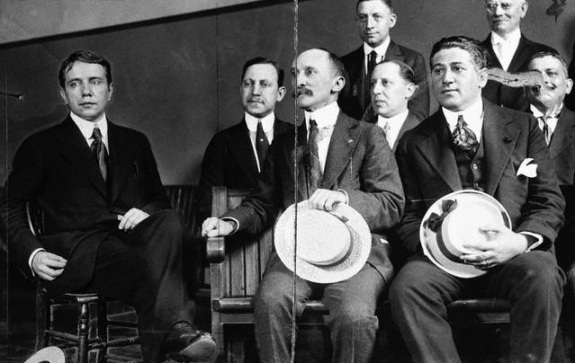
Thaw And Part Of The Jury That Finds Him Sane In 1915
On vacation in Long Beach, California later that year, Thaw meets a teenage boy, nineteen-year-old Fred Cump, at an ice cream parlor and becomes infatuated with the youth, and invites him to come to New York where Thaw will find him a home, work, and training from the influential Carnegie Institute. Duped, Gump shows up in New York on Christmas Eve of 1916 and is put up by Thaw in a suite at the Hotel McAlpin, not knowing his "benefactor" has also rented the room's adjacent suites so no one can hear his victim scream. Later that night, mask removed and mad once more, wielding two short whips, Thaw beats and sexually assaults Gump, forcing his victim to kiss his cheek and toes, while a bloodied Gump is made to vow from his knees, "I am your slave. I am your slave, you are my master for four years." The next morning, as Thaw eats breakfast, Gump is forced to kneel beside him and say, "Thank you, Master" as his "benefactor" tosses the youth bits of food. Meal complete, Thaw then turns Gump over to the beefy bodyguard he has hired to keep his prey a prisoner. Not the sharpest knife in the kitchen, after a day in New York City in which the two visit an aquarium and the Bronx Zoo, Gump is allowed to go alone to the lobby of the McAlpin for a soda and escapes. Charges filed, Thaw is located in Philadelphia hospital, recuperating from attempting suicide by slashing his throat and wrists. Arrested and tried (after the Gump Family refuses to be bought off for a bribe of $500,000), Thaw is once again found to be insane and this time is sent to Philadelphia's Kirkbride Asylum. He stays there until 1924, when he is again declared to be sane and is released. Purchasing a historic home in Clearbrook, Virginia, known as Kenilworth, Thaw spends the rest of his years quietly ... he joins the Rouss Fire Company, marches in parades, publishes a book of his memoirs titled, "The Traitor" in which he justifies his killing of White (stating, "Under the same circumstances, I'd kill him tomorrow."), and dabbles in film production (in 1935 he is forced to pay one of his partners $35,000 over a disputed script) before moving to Florida in 1944. There, three years later, he suffers a heart attack in Miami on February 22, 1947 and dies at the age of 76 ... leaving behind an estate of $1,000,000 (worth 11 million dollars by 2019 numbers), $10,000 of which he bequeaths to Evelyn.
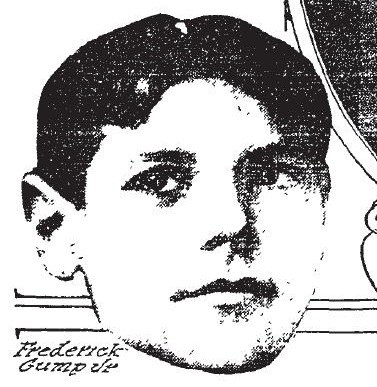
Gump

The New York Times
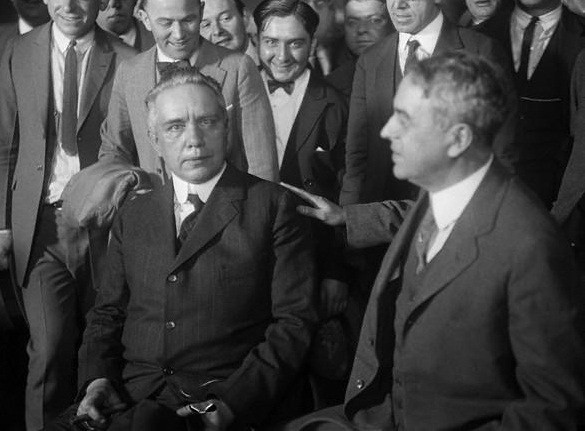
1924 Sanity Hearing
As for Evelyn, after divorcing Thaw (she has a son, Russell William, by the madman after becoming pregnant from a conjugal visit with Thaw while he is at Matteawan), she reconciles with her mother (who will provide much of Russell's early parenting), continues her vaudeville and silent movie careers, and marries her stage dancing partner in 1916, Jack Clifford (unable to get beyond her sordid past and being called Mr. Nesbit, the couple separate in 1918, and finally divorce in 1933. Struggling with alcoholism and an addiction to morphine, Evelyn briefly runs a Manhattan tearoom, works in burlesque shows around the country, attempts suicide by swallowing disinfectant after losing a dancing job in Chicago, and writes a memoir of her life in 1934 called, "Prodigal Days." Life finally turned around, WWII finds Evelyn in Los Angeles, California teaching ceramics and sculpting to students at the Grant Beach School of Arts and Crafts. She dies in a Santa Monica nursing home on January 17, 1967 at the age of 82 and is buried at the Holy Cross Cemetery in Culver City, California. She will not be around in 1975 when the best selling book, Ragtime, is published (in which the antics of White, Nesbit, and Thaw are novelized), but before she goes, in 1955, she is paid $10,000 to be a technical advisor on Hollywood's telling of the Stanford White murder, the Twentieth Century-Fox production of "The Girl in the Red Velvet Swing," directed by Richard Fleischer (his Academy Award winning resume will include "20,000 Leagues Under the Sea," "The Vikings," "Barabbas," "Tora! Tora! Tora!," "Fantastic Voyage," "Soylent Green," "Mr. Majestyk," and "Conan the Destroyer"), written by Walter Reisch (an Academy Award winner for co-writing the screenplay for "Titanic") and Charles Brackett (a five-time Oscar winner), and starring Oscar winner Ray Milland (for the Lost Weekend) as Stanford White, Farley Granger as Harry Kendall Thaw, and 22-year-old British ingenue and future dame, Joan Henrietta Collins, in the role of Evelyn.

Nesbit And Son
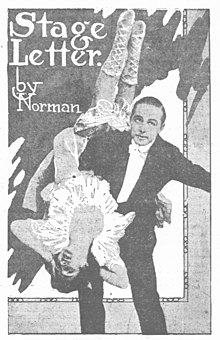
Nesbit And Clifford
Movie Poster

Sculptress Evelyn At 69
Advisor & Advisee

Collins As Evelyn